AQA · GCSE · Religious Studies
Course version: 8062 · Version from Sept 2018
The significance of prayer, including the Amidah, the standing prayer.
Full specification wording
Practices: the significance of prayer, including the Amidah, the standing prayer.
Prayer is central to Jewish life, serving as a bridge between God and humanity.
Checked against the AQA 8062 specification (opens in a new tab) on .
- Point 6 of 37
- 4 key terms
Study notes
From the checked teaching notes for this specification point.
The idea
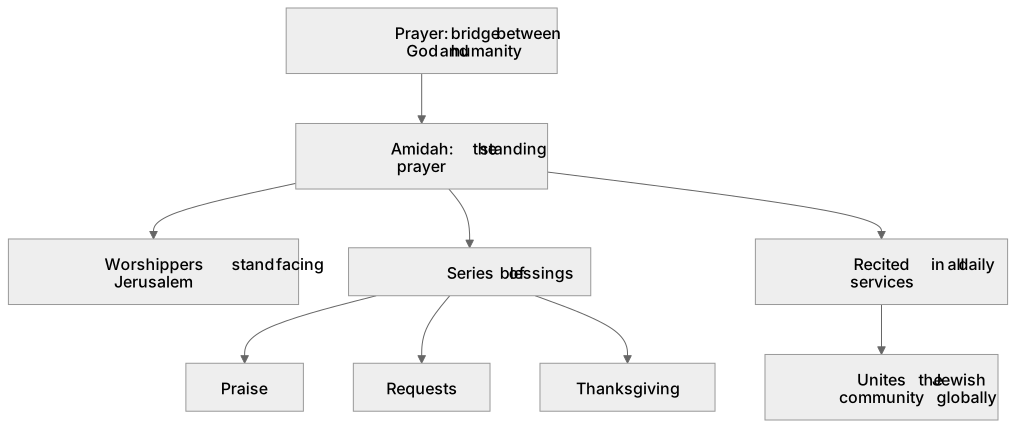
Prayer is central to Jewish life, serving as a bridge between God and humanity. It builds a personal relationship with the Almighty, expresses gratitude, and seeks forgiveness. A cornerstone of Jewish worship is the Amidah, known as the 'standing prayer', which forms the core of every Jewish worship service. Worshippers stand facing Jerusalem, demonstrating respect and readiness to serve God. The Amidah consists of a series of blessings that encompass praise, requests, and thanksgiving. Its significance lies in fulfilling the commandment to pray, uniting the Jewish community globally, and providing a structured yet deeply personal moment for spiritual reflection and connection with God's presence.
What earns the marks
- Explain that prayer allows Jews to communicate with God, expressing praise, gratitude, and requests.
- Identify the Amidah as the central prayer of Jewish liturgy, often called the 'standing prayer'.
- Describe the physical posture of the Amidah, standing and facing Jerusalem, as a sign of respect and attention to God.
- Discuss the structure of the Amidah, which includes blessings of praise, petitions for personal and communal needs, and thanksgiving.
- Evaluate the significance of the Amidah in uniting the Jewish community, as it is recited in all daily services.
Common mistakes and how to put them right
Confusing the Amidah with the Shema.
Put it right: The Shema is a declaration of faith, whereas the Amidah is a series of blessings forming the core standing prayer.
Assuming the Amidah is only recited on Shabbat.
Put it right: It is actually recited during all three daily prayer services, which are Shacharit, Minchah, and Maariv.
Stating that worshippers face east during the Amidah.
Put it right: They specifically face towards Jerusalem, which is only east if they are west of Israel.
Exam tips
- Use the term 'standing prayer' alongside 'Amidah' to demonstrate clear understanding of its physical requirement.
- Link the significance of prayer to building a relationship with God and maintaining Jewish identity.
- When evaluating the importance of the Amidah, contrast personal, spontaneous prayer with this structured, communal liturgy.
Try the lesson
The start of the Practices: the significance of prayer, including the Amidah, the standing prayer. lesson, made from checked teaching notes for this specification point.
Have a go first
Which of the following best describes the Amidah in Jewish worship?
Listen
Prayer is central to Jewish life, serving as a bridge between God and humanity. It builds a personal relationship with the Almighty, expresses gratitude, and seeks forgiveness. A cornerstone of Jewish worship is the Amidah, known as the 'standing prayer', which forms the core of every Jewish worship service. Worshippers stand facing Jerusalem, demonstrating respect and readiness to serve God. The Amidah consists of a series of blessings that encompass praise, requests, and thanksgiving. Its significance lies in fulfilling the commandment to pray, uniting the Jewish community globally, and providing a structured yet deeply personal moment for spiritual reflection and connection with God's presence. A strong answer earns marks for these points. Explain that prayer allows Jews to communicate with God, expressing praise, gratitude, and requests. Identify the Amidah as the central prayer of Jewish liturgy, often called the 'standing prayer'. Describe the physical posture of the Amidah, standing and facing Jerusalem, as a sign of respect and attention to God. Discuss the structure of the Amidah, which includes blessings of praise, petitions for personal and communal needs, and thanksgiving. Exam tip: Use the term 'standing prayer' alongside 'Amidah' to demonstrate clear understanding of its physical requirement.
See it
Key words
Say what each word means before you turn the card.
Amidah
Try answering aloud or in your head before turning the card.
Communication with God
Try answering aloud or in your head before turning the card.
Community and unity
Try answering aloud or in your head before turning the card.
Reverence and submission
Try answering aloud or in your head before turning the card.
See every definition
- Amidah
- A cornerstone of Jewish worship, known as the 'standing prayer', which forms the core of every Jewish worship service.
- Communication with God
- Prayer serves as a bridge between God and humanity, building a personal relationship with the Almighty, expressing gratitude, and seeking forgiveness.
- Community and unity
- Its significance lies in uniting the Jewish community globally, as it is recited in all daily services.
- Reverence and submission
- Worshippers stand facing Jerusalem, demonstrating respect and readiness to serve God.
Label the diagram
Some boxes have lost their names. Pick the right name for each number.
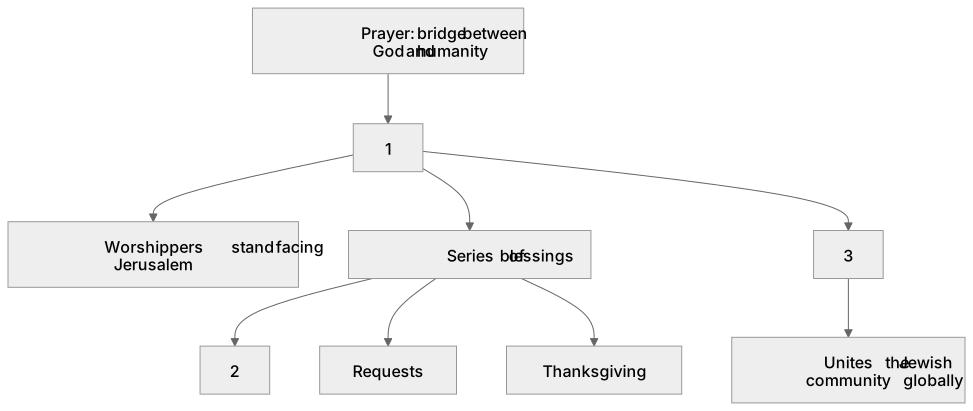
1Box 1
2Box 2
3Box 3
There is more to this lesson
The full lesson goes on to check your understanding and help you earn the marks. Create a free account to carry on, with your progress saved.
A week of Premium from your first lesson · Then the free plan continues · No card, no charge
Test your understanding of Practices: the significance of prayer, including the Amidah, the standing prayer.
Active recall beats re-reading. Take an instant quiz now to test what you’ve learned and lock it into long-term memory.
A week of Premium from your first lesson · Then the free plan continues · No card, no charge