AQA · GCSE · Religious Studies
Course version: 8062 · Version from Sept 2018
Practices: Vaisakhi (Baisakhi)
Vaisakhi, also known as Baisakhi, is a major Sikh festival originally celebrated as a harvest festival in the Punjab.
Checked against the AQA 8062 specification (opens in a new tab) on .
- Point 31 of 37
- 4 key terms
Study notes
From the checked teaching notes for this specification point.
The idea
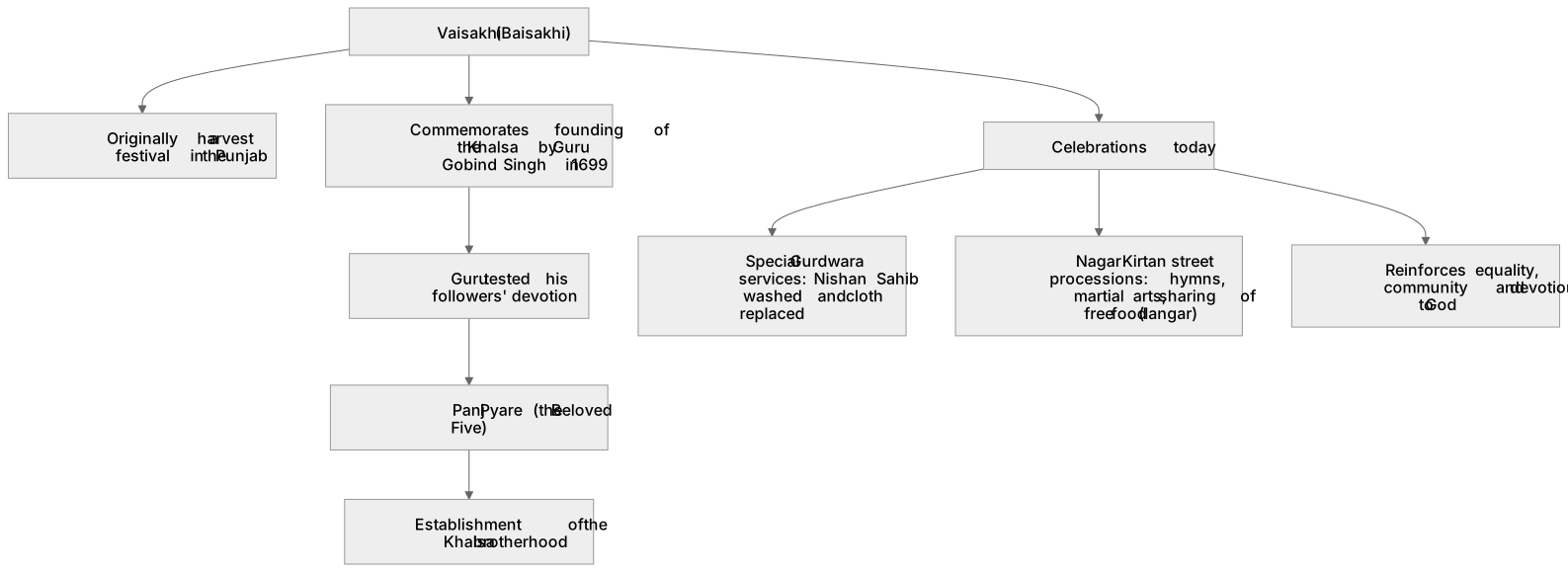
Vaisakhi, also known as Baisakhi, is a major Sikh festival originally celebrated as a harvest festival in the Punjab. Today, it primarily commemorates the founding of the Khalsa by Guru Gobind Singh in 1699. During this event, the Guru tested his followers' devotion, resulting in the Panj Pyare (the Beloved Five) and the establishment of the Khalsa brotherhood. Sikhs celebrate Vaisakhi with special Gurdwara services, where the Nishan Sahib (Sikh flag) is washed and its cloth replaced. Vibrant street processions called Nagar Kirtans take place, featuring hymns, martial arts, and the sharing of free food (langar). This festival reinforces core Sikh values of equality, community, and unwavering devotion to God.
What earns the marks
- Identifies Vaisakhi as the commemoration of the founding of the Khalsa in 1699.
- Describes the historical significance of Guru Gobind Singh and the Panj Pyare.
- Explains how Vaisakhi is celebrated today, including Nagar Kirtan processions and changing the Nishan Sahib.
- Links the festival to the reinforcement of Sikh identity, equality, and community through the langar.
Common mistakes and how to put them right
Confusing Vaisakhi with Divali (Bandi Chhor Divas).
Put it right: Ensure Vaisakhi is specifically linked to the Khalsa and 1699, while Bandi Chhor Divas relates to Guru Hargobind's release from prison.
Stating Vaisakhi is only a harvest festival.
Put it right: While it has agricultural roots in the Punjab, its primary religious significance for Sikhs is the formation of the Khalsa.
Misidentifying the Guru who founded the Khalsa.
Put it right: Attribute the founding of the Khalsa at Vaisakhi to Guru Gobind Singh, the tenth human Guru.
Exam tips
- Use specific terminology like Khalsa, Panj Pyare, and Nagar Kirtan to demonstrate detailed knowledge of Sikh practices.
- When evaluating the importance of Vaisakhi, contrast its historical origins with its modern role in uniting the Sikh diaspora.
- Link the celebrations of Vaisakhi to core Sikh beliefs, such as equality demonstrated through the langar during street processions.
Try the lesson
The start of the Practices: Vaisakhi (Baisakhi) lesson, made from checked teaching notes for this specification point.
Have a go first
What major historical event in Sikhism is commemorated during the festival of Vaisakhi?
Listen
Vaisakhi, also known as Baisakhi, is a major Sikh festival originally celebrated as a harvest festival in the Punjab. Today, it primarily commemorates the founding of the Khalsa by Guru Gobind Singh in 1699. During this event, the Guru tested his followers' devotion, resulting in the Panj Pyare (the Beloved Five) and the establishment of the Khalsa brotherhood. Sikhs celebrate Vaisakhi with special Gurdwara services, where the Nishan Sahib (Sikh flag) is washed and its cloth replaced. Vibrant street processions called Nagar Kirtans take place, featuring hymns, martial arts, and the sharing of free food (langar). This festival reinforces core Sikh values of equality, community, and unwavering devotion to God. A strong answer earns marks for these points. Identifies Vaisakhi as the commemoration of the founding of the Khalsa in 1699. Describes the historical significance of Guru Gobind Singh and the Panj Pyare. Explains how Vaisakhi is celebrated today, including Nagar Kirtan processions and changing the Nishan Sahib. Links the festival to the reinforcement of Sikh identity, equality, and community through the langar. A common slip: Confusing Vaisakhi with Divali (Bandi Chhor Divas). Instead, Ensure Vaisakhi is specifically linked to the Khalsa and 1699, while Bandi Chhor Divas relates to Guru Hargobind's release from prison. Exam tip: Use specific terminology like Khalsa, Panj Pyare, and Nagar Kirtan to demonstrate detailed knowledge of Sikh practices.
See it
Key words
Say what each word means before you turn the card.
Khalsa
Try answering aloud or in your head before turning the card.
Panj Pyare
Try answering aloud or in your head before turning the card.
Nagar Kirtan
Try answering aloud or in your head before turning the card.
langar
Try answering aloud or in your head before turning the card.
See every definition
- Khalsa
- The brotherhood founded by Guru Gobind Singh in 1699, which Vaisakhi primarily commemorates today.
- Panj Pyare
- The Beloved Five, resulting from the Guru testing his followers' devotion during the founding of the Khalsa.
- Nagar Kirtan
- Vibrant street processions featuring hymns, martial arts, and the sharing of free food.
- langar
- Free food shared during celebrations, reinforcing core Sikh values of equality and community.
Label the diagram
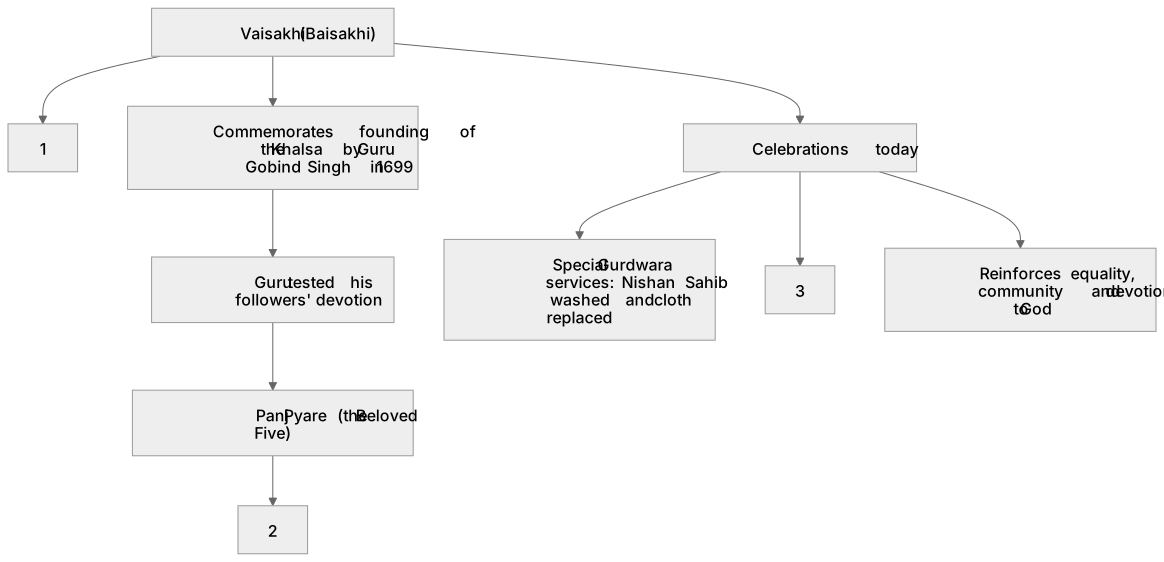
Some boxes have lost their names. Pick the right name for each number.
1Box 1
2Box 2
3Box 3
There is more to this lesson
The full lesson goes on to check your understanding and help you earn the marks. Create a free account to carry on, with your progress saved.
A week of Premium from your first lesson · Then the free plan continues · No card, no charge
Test your understanding of Practices: Vaisakhi (Baisakhi)
Active recall beats re-reading. Take an instant quiz now to test what you’ve learned and lock it into long-term memory.
A week of Premium from your first lesson · Then the free plan continues · No card, no charge