AQA · GCSE · Religious Studies
Course version: 8062 · Version from Sept 2018
Sikhism - 3.1.7.1 Beliefs and teachings: Key beliefs
This section introduces the foundational key beliefs of Sikhism, which centre on the absolute oneness of God (Waheguru) and the fundamental equality of all human beings.
Checked against the AQA 8062 specification (opens in a new tab) on .
- Point 1 of 16
- 4 key terms
Study notes
From the checked teaching notes for this specification point.
The idea
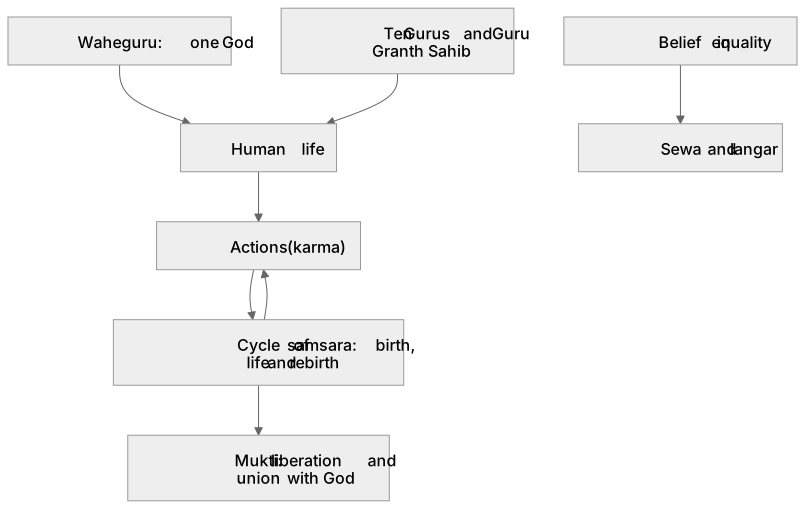
This section introduces the foundational key beliefs of Sikhism, which centre on the absolute oneness of God (Waheguru) and the fundamental equality of all human beings. Sikhs believe in the cycle of birth, life, and rebirth (samsara), where a person's actions (karma) determine their future lives. The ultimate spiritual goal is mukti, which is liberation from this cycle and a blissful union with God. These core tenets are guided by the teachings of the Ten Gurus and the eternal living Guru, the Guru Granth Sahib. A concrete example of these beliefs in action is the langar (community kitchen), where the principle of equality is demonstrated by everyone sitting together to share a meal, regardless of their social status or background.
What earns the marks
- Identify Waheguru as the single, formless, and eternal creator God in Sikhism.
- Explain the concept of karma and how it influences the cycle of samsara (rebirth).
- Describe mukti as the ultimate goal of achieving spiritual liberation and union with God.
- Explain how the belief in human equality is put into practice through sewa (selfless service) and the langar.
Common mistakes and how to put them right
Confusing Sikh reincarnation with Hindu moksha without noting Sikh specifics.
Put it right: Use the term 'mukti' and emphasise that it means union with Waheguru, achievable while living (jivan mukt).
Stating Sikhs worship the Ten Gurus.
Put it right: Clarify that Sikhs respect and learn from the Gurus but only worship the one God, Waheguru.
Describing the Guru Granth Sahib merely as a holy book.
Put it right: Refer to it as the eternal, living Guru that holds the ultimate spiritual authority in Sikhism.
Exam tips
- Use specific Sikh terminology like Waheguru, mukti, and samsara to demonstrate accurate subject knowledge.
- Link abstract beliefs, such as equality, to practical Sikh actions like volunteering in the langar.
- When evaluating the importance of key beliefs, contrast the focus on spiritual liberation with the importance of living an active, truthful family life.
Try the lesson
The start of the Sikhism - 3.1.7.1 Beliefs and teachings: Key beliefs lesson, made from checked teaching notes for this specification point.
Have a go first
Which of the following best describes the fundamental Sikh belief about the nature of God?
Listen
This section introduces the foundational key beliefs of Sikhism, which centre on the absolute oneness of God (Waheguru) and the fundamental equality of all human beings. Sikhs believe in the cycle of birth, life, and rebirth (samsara), where a person's actions (karma) determine their future lives. The ultimate spiritual goal is mukti, which is liberation from this cycle and a blissful union with God. These core tenets are guided by the teachings of the Ten Gurus and the eternal living Guru, the Guru Granth Sahib. A concrete example of these beliefs in action is the langar (community kitchen), where the principle of equality is demonstrated by everyone sitting together to share a meal, regardless of their social status or background. A strong answer earns marks for these points. Identify Waheguru as the single, formless, and eternal creator God in Sikhism. Explain the concept of karma and how it influences the cycle of samsara (rebirth). Describe mukti as the ultimate goal of achieving spiritual liberation and union with God. Explain how the belief in human equality is put into practice through sewa (selfless service) and the langar. A common slip: Confusing Sikh reincarnation with Hindu moksha without noting Sikh specifics. Instead, Use the term 'mukti' and emphasise that it means union with Waheguru, achievable while living (jivan mukt). Exam tip: Use specific Sikh terminology like Waheguru, mukti, and samsara to demonstrate accurate subject knowledge.
See it
Key words
Say what each word means before you turn the card.
Monotheism
Try answering aloud or in your head before turning the card.
Equality
Try answering aloud or in your head before turning the card.
Life after death
Try answering aloud or in your head before turning the card.
Spiritual authority
Try answering aloud or in your head before turning the card.
See every definition
- Monotheism
- Belief centred on the absolute oneness of God (Waheguru), the single, formless, and eternal creator God in Sikhism.
- Equality
- The fundamental equality of all human beings, demonstrated by everyone sitting together to share a meal in the langar regardless of social status or background.
- Life after death
- Belief in the cycle of birth, life, and rebirth (samsara), where a person's actions (karma) determine their future lives.
- Spiritual authority
- Guidance by the teachings of the Ten Gurus and the eternal living Guru, the Guru Granth Sahib.
Label the diagram
Some boxes have lost their names. Pick the right name for each number.
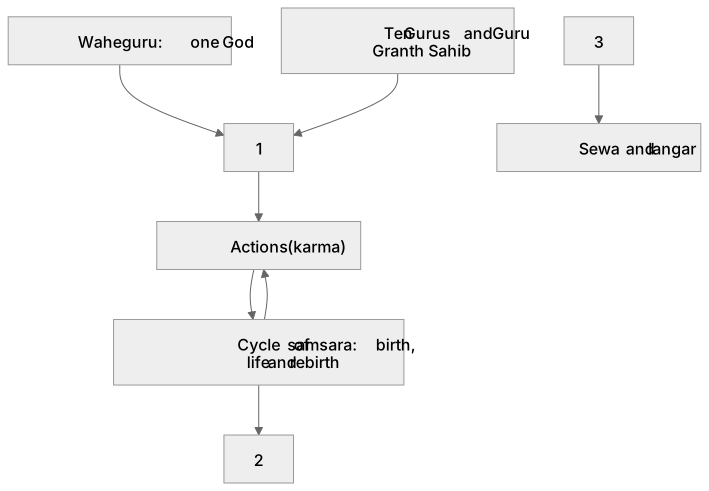
1Box 1
2Box 2
3Box 3
There is more to this lesson
The full lesson goes on to check your understanding and help you earn the marks. Create a free account to carry on, with your progress saved.
A week of Premium from your first lesson · Then the free plan continues · No card, no charge
Test your understanding of Sikhism - 3.1.7.1 Beliefs and teachings: Key beliefs
Active recall beats re-reading. Take an instant quiz now to test what you’ve learned and lock it into long-term memory.
A week of Premium from your first lesson · Then the free plan continues · No card, no charge