AQA · A-Level · Sociology
Course version: 7192 · Version from Sept 2015
Religious organisations, including cults, sects, denominations, churches…
Full specification wording
Beliefs in Society: religious organisations, including cults, sects, denominations, churches and New Age movements, and their relationship to religious and spiritual belief and practice
This topic explores the typology of religious organisations and their relationship to belief and practice.
Checked against the AQA 7192 specification (opens in a new tab) on .
- Point 3 of 4
- 3 key terms
Study notes
From the checked teaching notes for this specification point.
The idea
This topic explores the typology of religious organisations and their relationship to belief and practice. Sociologists classify these into churches, denominations, sects, and cults, alongside New Age movements. Churches (e.g. the Church of England) are large, inclusive, and linked to the state. Denominations (e.g. Methodism) are formal but not state-linked. Sects (e.g. Jehovah's Witnesses) are exclusive, demand high commitment, and claim a monopoly of truth. Cults (e.g. Scientology) are loose, individualistic, and tolerate other beliefs. New Age movements focus on self-spirituality and detraditionalisation.
What earns the marks
- Distinguish between churches, denominations, sects, and cults using sociological typologies such as those developed by Troeltsch and Niebuhr.
- Identify the core characteristics of New Age movements, focusing on self-spirituality and detraditionalisation as outlined by Heelas.
- Explain the relationship between organisational structure and the level of religious practice and commitment required from members.
- Analyse how different organisations relate to wider society, contrasting world-rejecting sects with world-accommodating denominations.
- Evaluate the contemporary relevance of these typologies, considering the blurring of boundaries between sects, cults, and New Age practices.
Common mistakes and how to put them right
Confusing sects and cults.
Put it right: Sects are highly cohesive, demand strong commitment, and claim a monopoly of truth, whereas cults are loosely organised and tolerate other beliefs.
Assuming all religious organisations require the same level of practice.
Put it right: Recognise that churches and denominations often have lower commitment levels compared to the intense lifestyle regulation of sects.
Treating New Age movements as traditional religions.
Put it right: Understand that New Age movements focus on individual spiritual growth and self-spirituality rather than collective worship of an external deity.
Exam tips
- Use specific sociological examples, such as the Moonies as a sect or Transcendental Meditation as a cult, to illustrate the different types of organisations.
- Apply Wallis's classification of New Religious Movements (world-rejecting, world-accommodating, world-affirming) when discussing the beliefs of sects and cults.
- Discuss how postmodernity has influenced the growth of New Age movements and the shift from traditional religious practice to individualised spiritual belief.
Try the lesson
The start of the Beliefs in Society: religious organisations, including cults, sects, denominations, churches and New Age movements, and their relationship to religious and spiritual belief and practice lesson, made from checked teaching notes for this specification point.
Have a go first
According to Ernst Troeltsch's typology of religious organisations, which of the following is a defining characteristic of a 'church'?
Listen
This topic explores the typology of religious organisations and their relationship to belief and practice. Sociologists classify these into churches, denominations, sects, and cults, alongside New Age movements. Churches (e.g. the Church of England) are large, inclusive, and linked to the state. Denominations (e.g. Methodism) are formal but not state-linked. Sects (e.g. Jehovah's Witnesses) are exclusive, demand high commitment, and claim a monopoly of truth. Cults (e.g. Scientology) are loose, individualistic, and tolerate other beliefs. New Age movements focus on self-spirituality and detraditionalisation. A strong answer earns marks for these points. Distinguish between churches, denominations, sects, and cults using sociological typologies such as those developed by Troeltsch and Niebuhr. Identify the core characteristics of New Age movements, focusing on self-spirituality and detraditionalisation as outlined by Heelas. Explain the relationship between organisational structure and the level of religious practice and commitment required from members. Analyse how different organisations relate to wider society, contrasting world-rejecting sects with world-accommodating denominations. A common slip: Confusing sects and cults. Instead, Sects are highly cohesive, demand strong commitment, and claim a monopoly of truth, whereas cults are loosely organised and tolerate other beliefs. Exam tip: Use specific sociological examples, such as the Moonies as a sect or Transcendental Meditation as a cult, to illustrate the different types of organisations.
See it

Key words
Say what each word means before you turn the card.
Typologies of religious organisations
Try answering aloud or in your head before turning the card.
New Religious Movements
Try answering aloud or in your head before turning the card.
The New Age and self-spirituality
Try answering aloud or in your head before turning the card.
See every definition
- Typologies of religious organisations
- Sociological classifications that distinguish churches, denominations, sects and cults, alongside New Age movements, and their relationship to belief and practice.
- New Religious Movements
- Movements classified by Wallis as world-rejecting, world-accommodating or world-affirming, used when discussing the beliefs of sects and cults.
- The New Age and self-spirituality
- Movements focusing on self-spirituality and detraditionalisation, and on individual spiritual growth rather than collective worship of an external deity.
Label the diagram
Some boxes have lost their names. Pick the right name for each number.
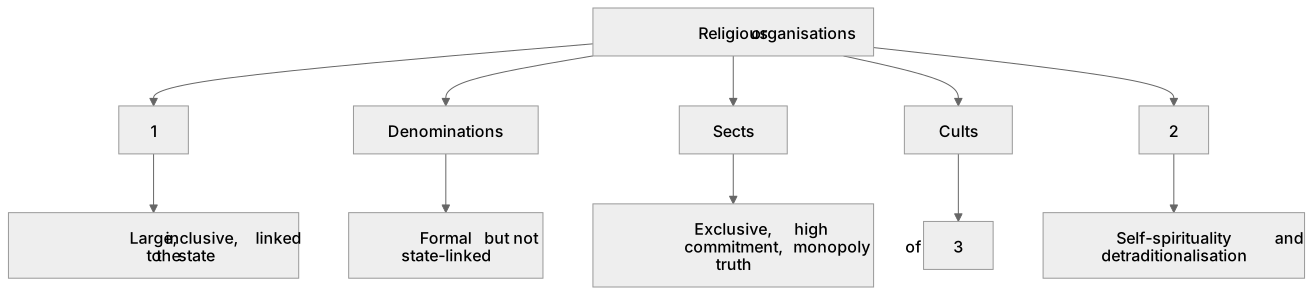
1Box 1
2Box 2
3Box 3
There is more to this lesson
The full lesson goes on to check your understanding and help you earn the marks. Create a free account to carry on, with your progress saved.
A week of Premium from your first lesson · Then the free plan continues · No card, no charge
Test your understanding of Beliefs in Society: religious organisations, including cults, sects, denominations, churches and New Age movements, and their relationship to religious and spiritual belief and practice
Active recall beats re-reading. Take an instant quiz now to test what you’ve learned and lock it into long-term memory.
A week of Premium from your first lesson · Then the free plan continues · No card, no charge