AQA · A-Level · Sociology
Course version: 7192 · Version from Sept 2015
Crime and Deviance: crime, deviance, social order and social control
Crime involves breaking a society's formal, written laws, risking official sanctions like imprisonment.
Checked against the AQA 7192 specification (opens in a new tab) on .
- Point 1 of 4
- 4 key terms
Study notes
From the checked teaching notes for this specification point.
The idea
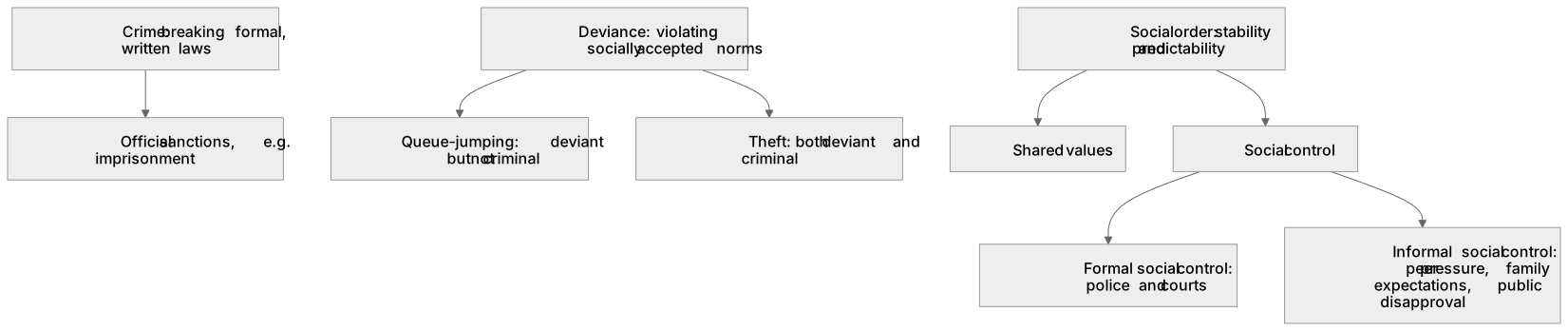
Crime involves breaking a society's formal, written laws, risking official sanctions like imprisonment. Deviance is broader, encompassing any behaviour that violates socially accepted norms. For example, queue-jumping is deviant but not criminal, whereas theft is both. Social order refers to the stability and predictability of society, often achieved through shared values. To maintain this order, societies use mechanisms of social control. Formal social control is enforced by institutions like the police and courts to regulate crime. Informal social control operates through everyday interactions, such as peer pressure, family expectations, or public disapproval, to regulate deviance and ensure individuals conform to societal expectations.
What earns the marks
- Define crime as the violation of formal, written laws subject to state sanctions.
- Define deviance as the violation of social norms, noting that it varies by time, place, and culture.
- Explain social order as the patterned, predictable state of society, maintained through shared norms and values.
- Distinguish between formal social control (e.g., police, courts) and informal social control (e.g., family, peers, media).
- Apply sociological perspectives to explain how social control serves different interests in maintaining social order.
Common mistakes and how to put them right
Using the terms 'crime' and 'deviance' interchangeably.
Put it right: Clearly distinguish that while all crime is usually deviant, not all deviance is criminal.
Assuming deviance is a fixed concept.
Put it right: Explain that deviance is socially constructed and relative; what is deviant in one culture or era may be normal in another.
Overlooking informal social control when discussing how order is maintained.
Put it right: Include examples of informal control, such as ostracism or parental grounding, alongside formal agencies.
Exam tips
- Always provide clear, distinct definitions for crime and deviance at the start of your answer to establish a strong foundation.
- Use concrete examples to illustrate the relativity of deviance, such as changes in laws regarding homosexuality or smoking in public.
- Link the concepts of social order and control to specific sociological theories, contrasting the consensus view of Functionalism with the conflict view of Marxism.
Try the lesson
The start of the Crime and Deviance: crime, deviance, social order and social control lesson, made from checked teaching notes for this specification point.
Have a go first
In sociological analysis, which statement most accurately distinguishes between the concepts of crime and deviance?
Listen
Crime involves breaking a society's formal, written laws, risking official sanctions like imprisonment. Deviance is broader, encompassing any behaviour that violates socially accepted norms. For example, queue-jumping is deviant but not criminal, whereas theft is both. Social order refers to the stability and predictability of society, often achieved through shared values. To maintain this order, societies use mechanisms of social control. Formal social control is enforced by institutions like the police and courts to regulate crime. Informal social control operates through everyday interactions, such as peer pressure, family expectations, or public disapproval, to regulate deviance and ensure individuals conform to societal expectations. A strong answer earns marks for these points. Define crime as the violation of formal, written laws subject to state sanctions. Define deviance as the violation of social norms, noting that it varies by time, place, and culture. Explain social order as the patterned, predictable state of society, maintained through shared norms and values. Distinguish between formal social control (e.g., police, courts) and informal social control (e.g., family, peers, media). A common slip: Using the terms 'crime' and 'deviance' interchangeably. Instead, Clearly distinguish that while all crime is usually deviant, not all deviance is criminal. Exam tip: Always provide clear, distinct definitions for crime and deviance at the start of your answer to establish a strong foundation.
See it
Key words
Say what each word means before you turn the card.
Social construction of crime and deviance
Try answering aloud or in your head before turning the card.
Mechanisms of formal and informal social control
Try answering aloud or in your head before turning the card.
Consensus versus conflict approaches to social order
Try answering aloud or in your head before turning the card.
Relativity of norms and values
Try answering aloud or in your head before turning the card.
See every definition
- Social construction of crime and deviance
- Deviance is relative, so what is deviant in one culture or era may be normal in another.
- Mechanisms of formal and informal social control
- Formal control is enforced by institutions like the police and courts, while informal control operates through everyday interactions such as peer pressure and family expectations.
- Consensus versus conflict approaches to social order
- The consensus view of Functionalism is contrasted with the conflict view of Marxism on how social control serves different interests in maintaining social order.
- Relativity of norms and values
- Deviance varies by time, place, and culture, so what is deviant in one culture or era may be normal in another.
Label the diagram
Some boxes have lost their names. Pick the right name for each number.
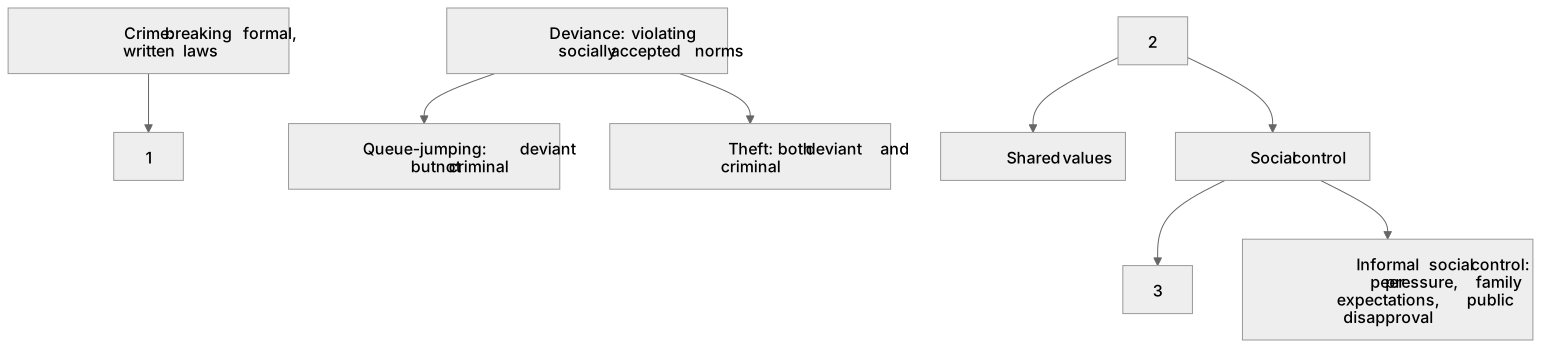
1Box 1
2Box 2
3Box 3
There is more to this lesson
The full lesson goes on to check your understanding and help you earn the marks. Create a free account to carry on, with your progress saved.
A week of Premium from your first lesson · Then the free plan continues · No card, no charge
Test your understanding of Crime and Deviance: crime, deviance, social order and social control
Active recall beats re-reading. Take an instant quiz now to test what you’ve learned and lock it into long-term memory.
A week of Premium from your first lesson · Then the free plan continues · No card, no charge