AQA · A-Level · Sociology
Course version: 7192 · Version from Sept 2015
Globalisation and crime in contemporary society; the media and crime;…
Full specification wording
Crime and Deviance: globalisation and crime in contemporary society; the media and crime; green crime; human rights and state crimes
This topic explores four interconnected contemporary issues in crime.
Checked against the AQA 7192 specification (opens in a new tab) on .
- Point 3 of 4
- 4 key terms
Study notes
From the checked teaching notes for this specification point.
The idea
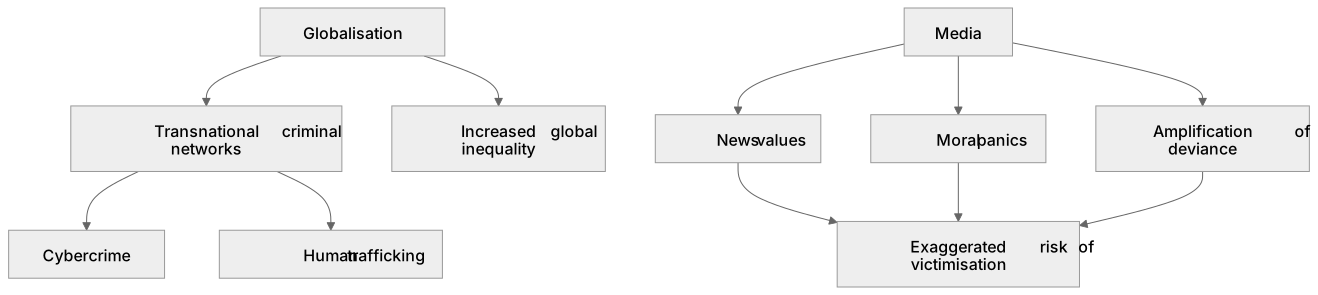
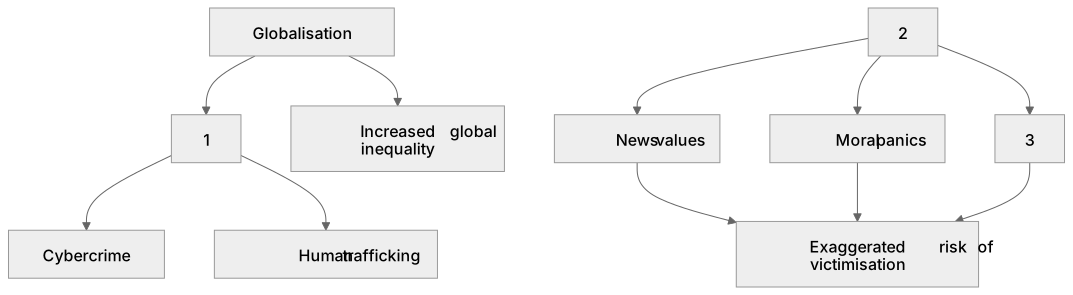
This topic explores four interconnected contemporary issues in crime. Globalisation has created new transnational criminal networks, such as cybercrime and human trafficking, while increasing global inequality. The media shapes public perceptions of crime through news values, moral panics, and the amplification of deviance, often exaggerating the risk of victimisation. Green crime examines harms against the environment, distinguishing between traditional legal definitions and broader zemiological approaches that focus on environmental harm regardless of legality. Finally, state crime involves illegal or deviant activities perpetrated by state agencies. This includes human rights abuses, raising complex questions about how to define crimes committed by those who make the laws.
What earns the marks
- Identify how globalisation facilitates transnational crimes like cybercrime, drug trafficking, and money laundering by crossing national borders.
- Explain the media's role in creating moral panics and deviancy amplification spirals through the disproportionate reporting of specific offences.
- Distinguish between primary green crimes (direct environmental destruction) and secondary green crimes (flouting environmental regulations).
- Define state crime and explain the difficulties in measuring it, particularly regarding the violation of human rights by sovereign governments.
Common mistakes and how to put them right
Confusing primary and secondary green crime.
Put it right: Primary green crimes result directly from the destruction of the earth's resources, whereas secondary green crimes involve flouting rules aimed at preventing environmental disasters.
Assuming state crime only refers to actions by dictatorships.
Put it right: State crime can be committed by democratic governments, such as illegal wars, institutional racism, or torture.
Believing the media accurately reflects crime statistics.
Put it right: The media over-represents violent and sexual crimes, creating a distorted public perception of the risk of victimisation.
Exam tips
- Use contemporary examples, such as recent cyberattacks or environmental disasters, to illustrate the impact of globalisation and green crime.
- When discussing state crime, evaluate the usefulness of defining crime based on human rights rather than domestic laws.
- Apply concepts like 'news values' to explain why certain crimes receive disproportionate media coverage compared to their actual frequency.
Try the lesson
The start of the Crime and Deviance: globalisation and crime in contemporary society; the media and crime; green crime; human rights and state crimes lesson, made from checked teaching notes for this specification point.
Have a go first
According to Manuel Castells, which of the following best describes the structure of the contemporary global criminal economy?
Listen
This topic explores four interconnected contemporary issues in crime. Globalisation has created new transnational criminal networks, such as cybercrime and human trafficking, while increasing global inequality. The media shapes public perceptions of crime through news values, moral panics, and the amplification of deviance, often exaggerating the risk of victimisation. Green crime examines harms against the environment, distinguishing between traditional legal definitions and broader zemiological approaches that focus on environmental harm regardless of legality. Finally, state crime involves illegal or deviant activities perpetrated by state agencies. This includes human rights abuses, raising complex questions about how to define crimes committed by those who make the laws. A strong answer earns marks for these points. Identify how globalisation facilitates transnational crimes like cybercrime, drug trafficking, and money laundering by crossing national borders. Explain the media's role in creating moral panics and deviancy amplification spirals through the disproportionate reporting of specific offences. Distinguish between primary green crimes (direct environmental destruction) and secondary green crimes (flouting environmental regulations). Define state crime and explain the difficulties in measuring it, particularly regarding the violation of human rights by sovereign governments. A common slip: Confusing primary and secondary green crime. Instead, Primary green crimes result directly from the destruction of the earth's resources, whereas secondary green crimes involve flouting rules aimed at preventing environmental disasters. Exam tip: Use contemporary examples, such as recent cyberattacks or environmental disasters, to illustrate the impact of globalisation and green crime.
See it
Key words
Say what each word means before you turn the card.
Globalisation and transnational crime
Try answering aloud or in your head before turning the card.
Media representation and moral panics
Try answering aloud or in your head before turning the card.
Environmental harm and zemiology
Try answering aloud or in your head before turning the card.
State power and human rights
Try answering aloud or in your head before turning the card.
See every definition
- Globalisation and transnational crime
- Globalisation has created new transnational criminal networks, such as cybercrime and human trafficking, while increasing global inequality.
- Media representation and moral panics
- The media shapes public perceptions of crime through news values, moral panics, and the amplification of deviance, often exaggerating the risk of victimisation.
- Environmental harm and zemiology
- Green crime examines harms against the environment, distinguishing between traditional legal definitions and broader zemiological approaches that focus on environmental harm regardless of legality.
- State power and human rights
- State crime involves illegal or deviant activities perpetrated by state agencies, including human rights abuses, raising complex questions about how to define crimes committed by those who make the laws.
Label the diagram
Some boxes have lost their names. Pick the right name for each number.
1Box 1
2Box 2
3Box 3
There is more to this lesson
The full lesson goes on to check your understanding and help you earn the marks. Create a free account to carry on, with your progress saved.
A week of Premium from your first lesson · Then the free plan continues · No card, no charge
Test your understanding of Crime and Deviance: globalisation and crime in contemporary society; the media and crime; green crime; human rights and state crimes
Active recall beats re-reading. Take an instant quiz now to test what you’ve learned and lock it into long-term memory.
A week of Premium from your first lesson · Then the free plan continues · No card, no charge