AQA · A-Level · Sociology
Course version: 7192 · Version from Sept 2015
The relationship between social change and social stability, and religious…
Full specification wording
Beliefs in Society: the relationship between social change and social stability, and religious beliefs, practices and organisations
This topic explores how religion acts as a conservative force maintaining social stability and a catalyst for social change.
Checked against the AQA 7192 specification (opens in a new tab) on .
- Point 2 of 4
- 4 key terms
Study notes
From the checked teaching notes for this specification point.
The idea
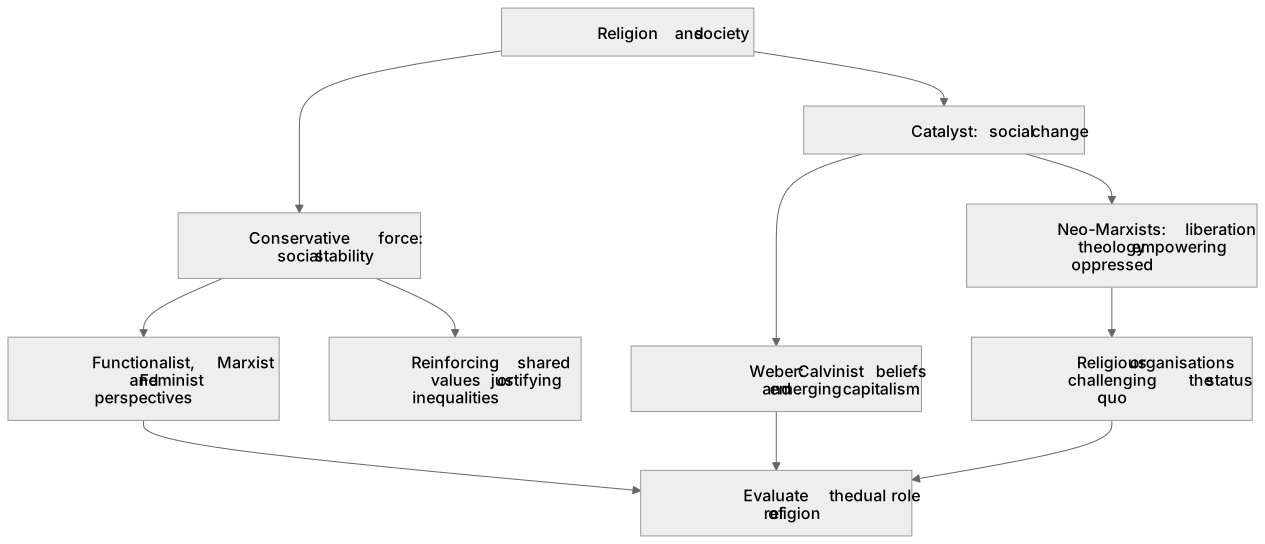
This topic explores how religion acts as a conservative force maintaining social stability and a catalyst for social change. Functionalists, Marxists, and Feminists view religious beliefs, practices, and organisations as promoting stability by reinforcing shared values or justifying inequalities. Conversely, Weber demonstrates how Calvinist beliefs drove the emergence of capitalism, illustrating religion's capacity to initiate profound social change. Neo-Marxists argue that religious organisations can support liberation theology, empowering the oppressed to challenge the status quo.
What earns the marks
- Identify Functionalist, Marxist, and Feminist perspectives on religion as a conservative force maintaining social stability.
- Explain Weber's theory of how Calvinist beliefs contributed to the social change of emerging capitalism.
- Analyse the role of religious organisations in social change, such as the Catholic Church's involvement in liberation theology.
- Evaluate the dual role of religion using criteria for when religion promotes change versus when it maintains stability.
Common mistakes and how to put them right
Assuming all Marxists view religion solely as a conservative force.
Put it right: Recognise that Neo-Marxists argue religion can possess relative autonomy and drive social change, as seen in liberation theology.
Confusing religious beliefs with religious organisations.
Put it right: Distinguish between theological ideas and structural bodies when explaining their distinct impacts on society.
Stating that Weber claimed Calvinism was the sole cause of capitalism.
Put it right: Clarify that Weber saw Calvinist beliefs as a major contributing factor alongside economic conditions, not the only cause.
Exam tips
- Use specific historical examples, such as the US Civil Rights Movement, to illustrate religion driving social change.
- Contrast traditional Marxist views of religion as an ideological weapon with Neo-Marxist views on its revolutionary potential.
- Consider how the type of religious organisation, such as a sect versus a church, influences its stance on social stability or change.
Try the lesson
The start of the Beliefs in Society: the relationship between social change and social stability, and religious beliefs, practices and organisations lesson, made from checked teaching notes for this specification point.
Have a go first
Which sociological perspective primarily views religion as a conservative force that maintains social stability by creating value consensus?
Listen
This topic explores how religion acts as a conservative force maintaining social stability and a catalyst for social change. Functionalists, Marxists, and Feminists view religious beliefs, practices, and organisations as promoting stability by reinforcing shared values or justifying inequalities. Conversely, Weber demonstrates how Calvinist beliefs drove the emergence of capitalism, illustrating religion's capacity to initiate profound social change. Neo-Marxists argue that religious organisations can support liberation theology, empowering the oppressed to challenge the status quo. A strong answer earns marks for these points. Identify Functionalist, Marxist, and Feminist perspectives on religion as a conservative force maintaining social stability. Explain Weber's theory of how Calvinist beliefs contributed to the social change of emerging capitalism. Analyse the role of religious organisations in social change, such as the Catholic Church's involvement in liberation theology. Evaluate the dual role of religion using criteria for when religion promotes change versus when it maintains stability. A common slip: Assuming all Marxists view religion solely as a conservative force. Instead, Recognise that Neo-Marxists argue religion can possess relative autonomy and drive social change, as seen in liberation theology. Exam tip: Use specific historical examples, such as the US Civil Rights Movement, to illustrate religion driving social change.
See it
Key words
Say what each word means before you turn the card.
Social stability and consensus
Try answering aloud or in your head before turning the card.
Social change and conflict
Try answering aloud or in your head before turning the card.
Ideology and power
Try answering aloud or in your head before turning the card.
Religious organisations and movements
Try answering aloud or in your head before turning the card.
See every definition
- Social stability and consensus
- Functionalists, Marxists, and Feminists view religious beliefs, practices, and organisations as promoting stability by reinforcing shared values or justifying inequalities.
- Social change and conflict
- Religion can act as a catalyst for social change, with Weber demonstrating how Calvinist beliefs drove the emergence of capitalism.
- Ideology and power
- Traditional Marxist views treat religion as an ideological weapon, while Neo-Marxists argue religious organisations can support liberation theology, empowering the oppressed to challenge the status quo.
- Religious organisations and movements
- Neo-Marxists argue that religious organisations can support liberation theology, empowering the oppressed to challenge the status quo.
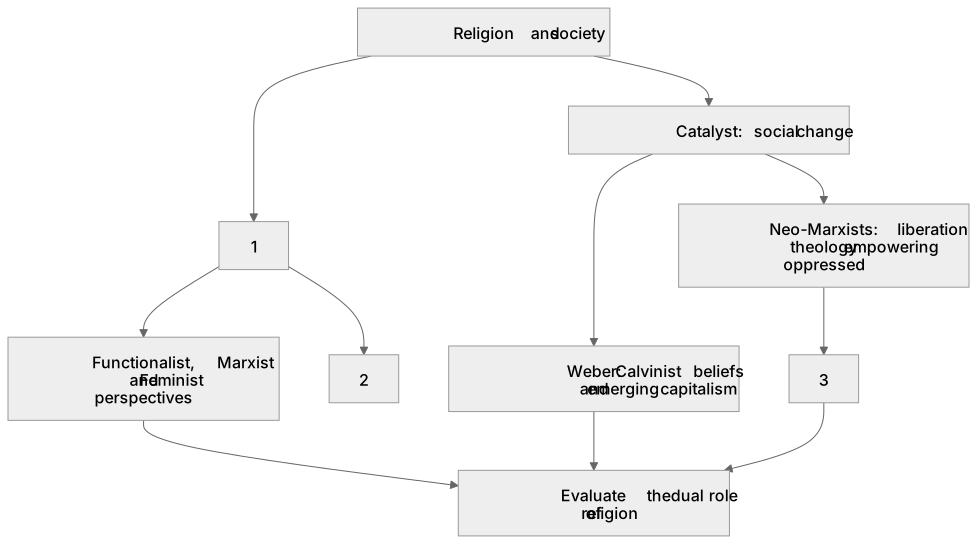
Label the diagram
Some boxes have lost their names. Pick the right name for each number.
1Box 1
2Box 2
3Box 3
There is more to this lesson
The full lesson goes on to check your understanding and help you earn the marks. Create a free account to carry on, with your progress saved.
A week of Premium from your first lesson · Then the free plan continues · No card, no charge
Test your understanding of Beliefs in Society: the relationship between social change and social stability, and religious beliefs, practices and organisations
Active recall beats re-reading. Take an instant quiz now to test what you’ve learned and lock it into long-term memory.
A week of Premium from your first lesson · Then the free plan continues · No card, no charge