AQA · A-Level · Sociology
Course version: 7192 · Version from Sept 2015
The relationship between different social groups and religious/spiritual…
Full specification wording
Beliefs in Society: the relationship between different social groups and religious/spiritual organisations and movements, beliefs and practices
Sociologists analyse how gender, age, ethnicity, and class shape engagement with religious and spiritual organisations, movements, beliefs, and practices.
Checked against the AQA 7192 specification (opens in a new tab) on .
- Point 4 of 4
- 4 key terms
Study notes
From the checked teaching notes for this specification point.
The idea
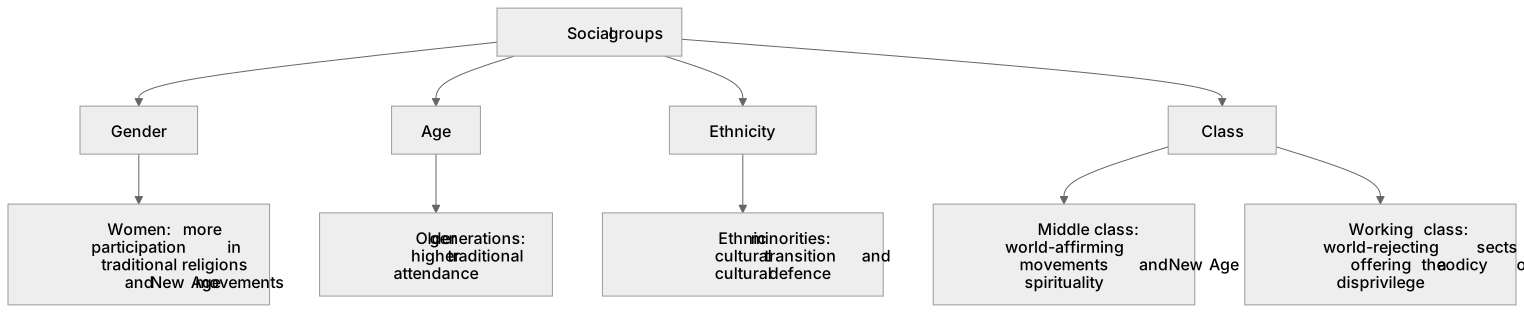
Sociologists analyse how gender, age, ethnicity, and class shape engagement with religious and spiritual organisations, movements, beliefs, and practices. Women are statistically more likely to participate in traditional religions and New Age movements, often linked to differential socialisation. Older generations show higher traditional attendance, reflecting historical period effects. Ethnic minorities frequently use religion for cultural transition and defence, maintaining identity through specific practices. Class influences affiliation; middle-class individuals often gravitate towards world-affirming movements or New Age spirituality, whereas working-class groups may join world-rejecting sects offering a theodicy of disprivilege.
What earns the marks
- Identify that women are generally more religious than men across all measures of religiosity in the UK, participating more in both traditional organisations and New Age movements.
- Recognise Bruce's concept of cultural defence, where religion unites a community against an external threat, often seen in the practices of ethnic minority groups.
- Understand Weber's concept of a theodicy of disprivilege, explaining why working-class or marginalised groups may be attracted to the beliefs of world-rejecting sects.
- Identify that New Age movements and world-affirming New Religious Movements disproportionately attract middle-class participants seeking personal growth and spiritual fulfilment.
Common mistakes and how to put them right
Assuming that secularisation affects all social groups equally.
Put it right: Secularisation trends vary significantly by age, gender, and ethnicity, with older people and ethnic minorities often retaining higher levels of religiosity.
Confusing cultural transition with cultural defence.
Put it right: Cultural transition refers to religion easing the move into a new society, whereas cultural defence uses religion to protect identity in a hostile environment.
Believing that sects only attract the working class.
Put it right: While sects often appeal to the marginalised, some middle-class individuals experiencing relative deprivation also join sects.
Exam tips
- When evaluating secularisation, use the differential religiosity of ethnic minorities and women as counter-evidence to a universal decline in belief.
- Clearly distinguish between the types of religious organisations, such as sects versus cults, when discussing which social classes they attract.
- Apply concepts like relative deprivation and marginalisation to explain why specific social groups are drawn to particular spiritual movements.
Try the lesson
The start of the Beliefs in Society: the relationship between different social groups and religious/spiritual organisations and movements, beliefs and practices lesson, made from checked teaching notes for this specification point.
Have a go first
Which of the following statements best describes the general relationship between gender and religious participation in the UK?
Listen
Sociologists analyse how gender, age, ethnicity, and class shape engagement with religious and spiritual organisations, movements, beliefs, and practices. Women are statistically more likely to participate in traditional religions and New Age movements, often linked to differential socialisation. Older generations show higher traditional attendance, reflecting historical period effects. Ethnic minorities frequently use religion for cultural transition and defence, maintaining identity through specific practices. Class influences affiliation; middle-class individuals often gravitate towards world-affirming movements or New Age spirituality, whereas working-class groups may join world-rejecting sects offering a theodicy of disprivilege. A strong answer earns marks for these points. Identify that women are generally more religious than men across all measures of religiosity in the UK, participating more in both traditional organisations and New Age movements. Recognise Bruce's concept of cultural defence, where religion unites a community against an external threat, often seen in the practices of ethnic minority groups. Understand Weber's concept of a theodicy of disprivilege, explaining why working-class or marginalised groups may be attracted to the beliefs of world-rejecting sects. Identify that New Age movements and world-affirming New Religious Movements disproportionately attract middle-class participants seeking personal growth and spiritual fulfilment. A common slip: Assuming that secularisation affects all social groups equally. Instead, secularisation trends vary significantly by age, gender, and ethnicity, with older people and ethnic minorities often retaining higher levels of religiosity. Exam tip: When evaluating secularisation, use the differential religiosity of ethnic minorities and women as counter-evidence to a universal decline in belief.
See it
Key words
Say what each word means before you turn the card.
Cultural defence
Try answering aloud or in your head before turning the card.
Cultural transition
Try answering aloud or in your head before turning the card.
Theodicy of disprivilege
Try answering aloud or in your head before turning the card.
Relative deprivation
Try answering aloud or in your head before turning the card.
See every definition
- Cultural defence
- Religion unites a community against an external threat, often seen in the practices of ethnic minority groups.
- Cultural transition
- Religion eases the move into a new society, as distinct from using religion to protect identity in a hostile environment.
- Theodicy of disprivilege
- A concept explaining why working-class or marginalised groups may be attracted to the beliefs of world-rejecting sects.
- Relative deprivation
- A concept applied to explain why some middle-class individuals experiencing it also join sects.
Label the diagram
Some boxes have lost their names. Pick the right name for each number.
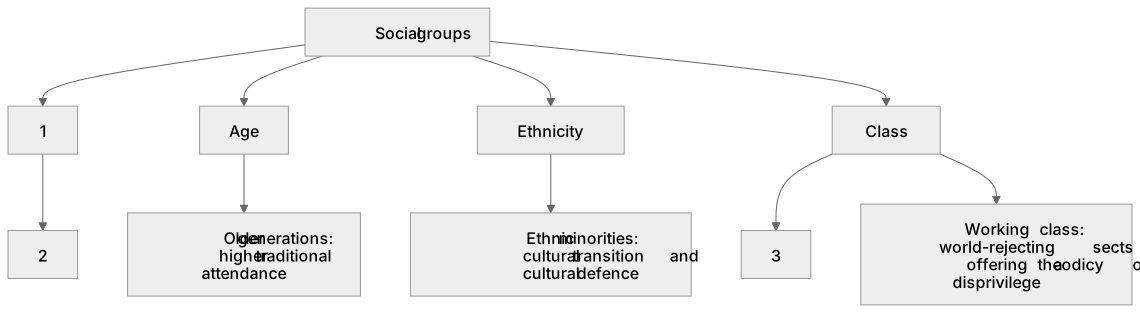
1Box 1
2Box 2
3Box 3
There is more to this lesson
The full lesson goes on to check your understanding and help you earn the marks. Create a free account to carry on, with your progress saved.
A week of Premium from your first lesson · Then the free plan continues · No card, no charge
Test your understanding of Beliefs in Society: the relationship between different social groups and religious/spiritual organisations and movements, beliefs and practices
Active recall beats re-reading. Take an instant quiz now to test what you’ve learned and lock it into long-term memory.
A week of Premium from your first lesson · Then the free plan continues · No card, no charge