AQA · A-Level · Sociology
Course version: 7192 · Version from Sept 2015
Demographic trends in the United Kingdom since 1900: birth rates, death…
Full specification wording
Families and Households: demographic trends in the United Kingdom since 1900: birth rates, death rates, family size, life expectancy, ageing population, and migration and globalisation.
Since 1900, the UK has experienced significant demographic shifts.
Checked against the AQA 7192 specification (opens in a new tab) on .
- Point 4 of 4
- 4 key terms
Study notes
From the checked teaching notes for this specification point.
The idea
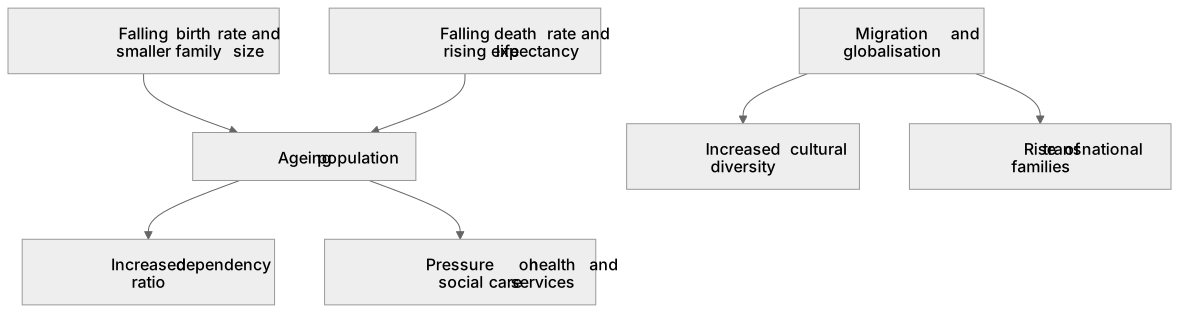
Since 1900, the UK has experienced significant demographic shifts. Birth rates and family sizes have generally declined, driven by changing social attitudes, women's increased workforce participation, and the availability of contraception. Conversely, death rates have fallen and life expectancy has risen due to medical advancements, improved public health, and better nutrition. These trends have resulted in an ageing population, increasing the dependency ratio and placing pressure on health and social care services. Furthermore, migration patterns have evolved, with globalisation facilitating greater movement of people. This has led to increased cultural diversity and changes in family structures, such as the rise of transnational families, significantly shaping contemporary UK society.
What earns the marks
- Identify the long-term decline in the UK birth rate and total fertility rate since 1900, noting fluctuations such as the post-WWII baby booms.
- Explain the reasons for the falling death rate and rising life expectancy, including improvements in sanitation, nutrition, and medical care.
- Analyse the consequences of an ageing population, such as the increased burden on public services and changes to the dependency ratio.
- Evaluate the impact of migration and globalisation on UK family structures, including increased diversity and the emergence of transnational families.
Common mistakes and how to put them right
Confusing birth rate with fertility rate.
Put it right: The birth rate is the number of live births per 1000 of the population per year, whereas the total fertility rate is the average number of children a woman will have during her fertile years.
Assuming the ageing population is solely caused by people living longer.
Put it right: It is also significantly driven by the declining birth rate, meaning fewer young people are entering the population.
Treating migration as a recent phenomenon.
Put it right: While globalisation has accelerated it, significant migration to and from the UK has occurred throughout the period since 1900, influencing family diversity over a long timeframe.
Exam tips
- When discussing family size, link the decline in the birth rate to changes in the position of women and the economic cost of raising children.
- Use the concept of the dependency ratio to explain the economic and social impacts of an ageing population on families and households.
- Connect globalisation to migration by explaining how interconnected economies and improved transport have facilitated the movement of people, altering UK demographic profiles.
Try the lesson
The start of the Families and Households: demographic trends in the United Kingdom since 1900: birth rates, death rates, family size, life expectancy, ageing population, and migration and globalisation. lesson, made from checked teaching notes for this specification point.
Have a go first
Which of the following best describes the overall trend in the UK death rate since 1900?
Listen
Since 1900, the UK has experienced significant demographic shifts. Birth rates and family sizes have generally declined, driven by changing social attitudes, women's increased workforce participation, and the availability of contraception. Conversely, death rates have fallen and life expectancy has risen due to medical advancements, improved public health, and better nutrition. These trends have resulted in an ageing population, increasing the dependency ratio and placing pressure on health and social care services. Furthermore, migration patterns have evolved, with globalisation facilitating greater movement of people. This has led to increased cultural diversity and changes in family structures, such as the rise of transnational families, significantly shaping contemporary UK society. A strong answer earns marks for these points. Identify the long-term decline in the UK birth rate and total fertility rate since 1900, noting fluctuations such as the post-WWII baby booms. Explain the reasons for the falling death rate and rising life expectancy, including improvements in sanitation, nutrition, and medical care. Analyse the consequences of an ageing population, such as the increased burden on public services and changes to the dependency ratio. Evaluate the impact of migration and globalisation on UK family structures, including increased diversity and the emergence of transnational families. Exam tip: When discussing family size, link the decline in the birth rate to changes in the position of women and the economic cost of raising children.
See it
Key words
Say what each word means before you turn the card.
Demographic change
Try answering aloud or in your head before turning the card.
Social policy and public health
Try answering aloud or in your head before turning the card.
Globalisation and migration
Try answering aloud or in your head before turning the card.
Family diversity and structure
Try answering aloud or in your head before turning the card.
See every definition
- Demographic change
- Significant shifts in the population, such as declining birth rates and family sizes, falling death rates and rising life expectancy.
- Social policy and public health
- Improved public health, alongside medical advancements and better nutrition, has contributed to falling death rates and rising life expectancy.
- Globalisation and migration
- Globalisation has facilitated greater movement of people, leading to increased cultural diversity and changes in family structures such as transnational families.
- Family diversity and structure
- Migration and globalisation have led to increased cultural diversity and changes in family structures, significantly shaping contemporary UK society.
Label the diagram
Some boxes have lost their names. Pick the right name for each number.
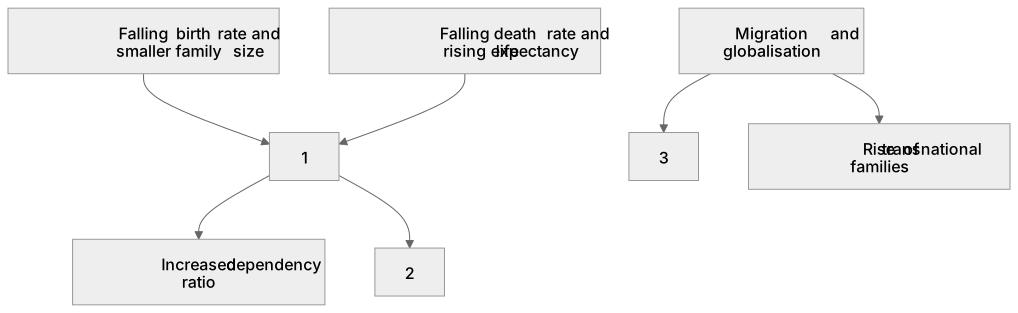
1Box 1
2Box 2
3Box 3
There is more to this lesson
The full lesson goes on to check your understanding and help you earn the marks. Create a free account to carry on, with your progress saved.
A week of Premium from your first lesson · Then the free plan continues · No card, no charge
Test your understanding of Families and Households: demographic trends in the United Kingdom since 1900: birth rates, death rates, family size, life expectancy, ageing population, and migration and globalisation.
Active recall beats re-reading. Take an instant quiz now to test what you’ve learned and lock it into long-term memory.
A week of Premium from your first lesson · Then the free plan continues · No card, no charge