AQA · A-Level · Sociology
Course version: 7192 · Version from Sept 2015
Gender roles, domestic labour and power relationships within the family in…
Full specification wording
Families and Households: gender roles, domestic labour and power relationships within the family in contemporary society
This topic explores gender roles, domestic labour, and power relationships within families in contemporary society.
Checked against the AQA 7192 specification (opens in a new tab) on .
- Point 2 of 4
- 4 key terms
Study notes
From the checked teaching notes for this specification point.
The idea
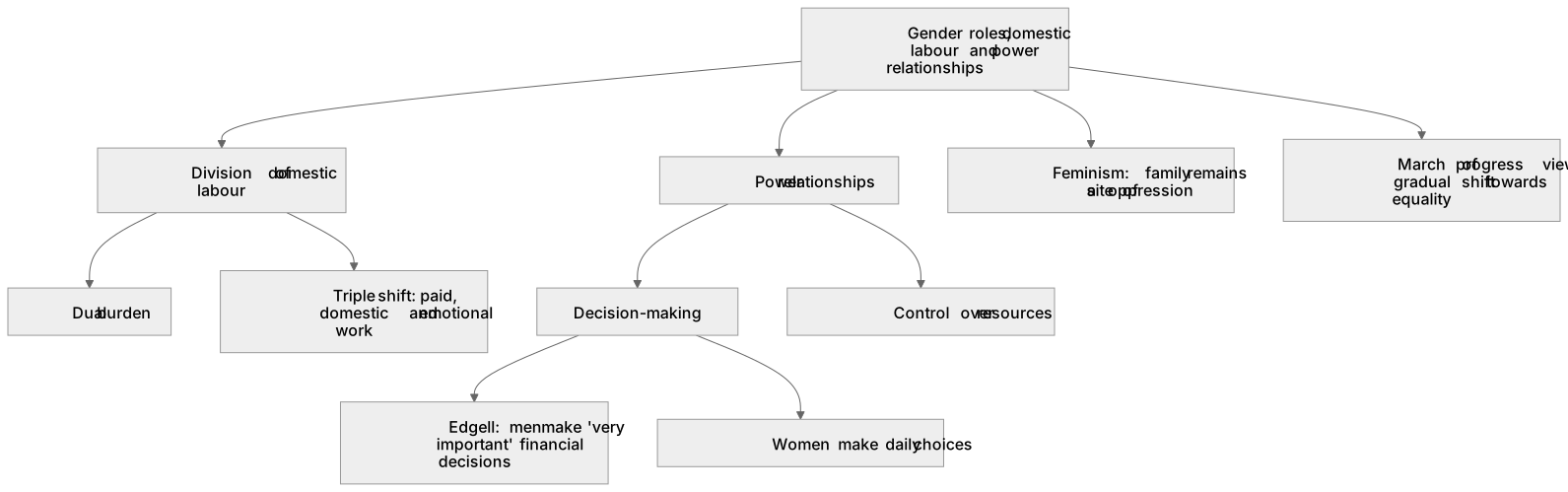
This topic explores gender roles, domestic labour, and power relationships within families in contemporary society. Sociologists debate whether families are becoming egalitarian or if patriarchal structures persist. You must examine the division of domestic labour, including the 'triple shift' (paid, domestic, and emotional work) often performed by women. Power relationships are analysed through decision-making and control over resources. For example, Edgell found men often make 'very important' financial decisions, while women make daily choices. Evaluate these dynamics using perspectives like feminism, which argues the family remains a site of oppression, and the march of progress view, suggesting a gradual shift towards equality.
What earns the marks
- Identify and explain the concept of the symmetrical family and joint conjugal roles.
- Analyse the unequal division of domestic labour, referencing concepts like the dual burden and triple shift.
- Evaluate power relationships by examining inequalities in decision-making and control over family finances.
- Apply sociological perspectives, such as feminist and march of progress views, to contemporary family dynamics.
Common mistakes and how to put them right
Confusing the 'dual burden' with the 'triple shift'.
Put it right: The dual burden refers to paid work and unpaid housework, whereas the triple shift adds emotional work to these two responsibilities.
Assuming that increased female employment automatically leads to an equal division of domestic labour.
Put it right: Recognise that many sociologists argue women still perform the majority of housework despite working full-time.
Treating 'power' only as physical dominance.
Put it right: Understand that power in the family also encompasses financial control, decision-making authority, and the ability to delegate tasks.
Exam tips
- Use specific sociological studies, such as Young and Willmott or Edgell, to support your arguments about domestic labour and power.
- Always link changes in gender roles within the family to wider social changes in contemporary society, such as changes in the law or the economy.
- Contrast the march of progress view with feminist perspectives to build strong evaluation in extended responses.
Try the lesson
The start of the Families and Households: gender roles, domestic labour and power relationships within the family in contemporary society lesson, made from checked teaching notes for this specification point.
Have a go first
Which of the following best describes the concept of the 'triple shift' as experienced by many women in contemporary families?
Listen
This topic explores gender roles, domestic labour, and power relationships within families in contemporary society. Sociologists debate whether families are becoming egalitarian or if patriarchal structures persist. You must examine the division of domestic labour, including the 'triple shift' (paid, domestic, and emotional work) often performed by women. Power relationships are analysed through decision-making and control over resources. For example, Edgell found men often make 'very important' financial decisions, while women make daily choices. Evaluate these dynamics using perspectives like feminism, which argues the family remains a site of oppression, and the march of progress view, suggesting a gradual shift towards equality. A strong answer earns marks for these points. Identify and explain the concept of the symmetrical family and joint conjugal roles. Analyse the unequal division of domestic labour, referencing concepts like the dual burden and triple shift. Evaluate power relationships by examining inequalities in decision-making and control over family finances. Apply sociological perspectives, such as feminist and march of progress views, to contemporary family dynamics. A common slip: Confusing the 'dual burden' with the 'triple shift'. Instead, The dual burden refers to paid work and unpaid housework, whereas the triple shift adds emotional work to these two responsibilities. Exam tip: Use specific sociological studies, such as Young and Willmott or Edgell, to support your arguments about domestic labour and power.
See it
Key words
Say what each word means before you turn the card.
Triple shift
Try answering aloud or in your head before turning the card.
Power relationships
Try answering aloud or in your head before turning the card.
March of progress view
Try answering aloud or in your head before turning the card.
Feminism
Try answering aloud or in your head before turning the card.
See every definition
- Triple shift
- Paid work, domestic work and emotional work, often performed by women.
- Power relationships
- Analysed through decision-making and control over resources within the family.
- March of progress view
- Suggests a gradual shift towards equality in gender roles and domestic labour.
- Feminism
- Argues the family remains a site of oppression.
Label the diagram
Some boxes have lost their names. Pick the right name for each number.
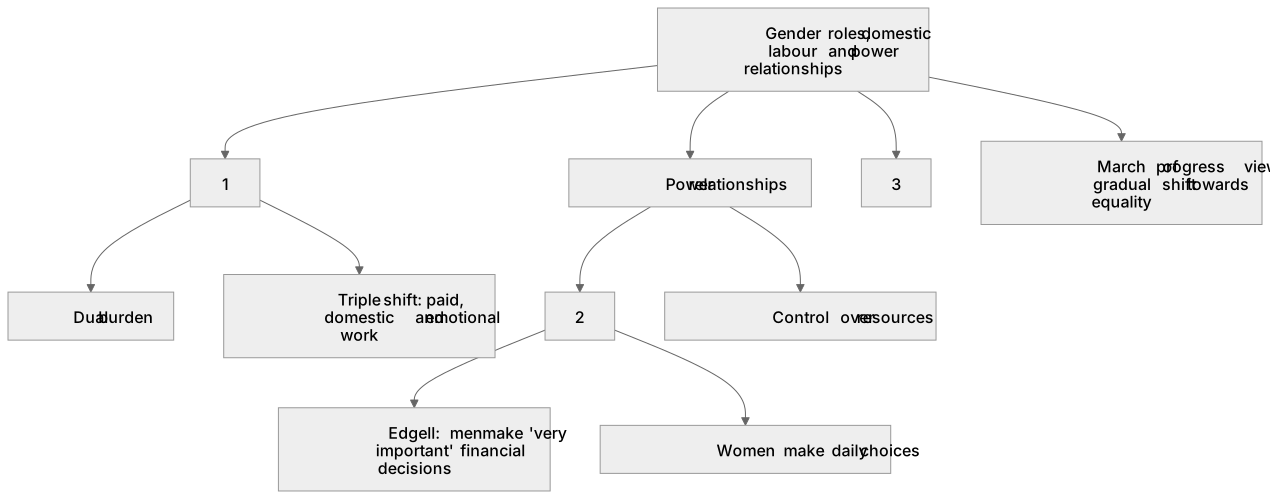
1Box 1
2Box 2
3Box 3
There is more to this lesson
The full lesson goes on to check your understanding and help you earn the marks. Create a free account to carry on, with your progress saved.
A week of Premium from your first lesson · Then the free plan continues · No card, no charge
Test your understanding of Families and Households: gender roles, domestic labour and power relationships within the family in contemporary society
Active recall beats re-reading. Take an instant quiz now to test what you’ve learned and lock it into long-term memory.
A week of Premium from your first lesson · Then the free plan continues · No card, no charge