AQA · A-Level · Sociology
Course version: 7192 · Version from Sept 2015
Core themes - 4.1.3 Theory and Methods: the nature of science and the…
Full specification wording
Subject Content – A-level: Core themes - 4.1.3 Theory and Methods: the nature of science and the extent to which Sociology can be regarded as scientific
Evaluating if sociology is a science requires defining the nature of science.
Checked against the AQA 7192 specification (opens in a new tab) on .
- Point 8 of 9
- 4 key terms
Study notes
From the checked teaching notes for this specification point.
The idea
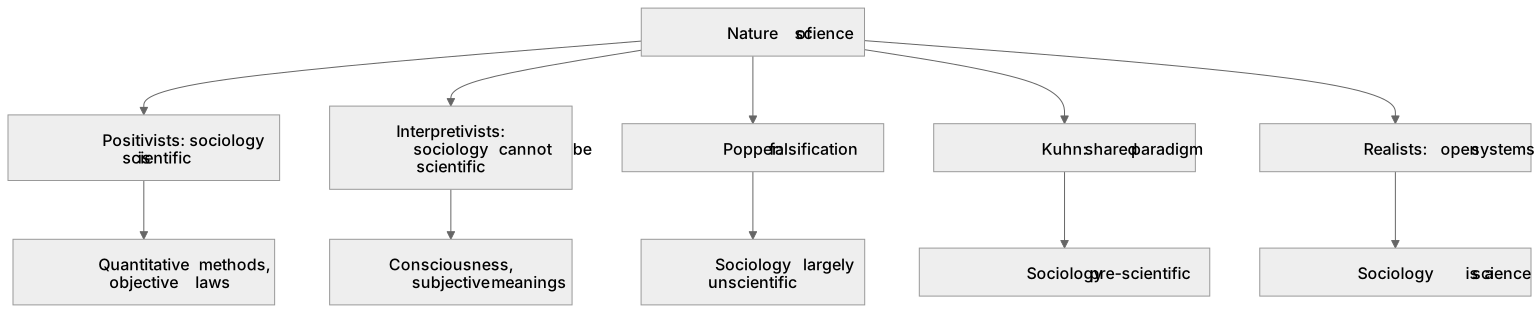
Evaluating if sociology is a science requires defining the nature of science. Positivists argue sociology is scientific, using quantitative methods to uncover objective laws, as Durkheim did using statistics to find causal relationships in suicide. Interpretivists argue humans possess consciousness, meaning sociology cannot be scientific; it requires qualitative methods to uncover subjective meanings. Popper defines science through falsification, arguing sociology is largely unscientific because its theories cannot be proven wrong. Kuhn suggests science requires a shared paradigm, making sociology pre-scientific due to competing perspectives. Realists argue sociology is a science studying open systems where variables cannot be strictly controlled.
What earns the marks
- Identify the positivist view that sociology is a science because it uses inductive reasoning and verification to discover objective laws of human behaviour.
- Recognise the interpretivist view that sociology cannot be a science because human beings have free will and construct meanings, unlike natural matter.
- Apply Karl Popper's concept of falsification to explain why some sociological theories may be considered unscientific if they cannot be proven wrong.
- Use Thomas Kuhn's concept of paradigms to evaluate sociology as a pre-scientific discipline that currently lacks a single unifying framework.
- Explain the realist perspective that sociology is a science because it studies open systems where underlying structures cause observable effects, even if variables cannot be controlled.
Common mistakes and how to put them right
Assuming all sociologists want sociology to be a science.
Put it right: Interpretivists actively reject the scientific model, arguing it is inappropriate for studying conscious human beings.
Confusing verificationism with falsificationism.
Put it right: Verificationism seeks evidence to prove a theory true, whereas falsificationism seeks evidence to prove a theory wrong.
Stating that Kuhn believes sociology is currently a science.
Put it right: Kuhn argues sociology is pre-scientific because it is characterised by competing perspectives rather than a single shared paradigm.
Exam tips
- When evaluating whether sociology is a science, explicitly define what 'science' means according to different theorists such as Popper, Kuhn, and realists.
- Use Durkheim's study of suicide as a concrete example of a positivist attempt to establish sociology as a science using quantitative data.
- Contrast closed systems, like laboratory experiments in physics, with open systems, like society, when discussing the realist view of science.
Try the lesson
The start of the Subject Content – A-level: Core themes - 4.1.3 Theory and Methods: the nature of science and the extent to which Sociology can be regarded as scientific lesson, made from checked teaching notes for this specification point.
Have a go first
According to Karl Popper, which of the following is the defining characteristic of a scientific theory?
Listen
Evaluating if sociology is a science requires defining the nature of science. Positivists argue sociology is scientific, using quantitative methods to uncover objective laws, as Durkheim did using statistics to find causal relationships in suicide. Interpretivists argue humans possess consciousness, meaning sociology cannot be scientific; it requires qualitative methods to uncover subjective meanings. Popper defines science through falsification, arguing sociology is largely unscientific because its theories cannot be proven wrong. Kuhn suggests science requires a shared paradigm, making sociology pre-scientific due to competing perspectives. Realists argue sociology is a science studying open systems where variables cannot be strictly controlled. A strong answer earns marks for these points. Identify the positivist view that sociology is a science because it uses inductive reasoning and verification to discover objective laws of human behaviour. Recognise the interpretivist view that sociology cannot be a science because human beings have free will and construct meanings, unlike natural matter. Apply Karl Popper's concept of falsification to explain why some sociological theories may be considered unscientific if they cannot be proven wrong. Use Thomas Kuhn's concept of paradigms to evaluate sociology as a pre-scientific discipline that currently lacks a single unifying framework. A common slip: Assuming all sociologists want sociology to be a science. Instead, Interpretivists actively reject the scientific model, arguing it is inappropriate for studying conscious human beings. Exam tip: When evaluating whether sociology is a science, explicitly define what 'science' means according to different theorists such as Popper, Kuhn, and realists.
See it
Key words
Say what each word means before you turn the card.
Positivism and Interpretivism
Try answering aloud or in your head before turning the card.
Falsification and Verification
Try answering aloud or in your head before turning the card.
Scientific Paradigms
Try answering aloud or in your head before turning the card.
Realism and Open Systems
Try answering aloud or in your head before turning the card.
See every definition
- Positivism and Interpretivism
- Positivists argue sociology is scientific, using quantitative methods to uncover objective laws, while Interpretivists argue humans possess consciousness, meaning sociology cannot be scientific and requires qualitative methods to uncover subjective meanings.
- Falsification and Verification
- Popper defines science through falsification, arguing sociology is largely unscientific because its theories cannot be proven wrong, whereas verification seeks evidence to prove a theory true.
- Scientific Paradigms
- Kuhn suggests science requires a shared paradigm, making sociology pre-scientific due to competing perspectives rather than a single unifying framework.
- Realism and Open Systems
- Realists argue sociology is a science studying open systems where variables cannot be strictly controlled, unlike closed systems such as laboratory experiments in physics.
Label the diagram
Some boxes have lost their names. Pick the right name for each number.
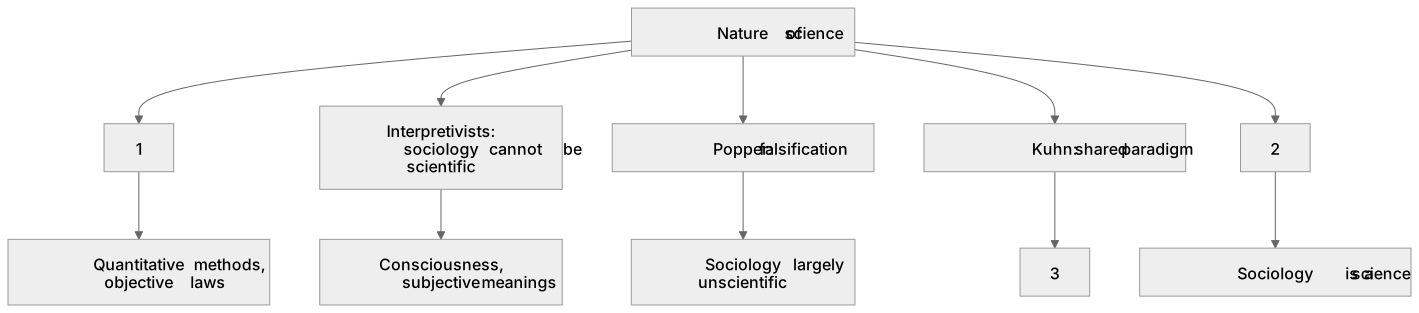
1Box 1
2Box 2
3Box 3
There is more to this lesson
The full lesson goes on to check your understanding and help you earn the marks. Create a free account to carry on, with your progress saved.
A week of Premium from your first lesson · Then the free plan continues · No card, no charge
Test your understanding of Subject Content – A-level: Core themes - 4.1.3 Theory and Methods: the nature of science and the extent to which Sociology can be regarded as scientific
Active recall beats re-reading. Take an instant quiz now to test what you’ve learned and lock it into long-term memory.
A week of Premium from your first lesson · Then the free plan continues · No card, no charge