AQA · A-Level · Sociology
Course version: 7192 · Version from Sept 2015
The nature, existence and persistence of poverty in contemporary society
Full specification wording
Work, Poverty and Welfare: the nature, existence and persistence of poverty in contemporary society
Understanding poverty in contemporary society requires examining its nature, existence, and persistence.
Checked against the AQA 7192 specification (opens in a new tab) on .
- Point 1 of 5
- 4 key terms
Study notes
From the checked teaching notes for this specification point.
The idea
Understanding poverty in contemporary society requires examining its nature, existence, and persistence. The 'nature' of poverty involves defining it, distinguishing between absolute poverty (lacking basic survival needs) and relative poverty (lacking resources for normal societal participation). Its 'existence' is measured using indicators like the consensual measure or income thresholds (e.g. below 60% of median income). The 'persistence' of poverty explores why it continues despite welfare systems. Explanations include structural factors, such as low-wage economies and systemic inequality, and cultural explanations, like the 'underclass' thesis, which argues that welfare dependency traps individuals in poverty across generations.
What earns the marks
- Identify the difference between absolute and relative poverty when discussing the nature of poverty.
- Recognise how the existence of poverty is measured, such as using relative income lines or deprivation indices.
- Evaluate structural explanations for the persistence of poverty, such as the impact of capitalism, low pay, and the gig economy.
- Evaluate cultural explanations for the persistence of poverty, including the cycle of deprivation and New Right concepts of an underclass.
Common mistakes and how to put them right
Confusing absolute and relative poverty.
Put it right: Absolute poverty refers to lacking basic necessities for survival, whereas relative poverty means lacking the resources to achieve the standard of living considered normal in a specific society.
Assuming poverty no longer exists in contemporary wealthy societies.
Put it right: Acknowledge that while absolute poverty may be rare in wealthy nations, relative poverty and social exclusion remain significant and measurable issues.
Treating cultural and structural explanations as identical.
Put it right: Clearly distinguish between cultural explanations (which focus on the values and behaviours of the poor) and structural explanations (which focus on economic systems and societal inequalities).
Exam tips
- Use contemporary examples, such as the rise of food banks or the gig economy, to illustrate the existence and persistence of poverty.
- When evaluating explanations for poverty, contrast structural theories (like Marxism) with cultural theories (like the New Right).
- Be prepared to discuss how different definitions of poverty affect the statistical measurement of its existence.
Try the lesson
The start of the Work, Poverty and Welfare: the nature, existence and persistence of poverty in contemporary society lesson, made from checked teaching notes for this specification point.
Have a go first
Which of the following best describes the concept of 'relative poverty' in contemporary sociological research?
Listen
Understanding poverty in contemporary society requires examining its nature, existence, and persistence. The 'nature' of poverty involves defining it, distinguishing between absolute poverty (lacking basic survival needs) and relative poverty (lacking resources for normal societal participation). Its 'existence' is measured using indicators like the consensual measure or income thresholds (e.g. below 60% of median income). The 'persistence' of poverty explores why it continues despite welfare systems. Explanations include structural factors, such as low-wage economies and systemic inequality, and cultural explanations, like the 'underclass' thesis, which argues that welfare dependency traps individuals in poverty across generations. A strong answer earns marks for these points. Identify the difference between absolute and relative poverty when discussing the nature of poverty. Recognise how the existence of poverty is measured, such as using relative income lines or deprivation indices. Evaluate structural explanations for the persistence of poverty, such as the impact of capitalism, low pay, and the gig economy. Evaluate cultural explanations for the persistence of poverty, including the cycle of deprivation and New Right concepts of an underclass. A common slip: Confusing absolute and relative poverty. Instead, Absolute poverty refers to lacking basic necessities for survival, whereas relative poverty means lacking the resources to achieve the standard of living considered normal in a specific society. Exam tip: Use contemporary examples, such as the rise of food banks or the gig economy, to illustrate the existence and persistence of poverty.
See it

Key words
Say what each word means before you turn the card.
Absolute poverty
Try answering aloud or in your head before turning the card.
Relative poverty
Try answering aloud or in your head before turning the card.
Structural explanations
Try answering aloud or in your head before turning the card.
Cultural explanations
Try answering aloud or in your head before turning the card.
See every definition
- Absolute poverty
- Lacking basic survival needs, as distinguished from relative poverty when defining the nature of poverty.
- Relative poverty
- Lacking resources for normal societal participation, as distinguished from absolute poverty when defining the nature of poverty.
- Structural explanations
- Explanations for the persistence of poverty focusing on factors such as low-wage economies and systemic inequality.
- Cultural explanations
- Explanations for the persistence of poverty such as the 'underclass' thesis, which argues welfare dependency traps individuals in poverty across generations.
Label the diagram
Some boxes have lost their names. Pick the right name for each number.
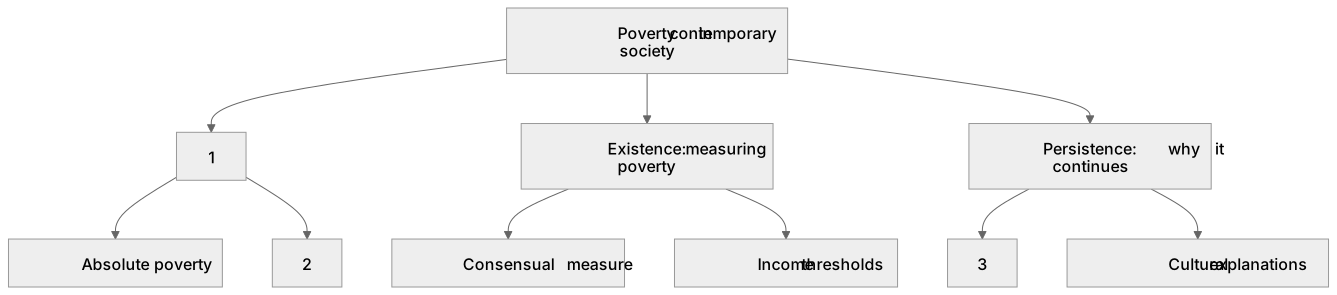
1Box 1
2Box 2
3Box 3
There is more to this lesson
The full lesson goes on to check your understanding and help you earn the marks. Create a free account to carry on, with your progress saved.
A week of Premium from your first lesson · Then the free plan continues · No card, no charge
Test your understanding of Work, Poverty and Welfare: the nature, existence and persistence of poverty in contemporary society
Active recall beats re-reading. Take an instant quiz now to test what you’ve learned and lock it into long-term memory.
A week of Premium from your first lesson · Then the free plan continues · No card, no charge