OCR · GCSE · Biology
Course version: J247 · Version from Sept 2018
Explain how the structure of a reflex arc is related to its function
Full specification wording
Coordination and control – the nervous system: explain how the structure of a reflex arc is related to its function
A reflex arc provides an involuntary, rapid, automatic protective pathway that shields organisms from physical trauma.
- Point 4 of 9
- 4 key terms
Study notes
From the teaching notes for this specification point.
The idea
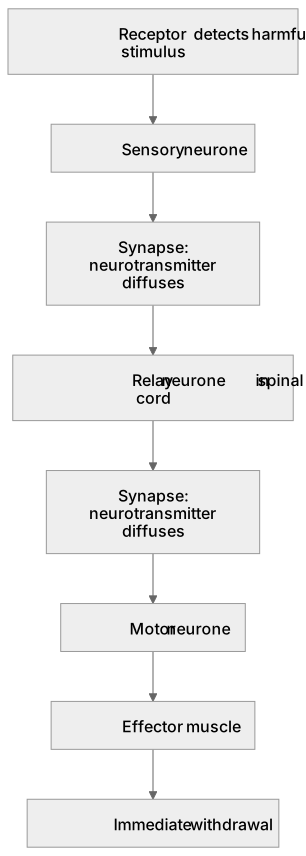
A reflex arc provides an involuntary, rapid, automatic protective pathway that shields organisms from physical trauma. Because conscious deliberation by the cerebral cortex would introduce fatal delays, the neural pathway passes directly through the spinal cord or unconscious brainstem. A receptor detects a harmful stimulus and initiates impulses in a sensory neurone. These impulses reach the spinal cord, where neurotransmitters diffuse across a synapse to depolarise a relay neurone. A second synapse transfers the signal to a motor neurone, which propagates impulses out to an effector muscle, causing immediate withdrawal. The minimal number of synapses ensures minimal synaptic delay and maximum survival value.
What earns the marks
- State that reflex actions are rapid, involuntary, and automatic responses that do not require conscious thought.
- Trace the complete pathway: receptor detects stimulus, sensory neurone, synapse, relay neurone in spinal cord, synapse, motor neurone, effector.
- Explain that bypassing conscious cerebral processing reduces reaction time to prevent or minimise tissue damage.
- Describe the role of neurotransmitter diffusion across synapses in maintaining unidirectional impulse transmission.
Common mistakes and how to put them right
Stating that the brain is completely unaware of a reflex action, rather than explaining that conscious perception occurs after the reflex has acted.
Confusing the order of neurones in the arc, placing motor neurones before sensory neurones.
Suggesting that electrical impulses travel across the synaptic cleft rather than chemical neurotransmitters.
Exam tips
- Always mention that reflex actions are protective and prevent tissue injury when asked about the purpose or function of a reflex.
- Learn the precise sequence: stimulus to receptor to sensory neurone to relay neurone in the Central Nervous System to motor neurone to effector to response.
Try the lesson
The start of the Coordination and control – the nervous system: explain how the structure of a reflex arc is related to its function lesson, made from teaching notes for this specification point.
Have a go first
Reflex actions are rapid and automatic. Which feature of a reflex arc's structure is most responsible for its speed?
Listen
A reflex arc provides an involuntary, rapid, automatic protective pathway that shields organisms from physical trauma. Because conscious deliberation by the cerebral cortex would introduce fatal delays, the neural pathway passes directly through the spinal cord or unconscious brainstem. A receptor detects a harmful stimulus and initiates impulses in a sensory neurone. These impulses reach the spinal cord, where neurotransmitters diffuse across a synapse to depolarise a relay neurone. A second synapse transfers the signal to a motor neurone, which propagates impulses out to an effector muscle, causing immediate withdrawal. The minimal number of synapses ensures minimal synaptic delay and maximum survival value. A strong answer earns marks for these points. state that reflex actions are rapid, involuntary, and automatic responses that do not require conscious thought. trace the complete pathway: receptor detects stimulus, sensory neurone, synapse, relay neurone in spinal cord, synapse, motor neurone, effector. explain that bypassing conscious cerebral processing reduces reaction time to prevent or minimise tissue damage. describe the role of neurotransmitter diffusion across synapses in maintaining unidirectional impulse transmission. Exam tip: Always mention that reflex actions are protective and prevent tissue injury when asked about the purpose or function of a reflex.
See it
Key words
Say what each word means before you turn the card.
reflex arc
Try answering aloud or in your head before turning the card.
involuntary response
Try answering aloud or in your head before turning the card.
synaptic transmission
Try answering aloud or in your head before turning the card.
tissue protection
Try answering aloud or in your head before turning the card.
See every definition
- reflex arc
- A pathway that provides an involuntary, rapid, automatic protective response, passing directly through the spinal cord or unconscious brainstem.
- involuntary response
- A rapid, automatic reaction that does not require conscious thought and shields organisms from physical trauma.
- synaptic transmission
- Neurotransmitters diffuse across a synapse to depolarise a relay neurone, maintaining unidirectional impulse transmission.
- tissue protection
- Bypassing conscious cerebral processing reduces reaction time to prevent or minimise tissue damage.
There is more to this lesson
The full lesson goes on to check your understanding and help you earn the marks. Create a free account to carry on, with your progress saved.
A week of Premium from your first lesson · Then the free plan continues · No card, no charge
Test your understanding of Coordination and control – the nervous system: explain how the structure of a reflex arc is related to its function
Active recall beats re-reading. Take an instant quiz now to test what you’ve learned and lock it into long-term memory.
A week of Premium from your first lesson · Then the free plan continues · No card, no charge