OCR · GCSE · Biology
Course version: J247 · Version from Sept 2018
Describe different levels of organisation in an ecosystem from individual…
Full specification wording
Ecosystems: describe different levels of organisation in an ecosystem from individual organisms to the whole ecosystem
Ecosystems exhibit a hierarchical structural organisation ranging from single organisms to entire biomes.
- Point 10 of 15
- 2 key terms
Study notes
From the teaching notes for this specification point.
The idea
Ecosystems exhibit a hierarchical structural organisation ranging from single organisms to entire biomes. At the base level is the individual organism, a single living member of a species. A population consists of all individuals of the same species coexisting in a specific geographic habitat at a given time and capable of interbreeding. A community encompasses all the different populations of diverse plant, animal, fungal, and microbial species living and interacting together within that shared habitat. Finally, an ecosystem comprises the complete, self-sustaining functional unit formed by the living community of organisms interacting with all the non-living physical and chemical abiotic components of their environment.
What earns the marks
- Define an individual as a single living organism of a specific species.
- Define a population as all the individuals of one species living in a specified habitat at a given time.
- Define a community as all the populations of different species coexisting and interacting within a habitat.
- Define an ecosystem as the interaction of a living community with the non-living abiotic factors of the environment.
Common mistakes and how to put them right
Confusing a population (one single species) with a community (multiple species living together).
Defining an ecosystem as just the living organisms, omitting the abiotic physical and chemical environment.
Using the terms habitat and ecosystem interchangeably.
Exam tips
- Learn the precise hierarchy in order: individual, population, community, ecosystem.
- Remember that an ecosystem includes both biotic (living community) and abiotic (non-living environment) components.
Try the lesson
The start of the Ecosystems: describe different levels of organisation in an ecosystem from individual organisms to the whole ecosystem lesson, made from teaching notes for this specification point.
Have a go first
Which term describes all the organisms of one species living in the same area at the same time?
Listen
Ecosystems exhibit a hierarchical structural organisation ranging from single organisms to entire biomes. At the base level is the individual organism, a single living member of a species. A population consists of all individuals of the same species coexisting in a specific geographic habitat at a given time and capable of interbreeding. A community encompasses all the different populations of diverse plant, animal, fungal, and microbial species living and interacting together within that shared habitat. Finally, an ecosystem comprises the complete, self-sustaining functional unit formed by the living community of organisms interacting with all the non-living physical and chemical abiotic components of their environment. A strong answer earns marks for these points. define an individual as a single living organism of a specific species. define a population as all the individuals of one species living in a specified habitat at a given time. define a community as all the populations of different species coexisting and interacting within a habitat. define an ecosystem as the interaction of a living community with the non-living abiotic factors of the environment. Exam tip: Learn the precise hierarchy in order: individual, population, community, ecosystem.
See it
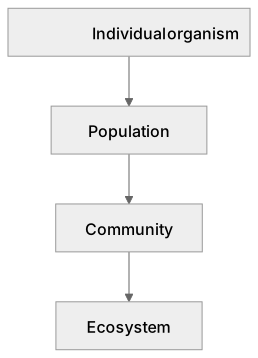
Put it in order
Put these steps in the order they happen.
- 1. Community
- 2. Ecosystem
- 3. Population
- 4. Individual organism
Key words
Say what each word means before you turn the card.
individual
Try answering aloud or in your head before turning the card.
ecosystem definition
Try answering aloud or in your head before turning the card.
See every definition
- individual
- A single living member of a species.
- ecosystem definition
- The complete, self-sustaining functional unit formed by the living community of organisms interacting with all the non-living physical and chemical abiotic components of their environment.
Label the diagram
Some boxes have lost their names. Pick the right name for each number.
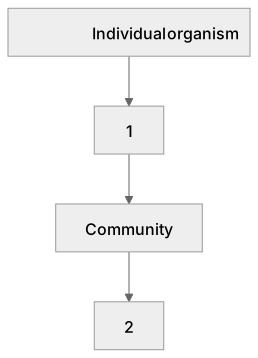
1Box 1
2Box 2
There is more to this lesson
The full lesson goes on to check your understanding and help you earn the marks. Create a free account to carry on, with your progress saved.
A week of Premium from your first lesson · Then the free plan continues · No card, no charge
Test your understanding of Ecosystems: describe different levels of organisation in an ecosystem from individual organisms to the whole ecosystem
Active recall beats re-reading. Take an instant quiz now to test what you’ve learned and lock it into long-term memory.
A week of Premium from your first lesson · Then the free plan continues · No card, no charge