OCR · GCSE · Biology
Course version: J247 · Version from Sept 2018
Explain the impact of the selective breeding of food plants and…
Full specification wording
Feeding the human race: explain the impact of the selective breeding of food plants and domesticated animals
Selective breeding, or artificial selection, involves humans deliberately choosing individual animals or plants exhibiting desirable traits (such as high milk yield in cattle, drought resistance…
- Point 4 of 8
- 4 key terms
Study notes
From the teaching notes for this specification point.
The idea
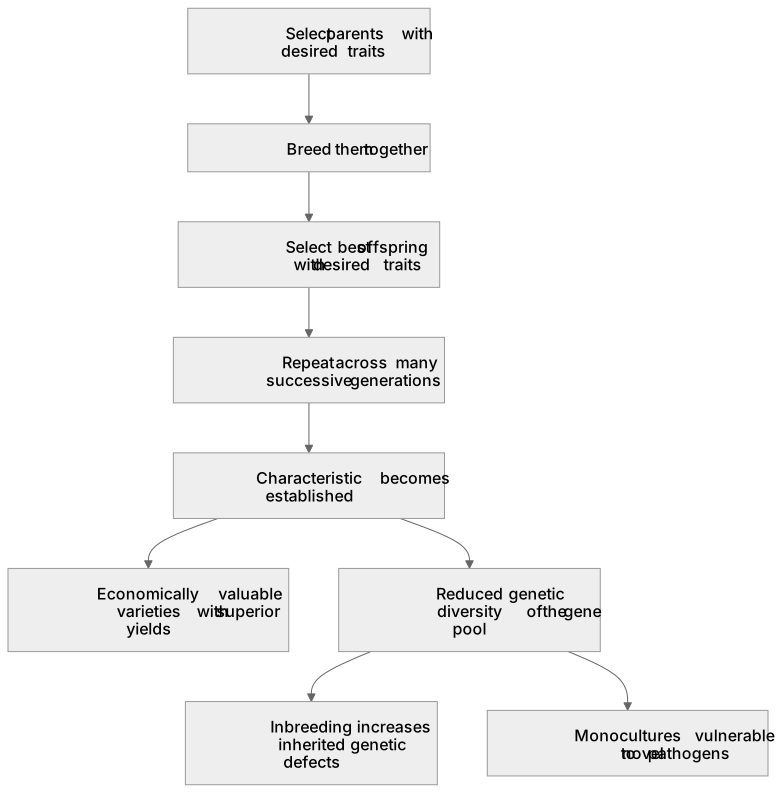
Selective breeding, or artificial selection, involves humans deliberately choosing individual animals or plants exhibiting desirable traits (such as high milk yield in cattle, drought resistance in wheat, or gentle temperament in domestic dogs) to breed together. The best offspring displaying the desired traits are selected and bred across many successive generations until the characteristic becomes established. While it produces economically valuable crop and livestock varieties with superior yields, it severely reduces the genetic diversity of the gene pool. Inbreeding increases the prevalence of inherited genetic defects and leaves entire monocultures vulnerable to devastation by novel pathogens.
What earns the marks
- Describe the selective breeding process: selecting parents with desired characteristics, breeding them, and repeating across generations.
- Give examples of desirable traits bred in agriculture, such as disease resistance in crops, high milk yield in cows, or large seed heads.
- Explain negative impacts: reduced genetic diversity in the gene pool and increased risk of harmful recessive genetic disorders.
- Explain that low genetic variation leaves entire populations vulnerable to being wiped out by a single new disease.
Common mistakes and how to put them right
Confusing selective breeding with genetic engineering, thinking selective breeding involves modifying DNA in a laboratory.
Believing selective breeding produces immediate results in a single generation rather than requiring many generations.
Exam tips
- State clearly that selective breeding takes many generations to establish the desired characteristic.
- Always link reduced genetic diversity directly to vulnerability to disease outbreaks and inbreeding depression.
Try the lesson
The start of the Feeding the human race: explain the impact of the selective breeding of food plants and domesticated animals lesson, made from teaching notes for this specification point.
Have a go first
What is selective breeding?
Listen
Selective breeding, or artificial selection, involves humans deliberately choosing individual animals or plants exhibiting desirable traits (such as high milk yield in cattle, drought resistance in wheat, or gentle temperament in domestic dogs) to breed together. The best offspring displaying the desired traits are selected and bred across many successive generations until the characteristic becomes established. While it produces economically valuable crop and livestock varieties with superior yields, it severely reduces the genetic diversity of the gene pool. Inbreeding increases the prevalence of inherited genetic defects and leaves entire monocultures vulnerable to devastation by novel pathogens. A strong answer earns marks for these points. Describe the selective breeding process: selecting parents with desired characteristics, breeding them, and repeating across generations. Give examples of desirable traits bred in agriculture, such as disease resistance in crops, high milk yield in cows, or large seed heads. Explain negative impacts: reduced genetic diversity in the gene pool and increased risk of harmful recessive genetic disorders. Explain that low genetic variation leaves entire populations vulnerable to being wiped out by a single new disease. Exam tip: State clearly that selective breeding takes many generations to establish the desired characteristic.
See it
Key words
Say what each word means before you turn the card.
selective breeding
Try answering aloud or in your head before turning the card.
artificial selection
Try answering aloud or in your head before turning the card.
gene pool reduction
Try answering aloud or in your head before turning the card.
inbreeding depression
Try answering aloud or in your head before turning the card.
See every definition
- selective breeding
- Humans deliberately choosing individual animals or plants exhibiting desirable traits to breed together, repeating across many successive generations until the characteristic becomes established.
- artificial selection
- Another name for selective breeding, in which humans deliberately choose individuals with desirable traits to breed together.
- gene pool reduction
- A severe reduction in the genetic diversity of the gene pool caused by selective breeding.
- inbreeding depression
- Increased prevalence of inherited genetic defects and harmful recessive genetic disorders resulting from inbreeding.
Label the diagram
Some boxes have lost their names. Pick the right name for each number.
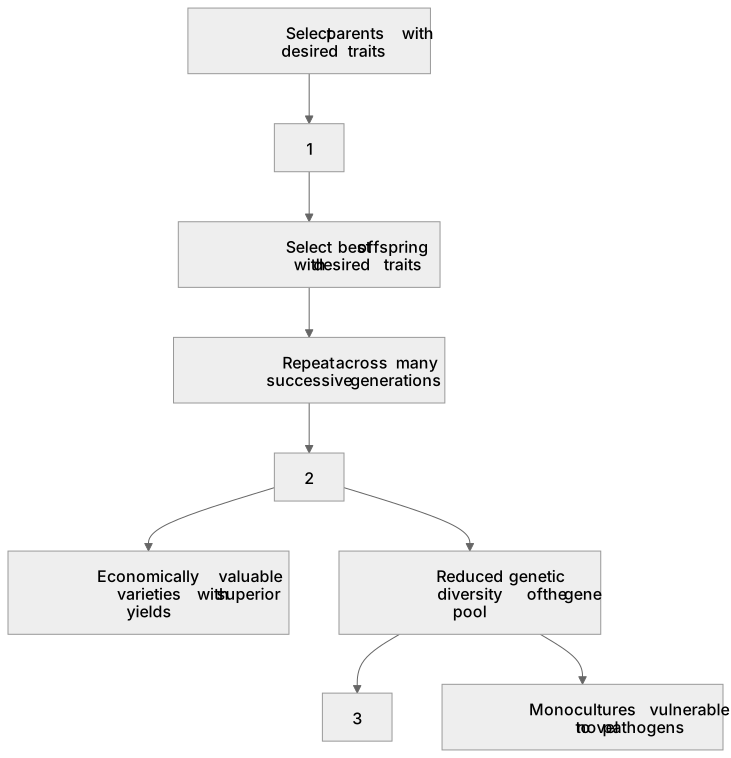
1Box 1
2Box 2
3Box 3
There is more to this lesson
The full lesson goes on to check your understanding and help you earn the marks. Create a free account to carry on, with your progress saved.
A week of Premium from your first lesson · Then the free plan continues · No card, no charge
Test your understanding of Feeding the human race: explain the impact of the selective breeding of food plants and domesticated animals
Active recall beats re-reading. Take an instant quiz now to test what you’ve learned and lock it into long-term memory.
A week of Premium from your first lesson · Then the free plan continues · No card, no charge