OCR · GCSE · Biology
Course version: J247 · Version from Sept 2018
Describe sex determination in humans using a genetic cross (to include:…
Full specification wording
Inheritance: describe sex determination in humans using a genetic cross (to include: the use of Punnett squares)
Biological sex in humans is determined by the 23rd pair of chromosomes, termed the sex chromosomes.
- Point 14 of 16
- 4 key terms
Study notes
From the teaching notes for this specification point.
The idea
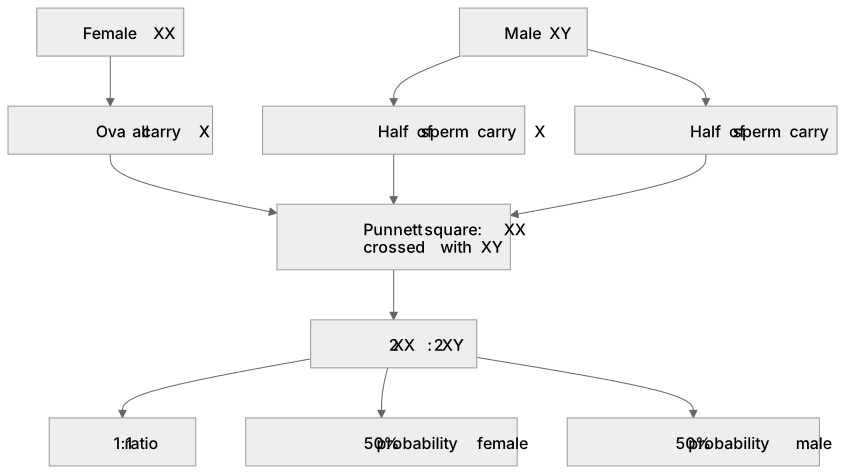
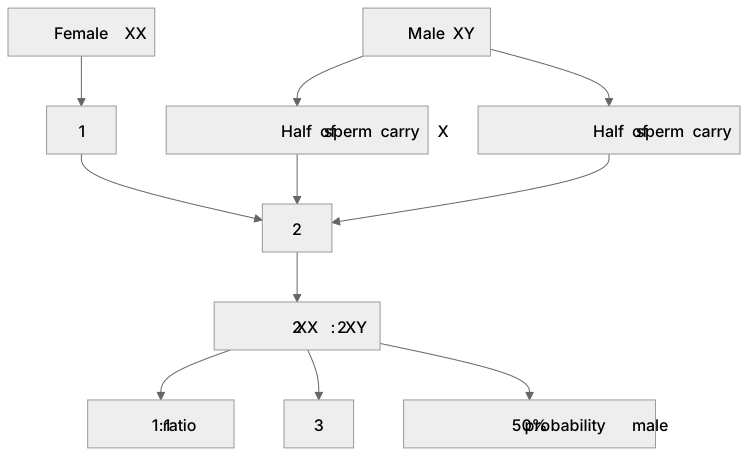
Biological sex in humans is determined by the 23rd pair of chromosomes, termed the sex chromosomes. Females possess two homologous X chromosomes (XX), making them homogametic, so all female ova carry a single X chromosome. Males possess one X and one smaller Y chromosome (XY), making them heterogametic; half of all sperm carry an X chromosome and half carry a Y chromosome. Modelling this in a Punnett square (XX crossed with XY) yields 2 XX to 2 XY, establishing an equal 1 to 1 ratio or a 50% probability of a male or female child at every fertilisation.
What earns the marks
- State that human biological sex is determined by sex chromosomes: XX in females and XY in males.
- Construct a Punnett square crossing maternal XX gametes with paternal X and Y gametes.
- Show that the cross results in 50% XX (female) and 50% XY (male) genotypes, representing a 1:1 ratio.
Common mistakes and how to put them right
Believing the mother determines the sex of the child, rather than the father whose sperm can carry either an X or Y chromosome.
Thinking that having several children of one sex alters the 50% probability for the next pregnancy.
Exam tips
- State clearly that the father sperm determines biological sex because sperm carry either an X or Y chromosome, whereas all eggs carry an X.
- Show the complete Punnett square with gametes clearly labelled to secure all construction marks.
Try the lesson
The start of the Inheritance: describe sex determination in humans using a genetic cross (to include: the use of Punnett squares) lesson, made from teaching notes for this specification point.
Have a go first
In humans, which sex chromosomes does a female have?
Listen
Biological sex in humans is determined by the 23rd pair of chromosomes, termed the sex chromosomes. Females possess two homologous X chromosomes (XX), making them homogametic, so all female ova carry a single X chromosome. Males possess one X and one smaller Y chromosome (XY), making them heterogametic; half of all sperm carry an X chromosome and half carry a Y chromosome. Modelling this in a Punnett square (XX crossed with XY) yields 2 XX to 2 XY, establishing an equal 1 to 1 ratio or a 50% probability of a male or female child at every fertilisation. A strong answer earns marks for these points. State that human biological sex is determined by sex chromosomes: XX in females and XY in males. Construct a Punnett square crossing maternal XX gametes with paternal X and Y gametes. Show that the cross results in 50% XX (female) and 50% XY (male) genotypes, representing a 1:1 ratio. Exam tip: State clearly that the father sperm determines biological sex because sperm carry either an X or Y chromosome, whereas all eggs carry an X.
See it
Key words
Say what each word means before you turn the card.
sex chromosomes
Try answering aloud or in your head before turning the card.
sex determination
Try answering aloud or in your head before turning the card.
Punnett squares
Try answering aloud or in your head before turning the card.
fertilisation probability
Try answering aloud or in your head before turning the card.
See every definition
- sex chromosomes
- The 23rd pair of chromosomes in humans, which determines biological sex.
- sex determination
- Biological sex in humans is determined by the sex chromosomes, with XX in females and XY in males.
- Punnett squares
- A way of modelling a genetic cross, such as XX crossed with XY, to show the resulting genotypes.
- fertilisation probability
- At every fertilisation there is a 50% probability of a male or female child, an equal 1 to 1 ratio.
Label the diagram
Some boxes have lost their names. Pick the right name for each number.
1Box 1
2Box 2
3Box 3
There is more to this lesson
The full lesson goes on to check your understanding and help you earn the marks. Create a free account to carry on, with your progress saved.
A week of Premium from your first lesson · Then the free plan continues · No card, no charge
Test your understanding of Inheritance: describe sex determination in humans using a genetic cross (to include: the use of Punnett squares)
Active recall beats re-reading. Take an instant quiz now to test what you’ve learned and lock it into long-term memory.
A week of Premium from your first lesson · Then the free plan continues · No card, no charge