OCR · GCSE · Biology
Course version: J247 · Version from Sept 2018
Describe that the genome, and its interaction with the environment,…
Full specification wording
Inheritance: describe that the genome, and its interaction with the environment, influence the development of the phenotype of an organism (to include: use of examples of discontinuous (e.g. eye colour) and continuous variation (e.g. weight and height))
An organism phenotype results from complex interactions between its inherited genetic material and environmental influences.
- Point 6 of 16
- 3 key terms
Study notes
From the teaching notes for this specification point.
The idea
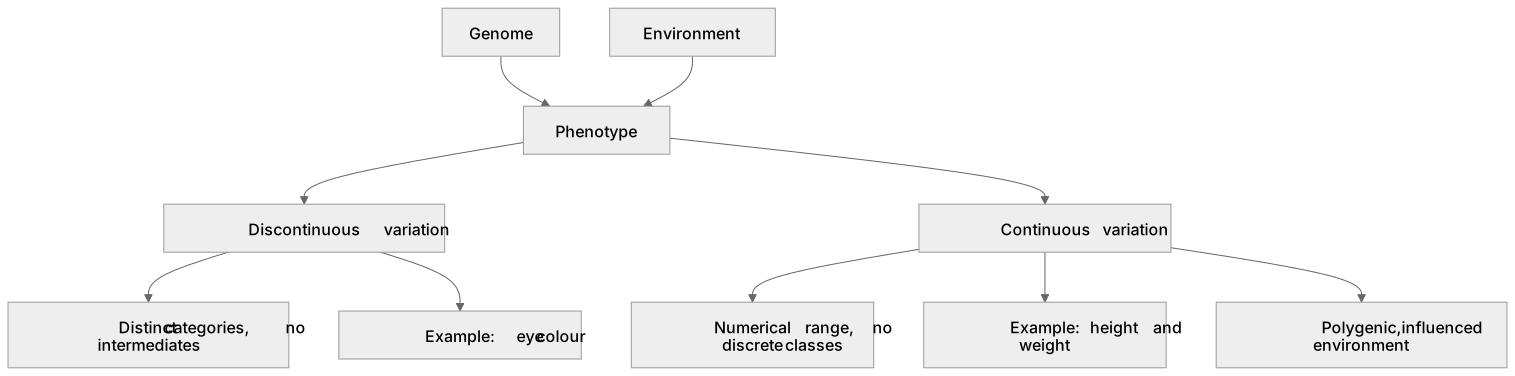
An organism phenotype results from complex interactions between its inherited genetic material and environmental influences. Discontinuous variation produces distinct, non-overlapping categories with no intermediate states, such as human ABO blood groups or eye colour; this variation is typically controlled by a single gene with negligible environmental influence. In contrast, continuous variation exhibits a smooth numerical gradient across a continuous range, such as human height or body mass. Continuous traits are polygenic and substantially modified by environmental factors like nutrition, illness, and physical activity.
What earns the marks
- Explain that phenotype develops through the interaction between an organism genotype and its environment.
- Describe discontinuous variation as distinct categories with no intermediates, giving an example such as eye colour or blood group.
- Describe continuous variation as a numerical range without discrete classes, giving an example such as height or mass.
- Explain that continuous variation is polygenic and heavily influenced by environmental factors such as diet.
Common mistakes and how to put them right
Classifying height as discontinuous because people are often grouped into tall or short categories.
Failing to identify environmental factors when explaining differences in continuous phenotypic traits.
Exam tips
- Remember that discontinuous variation is plotted on bar charts with spaces between bars, whereas continuous data forms histograms with a normal distribution curve.
- When asked to explain variation in plant height, always cite both genetic factors and environmental factors such as light or soil mineral availability.
Try the lesson
The start of the Inheritance: describe that the genome, and its interaction with the environment, influence the development of the phenotype of an organism (to include: use of examples of discontinuous (e.g. eye colour) and continuous variation (e.g. weight and height)) lesson, made from teaching notes for this specification point.
Have a go first
Which statement describes how the genome and the environment influence the phenotype of an organism?
Listen
An organism phenotype results from complex interactions between its inherited genetic material and environmental influences. Discontinuous variation produces distinct, non-overlapping categories with no intermediate states, such as human ABO blood groups or eye colour; this variation is typically controlled by a single gene with negligible environmental influence. In contrast, continuous variation exhibits a smooth numerical gradient across a continuous range, such as human height or body mass. Continuous traits are polygenic and substantially modified by environmental factors like nutrition, illness, and physical activity. A strong answer earns marks for these points. Explain that phenotype develops through the interaction between an organism genotype and its environment. Describe discontinuous variation as distinct categories with no intermediates, giving an example such as eye colour or blood group. Describe continuous variation as a numerical range without discrete classes, giving an example such as height or mass. Explain that continuous variation is polygenic and heavily influenced by environmental factors such as diet. Exam tip: Remember that discontinuous variation is plotted on bar charts with spaces between bars, whereas continuous data forms histograms with a normal distribution curve.
See it
Key words
Say what each word means before you turn the card.
continuous variation
Try answering aloud or in your head before turning the card.
discontinuous variation
Try answering aloud or in your head before turning the card.
phenotype
Try answering aloud or in your head before turning the card.
See every definition
- continuous variation
- A smooth numerical gradient across a continuous range, such as human height or body mass, which is polygenic and substantially modified by environmental factors.
- discontinuous variation
- Distinct, non-overlapping categories with no intermediate states, such as human ABO blood groups or eye colour, typically controlled by a single gene with negligible environmental influence.
- phenotype
- The result of complex interactions between an organism's inherited genetic material and environmental influences.
Label the diagram
Some boxes have lost their names. Pick the right name for each number.
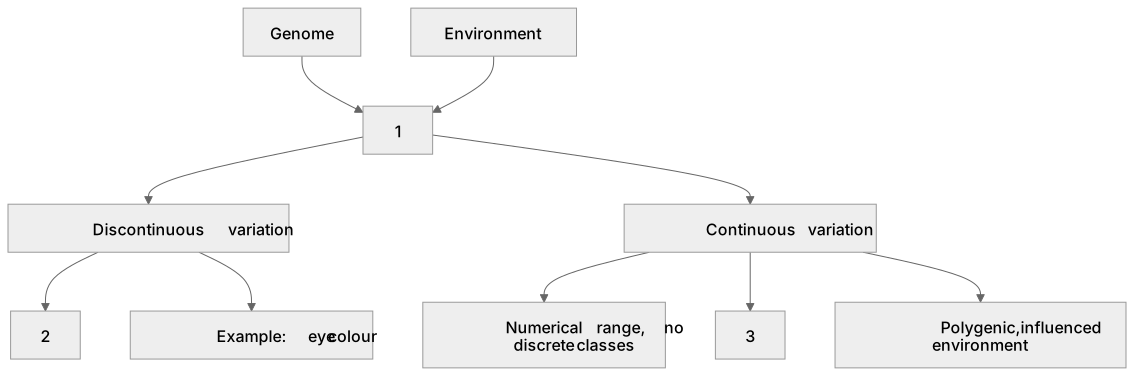
1Box 1
2Box 2
3Box 3
There is more to this lesson
The full lesson goes on to check your understanding and help you earn the marks. Create a free account to carry on, with your progress saved.
A week of Premium from your first lesson · Then the free plan continues · No card, no charge
Test your understanding of Inheritance: describe that the genome, and its interaction with the environment, influence the development of the phenotype of an organism (to include: use of examples of discontinuous (e.g. eye colour) and continuous variation (e.g. weight and height))
Active recall beats re-reading. Take an instant quiz now to test what you’ve learned and lock it into long-term memory.
A week of Premium from your first lesson · Then the free plan continues · No card, no charge