OCR · GCSE · Biology
Course version: J247 · Version from Sept 2018
Recall that all variants arise from mutations, and that most have no…
Full specification wording
Inheritance: Recall that all variants arise from mutations, and that most have no effect on the phenotype, some influence phenotype and a very few determine phenotype
Genetic variation originates through mutations, which are spontaneous changes in the DNA base sequence arising during replication.
- Point 7 of 16
- 4 key terms
Study notes
From the teaching notes for this specification point.
The idea
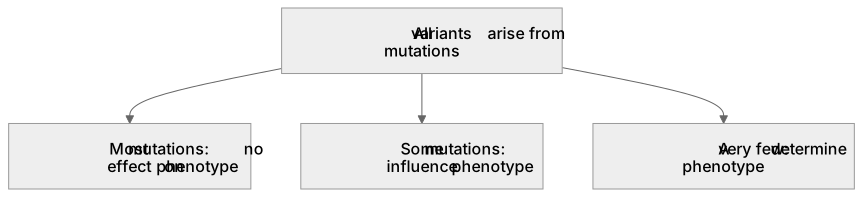
Genetic variation originates through mutations, which are spontaneous changes in the DNA base sequence arising during replication. Because of the degeneracy of the genetic code and the large proportion of non-coding DNA, the vast majority of mutations do not alter amino acid sequences or protein functionality, producing no phenotypic change. Some mutations cause subtle changes in protein structure or gene expression, slightly influencing phenotype. Only a very small minority of mutations dramatically alter protein tertiary structure to determine a distinct phenotype, such as in cystic fibrosis.
What earns the marks
- State that all genetic variants arise from random mutations in the DNA base sequence.
- Explain that most mutations have no observable effect on phenotype due to non-coding DNA or silent changes.
- State that some mutations influence phenotype slightly, while very few determine phenotype directly.
Common mistakes and how to put them right
Believing that all mutations are harmful or fatal, overlooking neutral and beneficial variations.
Claiming that mutations occur in response to environmental needs rather than occurring spontaneously.
Exam tips
- Structure answers into the three spec tiers: most mutations have no effect, some influence phenotype, and very few determine phenotype.
- Be clear that mutations are random changes in the DNA base sequence.
Try the lesson
The start of the Inheritance: Recall that all variants arise from mutations, and that most have no effect on the phenotype, some influence phenotype and a very few determine phenotype lesson, made from teaching notes for this specification point.
Have a go first
Which statement describes the origin of all genetic variants?
Listen
Genetic variation originates through mutations, which are spontaneous changes in the DNA base sequence arising during replication. Because of the degeneracy of the genetic code and the large proportion of non-coding DNA, the vast majority of mutations do not alter amino acid sequences or protein functionality, producing no phenotypic change. Some mutations cause subtle changes in protein structure or gene expression, slightly influencing phenotype. Only a very small minority of mutations dramatically alter protein tertiary structure to determine a distinct phenotype, such as in cystic fibrosis. A strong answer earns marks for these points. State that all genetic variants arise from random mutations in the DNA base sequence. Explain that most mutations have no observable effect on phenotype due to non-coding DNA or silent changes. State that some mutations influence phenotype slightly, while very few determine phenotype directly. Exam tip: Structure answers into the three spec tiers: most mutations have no effect, some influence phenotype, and very few determine phenotype.
See it
Key words
Say what each word means before you turn the card.
genetic mutations
Try answering aloud or in your head before turning the card.
origin of variation
Try answering aloud or in your head before turning the card.
phenotypic consequences
Try answering aloud or in your head before turning the card.
silent mutations
Try answering aloud or in your head before turning the card.
See every definition
- genetic mutations
- Spontaneous changes in the DNA base sequence that arise during replication and are the source of all genetic variants.
- origin of variation
- All variants arise from mutations, which are spontaneous changes in the DNA base sequence arising during replication.
- phenotypic consequences
- Most mutations have no effect on the phenotype, some influence phenotype and a very few determine phenotype.
- silent mutations
- Changes that do not alter amino acid sequences or protein functionality, producing no phenotypic change.
Label the diagram
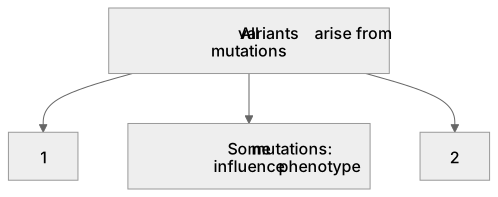
Some boxes have lost their names. Pick the right name for each number.
1Box 1
2Box 2
There is more to this lesson
The full lesson goes on to check your understanding and help you earn the marks. Create a free account to carry on, with your progress saved.
A week of Premium from your first lesson · Then the free plan continues · No card, no charge
Test your understanding of Inheritance: Recall that all variants arise from mutations, and that most have no effect on the phenotype, some influence phenotype and a very few determine phenotype
Active recall beats re-reading. Take an instant quiz now to test what you’ve learned and lock it into long-term memory.
A week of Premium from your first lesson · Then the free plan continues · No card, no charge