OCR · GCSE · Biology
Course version: J247 · Version from Sept 2018
Describe the gross structure of the kidney and the structure of the kidney…
Full specification wording
Maintaining internal environments: describe the gross structure of the kidney and the structure of the kidney tubule (to include: Bowman’s capsule, proximal convoluted tubule, loop of Henlé and collecting duct) (content found only in the biology separate science qualification)
The kidney has three gross regions: the outer cortex, the medulla, and the central renal pelvis, which leads into the ureter.
- Point 9 of 11
- 4 key terms
Study notes
From the teaching notes for this specification point.
The idea
The kidney has three gross regions: the outer cortex, the medulla, and the central renal pelvis, which leads into the ureter. Blood arrives via the renal artery and leaves via the renal vein. Each kidney contains many nephrons. A nephron starts at Bowman's capsule in the cortex, a cup-shaped structure surrounding the glomerulus, where high hydrostatic pressure drives ultrafiltration of small molecules into the tubule. Filtrate then flows through the proximal convoluted tubule, where selective reabsorption returns all glucose, amino acids and some salts to the blood. Next, the filtrate passes down the loop of Henlé into the medulla, then into the collecting duct, which carries urine to the pelvis. The distal convoluted tubule lies between the loop of Henlé and the collecting duct, but it is not required by this specification statement.
What earns the marks
- Identify the gross anatomical zones of the kidney: the outer cortex, the medulla, and the central renal pelvis leading to the ureter, plus the renal artery and renal vein.
- Describe ultrafiltration in Bowman's capsule: high hydrostatic pressure in the glomerulus forces water, glucose, salts and urea into the tubule, while blood cells and large proteins are retained.
- Describe selective reabsorption in the proximal convoluted tubule: all glucose and amino acids, and some salts, are transported back into the blood, so they are absent from healthy urine.
- State that the loop of Henlé extends into the medulla and the collecting duct carries urine to the renal pelvis; the distal convoluted tubule is not required by this statement.
- Interpret a labelled diagram of the kidney and nephron, correctly naming each specified structure and its location.
Common mistakes and how to put them right
Confusing the ureter (carries urine from kidney to bladder) with the urethra (carries urine out of the body).
Put it right: The ureter connects kidney to bladder; the urethra connects bladder to outside.
Believing blood cells and large proteins pass into the filtrate during normal ultrafiltration.
Put it right: The glomerulus and Bowman's capsule retain cells and large proteins; only small molecules are filtered.
Stating that glucose is excreted in the urine of a healthy person.
Put it right: In a healthy person all filtered glucose is reabsorbed by active transport in the proximal convoluted tubule.
Including the distal convoluted tubule as a required structure.
Put it right: This statement lists only Bowman's capsule, proximal convoluted tubule, loop of Henlé and collecting duct; the distal convoluted tubule is not required here.
Exam tips
- Learn the nephron sequence required by this statement: Bowman's capsule, proximal convoluted tubule, loop of Henlé, collecting duct. The distal convoluted tubule is not required here.
- When describing ultrafiltration, name the glomerulus and Bowman's capsule, and state that high hydrostatic pressure forces small molecules into the tubule while cells and large proteins remain in the blood.
Try the lesson
The start of the Maintaining internal environments: describe the gross structure of the kidney and the structure of the kidney tubule (to include: Bowman’s capsule, proximal convoluted tubule, loop of Henlé and collecting duct) (content found only in the biology separate science qualification) lesson, made from teaching notes for this specification point.
Have a go first
Which part of the kidney tubule is a cup-shaped structure that surrounds a knot of blood capillaries?
Listen
The kidney has three gross regions: the outer cortex, the medulla, and the central renal pelvis, which leads into the ureter. Blood arrives via the renal artery and leaves via the renal vein. Each kidney contains many nephrons. A nephron starts at Bowman's capsule in the cortex, a cup-shaped structure surrounding the glomerulus, where high hydrostatic pressure drives ultrafiltration of small molecules into the tubule. Filtrate then flows through the proximal convoluted tubule, where selective reabsorption returns all glucose, amino acids and some salts to the blood. Next, the filtrate passes down the loop of Henlé into the medulla, then into the collecting duct, which carries urine to the pelvis. The distal convoluted tubule lies between the loop of Henlé and the collecting duct, but it is not required by this specification statement. A strong answer earns marks for these points. Identify the gross anatomical zones of the kidney: the outer cortex, the medulla, and the central renal pelvis leading to the ureter, plus the renal artery and renal vein. Describe ultrafiltration in Bowman's capsule: high hydrostatic pressure in the glomerulus forces water, glucose, salts and urea into the tubule, while blood cells and large proteins are retained. Describe selective reabsorption in the proximal convoluted tubule: all glucose and amino acids, and some salts, are transported back into the blood, so they are absent from healthy urine. State that the loop of Henlé extends into the medulla and the collecting duct carries urine to the renal pelvis; the distal convoluted tubule is not required by this statement. A common slip: Confusing the ureter (carries urine from kidney to bladder) with the urethra (carries urine out of the body). Instead, the ureter connects kidney to bladder; the urethra connects bladder to outside. Exam tip: Learn the nephron sequence required by this statement: Bowman's capsule, proximal convoluted tubule, loop of Henlé, collecting duct. The distal convoluted tubule is not required here.
See it
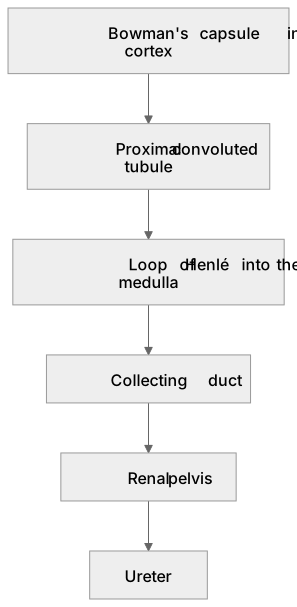
Put it in order
Put these steps in the order they happen.
- 1. Loop of Henlé into the medulla
- 2. Proximal convoluted tubule
- 3. Bowman's capsule in the cortex
- 4. Ureter
- 5. Renal pelvis
- 6. Collecting duct
Key words
Say what each word means before you turn the card.
kidney gross anatomy
Try answering aloud or in your head before turning the card.
nephron structure
Try answering aloud or in your head before turning the card.
Bowman's capsule and ultrafiltration
Try answering aloud or in your head before turning the card.
selective reabsorption in the proximal convoluted tubule
Try answering aloud or in your head before turning the card.
See every definition
- kidney gross anatomy
- The kidney has three gross regions: the outer cortex, the medulla, and the central renal pelvis, which leads into the ureter.
- nephron structure
- A nephron starts at Bowman's capsule in the cortex and continues through the proximal convoluted tubule, the loop of Henlé and the collecting duct.
- Bowman's capsule and ultrafiltration
- A cup-shaped structure surrounding the glomerulus, where high hydrostatic pressure drives ultrafiltration of small molecules into the tubule.
- selective reabsorption in the proximal convoluted tubule
- The process in which all glucose, amino acids and some salts are returned to the blood.
Label the diagram
Some boxes have lost their names. Pick the right name for each number.
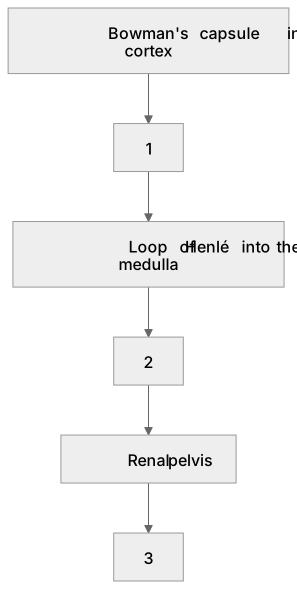
1Box 1
2Box 2
3Box 3
There is more to this lesson
The full lesson goes on to check your understanding and help you earn the marks. Create a free account to carry on, with your progress saved.
A week of Premium from your first lesson · Then the free plan continues · No card, no charge
Test your understanding of Maintaining internal environments: describe the gross structure of the kidney and the structure of the kidney tubule (to include: Bowman’s capsule, proximal convoluted tubule, loop of Henlé and collecting duct) (content found only in the biology separate science qualification)
Active recall beats re-reading. Take an instant quiz now to test what you’ve learned and lock it into long-term memory.
A week of Premium from your first lesson · Then the free plan continues · No card, no charge