OCR · GCSE · Biology
Course version: J247 · Version from Sept 2018
Describe the function of the kidneys in maintaining the water balance of…
Full specification wording
Maintaining internal environments: describe the function of the kidneys in maintaining the water balance of the body (to include: varying the amount and concentration of urine and hence water excreted) (content found only in the biology separate science qualification)
The kidneys are the primary organs of osmoregulation and nitrogenous waste excretion in humans.
- Point 8 of 11
- 4 key terms
Study notes
From the teaching notes for this specification point.
The idea
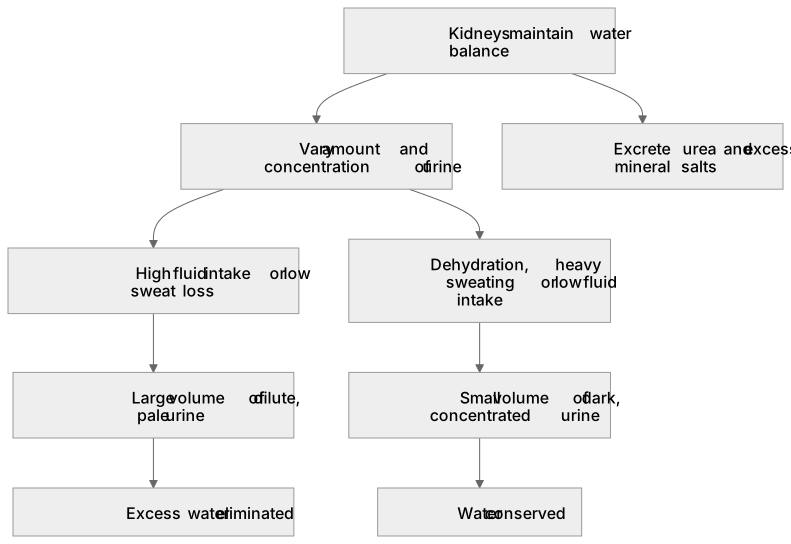
The kidneys are the primary organs of osmoregulation and nitrogenous waste excretion in humans. By adjusting the volume and solute concentration of excreted urine, the kidneys maintain the water potential of blood plasma and tissue fluid within narrow limits. When excess water is consumed, or during periods of low sweat loss, the kidneys respond by reducing water reabsorption along the tubules, producing a large volume of dilute, pale urine to eliminate surplus fluid. Conversely, when the body faces dehydration due to vigorous exercise, heavy sweating, or inadequate fluid intake, the kidneys reabsorb a high proportion of water back into blood capillaries, excreting a small volume of dark, concentrated urine.
What earns the marks
- Describe the role of kidneys in filtering the blood and varying urine volume and concentration to maintain water balance.
- Explain that during dehydration or heavy sweating, the kidneys excrete a small volume of concentrated urine to conserve water.
- Explain that when fluid intake is high, the kidneys excrete a large volume of dilute urine to eliminate excess water.
- State that kidneys excrete nitrogenous metabolic waste, specifically urea, alongside excess mineral salts and water.
Common mistakes and how to put them right
Believing the kidneys produce water, rather than conserving or excreting water obtained from diet and metabolism.
Confusing the volume of urine with its concentration, forgetting that concentrated urine has low volume but high solute content.
Overlooking the dual role of the kidney in both osmoregulation and the excretion of toxic urea.
Exam tips
- Link fluid balance directly to urine characteristics: dehydration leads to small volume and high concentration; overhydration leads to large volume and low concentration.
- Identify urea as the primary nitrogenous waste excreted in urine alongside regulated quantities of water and salts.
Try the lesson
The start of the Maintaining internal environments: describe the function of the kidneys in maintaining the water balance of the body (to include: varying the amount and concentration of urine and hence water excreted) (content found only in the biology separate science qualification) lesson, made from teaching notes for this specification point.
Have a go first
What is the main function of the kidneys in maintaining the water balance of the body?
Listen
The kidneys are the primary organs of osmoregulation and nitrogenous waste excretion in humans. By adjusting the volume and solute concentration of excreted urine, the kidneys maintain the water potential of blood plasma and tissue fluid within narrow limits. When excess water is consumed, or during periods of low sweat loss, the kidneys respond by reducing water reabsorption along the tubules, producing a large volume of dilute, pale urine to eliminate surplus fluid. Conversely, when the body faces dehydration due to vigorous exercise, heavy sweating, or inadequate fluid intake, the kidneys reabsorb a high proportion of water back into blood capillaries, excreting a small volume of dark, concentrated urine. A strong answer earns marks for these points. describe the role of kidneys in filtering the blood and varying urine volume and concentration to maintain water balance. explain that during dehydration or heavy sweating, the kidneys excrete a small volume of concentrated urine to conserve water. explain that when fluid intake is high, the kidneys excrete a large volume of dilute urine to eliminate excess water. state that kidneys excrete nitrogenous metabolic waste, specifically urea, alongside excess mineral salts and water. Exam tip: Link fluid balance directly to urine characteristics: dehydration leads to small volume and high concentration; overhydration leads to large volume and low concentration.
See it
Key words
Say what each word means before you turn the card.
osmoregulation
Try answering aloud or in your head before turning the card.
kidney function
Try answering aloud or in your head before turning the card.
urine volume and concentration
Try answering aloud or in your head before turning the card.
water balance
Try answering aloud or in your head before turning the card.
See every definition
- osmoregulation
- The kidneys are the primary organs of this in humans, maintaining the water potential of blood plasma and tissue fluid within narrow limits.
- kidney function
- Filtering the blood and varying urine volume and concentration to maintain water balance, and excreting nitrogenous metabolic waste, specifically urea, alongside excess mineral salts and water.
- urine volume and concentration
- During dehydration or heavy sweating a small volume of concentrated urine is excreted to conserve water, while high fluid intake produces a large volume of dilute urine to eliminate excess water.
- water balance
- Maintained by the kidneys varying the amount and concentration of urine and hence water excreted, conserving or excreting water obtained from diet and metabolism.
Label the diagram
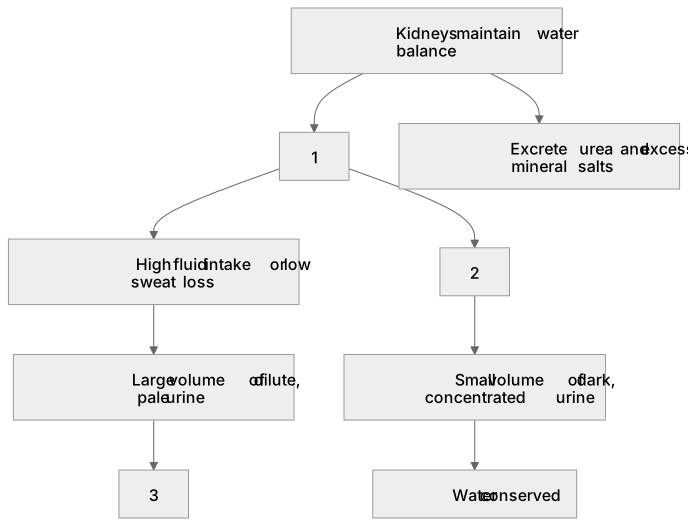
Some boxes have lost their names. Pick the right name for each number.
1Box 1
2Box 2
3Box 3
There is more to this lesson
The full lesson goes on to check your understanding and help you earn the marks. Create a free account to carry on, with your progress saved.
A week of Premium from your first lesson · Then the free plan continues · No card, no charge
Test your understanding of Maintaining internal environments: describe the function of the kidneys in maintaining the water balance of the body (to include: varying the amount and concentration of urine and hence water excreted) (content found only in the biology separate science qualification)
Active recall beats re-reading. Take an instant quiz now to test what you’ve learned and lock it into long-term memory.
A week of Premium from your first lesson · Then the free plan continues · No card, no charge