OCR · GCSE · Biology
Course version: J247 · Version from Sept 2018
Explain the effect on cells of osmotic changes in body fluids (to include:…
Full specification wording
Maintaining internal environments: explain the effect on cells of osmotic changes in body fluids (to include: higher, lower or equal water potentials leading to lysis or shrinking (no mathematical use of water potentials required)) (content found only in the biology separate science qualification)
Animal cells lack a rigid cellulose cell wall and are therefore highly vulnerable to osmotic fluctuations in extracellular fluids.
- Point 7 of 11
- 3 key terms
Study notes
From the teaching notes for this specification point.
The idea
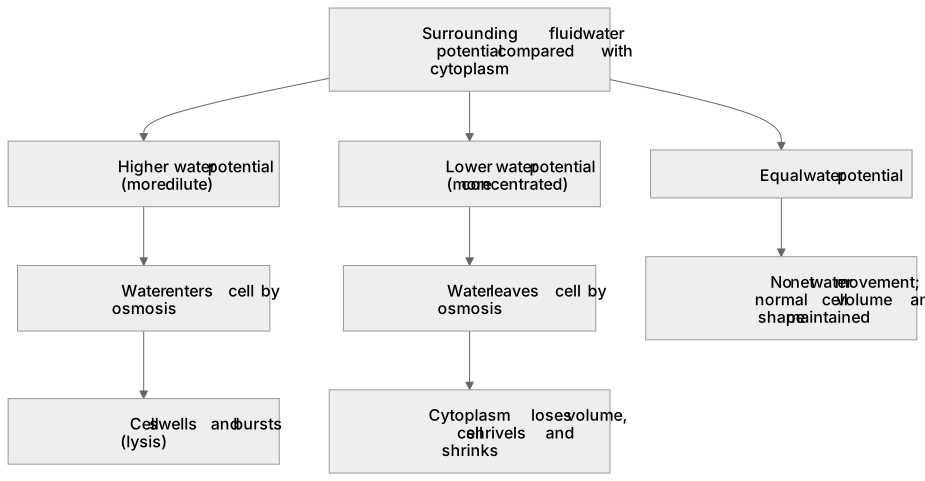
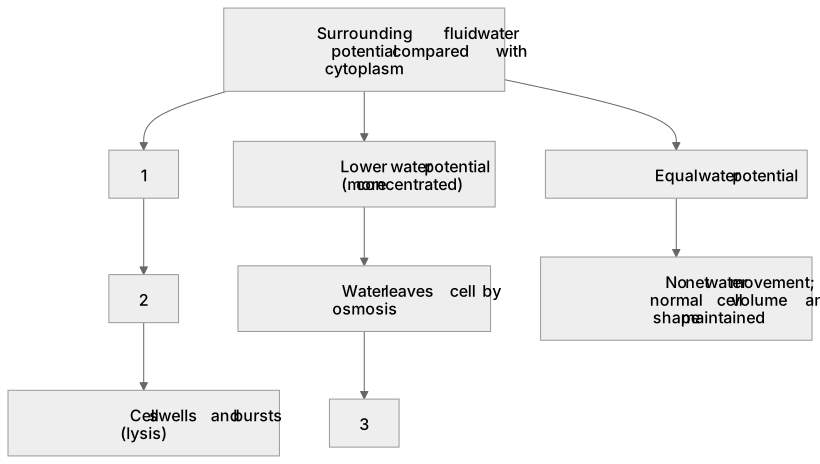
Animal cells lack a rigid cellulose cell wall and are therefore highly vulnerable to osmotic fluctuations in extracellular fluids. Osmosis is the net diffusion of water molecules across a partially permeable membrane down a water potential gradient. If surrounding tissue fluid has a higher water potential (more dilute) than the cytoplasm, water enters the cell by osmosis; the increased internal hydrostatic volume stretches the cell membrane until it bursts, a process termed lysis. Conversely, if extracellular fluid has a lower water potential (more concentrated) than the cytoplasm, water moves out of the cell by osmosis, causing the cytoplasm to lose volume, shrivel, and shrink (crenation). If water potentials are equal, no net movement occurs.
What earns the marks
- Explain that animal cells lack rigid cell walls, making them susceptible to bursting or shrinking from osmotic water movement.
- Describe lysis: in dilute surrounding fluid with higher water potential, water enters by osmosis until the cell swells and bursts.
- Describe shrinking: in concentrated surrounding fluid with lower water potential, water leaves by osmosis, causing the cell to shrivel.
- Explain that equal water potential prevents net water movement, maintaining normal cell volume, shape, and metabolic function.
Common mistakes and how to put them right
Confusing plant cell turgor with animal cell lysis, claiming animal cells become turgid rather than bursting.
Stating that water potential moves rather than water molecules moving down a water potential gradient.
Forgetting that when water potentials are equal, water molecules still diffuse in equal numbers in both directions.
Exam tips
- Always state the direction of net water movement and explain that water moves from higher water potential to lower water potential.
- Use the specific scientific term 'lysis' for animal cells bursting in dilute solution and 'crenation' or 'shrinking' in concentrated solution.
Try the lesson
The start of the Maintaining internal environments: explain the effect on cells of osmotic changes in body fluids (to include: higher, lower or equal water potentials leading to lysis or shrinking (no mathematical use of water potentials required)) (content found only in the biology separate science qualification) lesson, made from teaching notes for this specification point.
Have a go first
A red blood cell is placed in a body fluid with a higher water potential than the cell contents. What happens to the cell?
Listen
Animal cells lack a rigid cellulose cell wall and are therefore highly vulnerable to osmotic fluctuations in extracellular fluids. Osmosis is the net diffusion of water molecules across a partially permeable membrane down a water potential gradient. If surrounding tissue fluid has a higher water potential (more dilute) than the cytoplasm, water enters the cell by osmosis; the increased internal hydrostatic volume stretches the cell membrane until it bursts, a process termed lysis. Conversely, if extracellular fluid has a lower water potential (more concentrated) than the cytoplasm, water moves out of the cell by osmosis, causing the cytoplasm to lose volume, shrivel, and shrink (crenation). If water potentials are equal, no net movement occurs. A strong answer earns marks for these points. explain that animal cells lack rigid cell walls, making them susceptible to bursting or shrinking from osmotic water movement. describe lysis: in dilute surrounding fluid with higher water potential, water enters by osmosis until the cell swells and bursts. describe shrinking: in concentrated surrounding fluid with lower water potential, water leaves by osmosis, causing the cell to shrivel. explain that equal water potential prevents net water movement, maintaining normal cell volume, shape, and metabolic function. Exam tip: Always state the direction of net water movement and explain that water moves from higher water potential to lower water potential.
See it
Key words
Say what each word means before you turn the card.
osmosis
Try answering aloud or in your head before turning the card.
lysis
Try answering aloud or in your head before turning the card.
crenation
Try answering aloud or in your head before turning the card.
See every definition
- osmosis
- The net diffusion of water molecules across a partially permeable membrane down a water potential gradient.
- lysis
- The bursting of an animal cell when water enters by osmosis and the increased internal hydrostatic volume stretches the cell membrane until it bursts.
- crenation
- The shrivelling and shrinking of a cell when water moves out by osmosis and the cytoplasm loses volume.
Label the diagram
Some boxes have lost their names. Pick the right name for each number.
1Box 1
2Box 2
3Box 3
There is more to this lesson
The full lesson goes on to check your understanding and help you earn the marks. Create a free account to carry on, with your progress saved.
A week of Premium from your first lesson · Then the free plan continues · No card, no charge
Test your understanding of Maintaining internal environments: explain the effect on cells of osmotic changes in body fluids (to include: higher, lower or equal water potentials leading to lysis or shrinking (no mathematical use of water potentials required)) (content found only in the biology separate science qualification)
Active recall beats re-reading. Take an instant quiz now to test what you’ve learned and lock it into long-term memory.
A week of Premium from your first lesson · Then the free plan continues · No card, no charge