OCR · GCSE · Biology
Course version: J247 · Version from Sept 2018
Explain the importance of maintaining a constant internal environment in…
Full specification wording
Maintaining internal environments: explain the importance of maintaining a constant internal environment in response to internal and external change (to include: allowing metabolic reactions to proceed at appropriate rates)
Homeostasis is the regulation of internal cellular and tissue fluid conditions to maintain a stable, optimal environment despite fluctuating external conditions.
- Point 2 of 11
- 4 key terms
Study notes
From the teaching notes for this specification point.
The idea
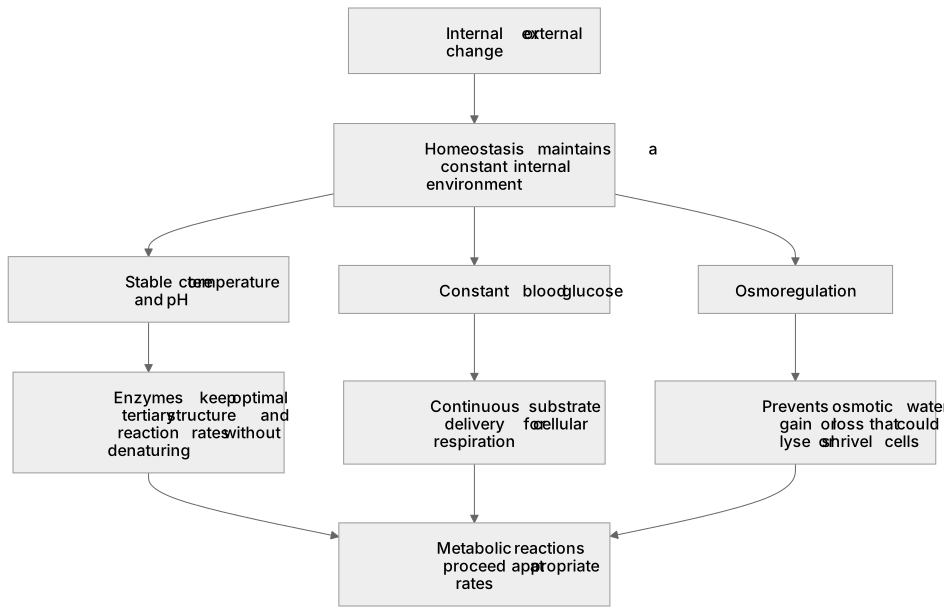
Homeostasis is the regulation of internal cellular and tissue fluid conditions to maintain a stable, optimal environment despite fluctuating external conditions. Internal stability is essential because cellular biochemical pathways depend on enzyme-catalysed reactions. Enzymes require an optimal core temperature (around 37 °C in humans) and optimal pH; deviations can reduce kinetic collisions at low temperatures or denature enzyme active sites at high temperatures, halting respiration and metabolism. Similarly, maintaining blood glucose provides a steady supply of substrate for aerobic cellular respiration while preventing severe osmotic water shifts that could damage or lyse cells.
What earns the marks
- Define homeostasis as the maintenance of a constant, stable internal environment despite external fluctuations.
- Explain that stable core temperature and pH ensure enzymes maintain optimal tertiary structure and reaction rates without denaturing.
- Explain that maintaining constant blood glucose ensures continuous substrate delivery for cellular respiration.
- Describe how osmoregulation prevents excessive osmotic water gain or loss that could lyse or shrivel body cells.
Common mistakes and how to put them right
Stating that homeostasis keeps the external environment constant rather than the internal body environment.
Claiming that high body temperatures kill enzymes rather than stating that enzymes denature due to altered active sites.
Forgetting that internal variables fluctuate within narrow physiological ranges around a set point rather than remaining absolutely fixed.
Exam tips
- Always link homeostatic control of temperature directly to enzyme activity and the prevention of active site denaturation.
- Mention negative feedback as the primary mechanism that brings disturbed internal parameters back to their target set points.
Try the lesson
The start of the Maintaining internal environments: explain the importance of maintaining a constant internal environment in response to internal and external change (to include: allowing metabolic reactions to proceed at appropriate rates) lesson, made from teaching notes for this specification point.
Have a go first
Why is it important that the human body keeps its internal temperature within a narrow range?
Listen
Homeostasis is the regulation of internal cellular and tissue fluid conditions to maintain a stable, optimal environment despite fluctuating external conditions. Internal stability is essential because cellular biochemical pathways depend on enzyme-catalysed reactions. Enzymes require an optimal core temperature (around 37 °C in humans) and optimal pH; deviations can reduce kinetic collisions at low temperatures or denature enzyme active sites at high temperatures, halting respiration and metabolism. Similarly, maintaining blood glucose provides a steady supply of substrate for aerobic cellular respiration while preventing severe osmotic water shifts that could damage or lyse cells. A strong answer earns marks for these points. define homeostasis as the maintenance of a constant, stable internal environment despite external fluctuations. explain that stable core temperature and pH ensure enzymes maintain optimal tertiary structure and reaction rates without denaturing. explain that maintaining constant blood glucose ensures continuous substrate delivery for cellular respiration. describe how osmoregulation prevents excessive osmotic water gain or loss that could lyse or shrivel body cells. Exam tip: Always link homeostatic control of temperature directly to enzyme activity and the prevention of active site denaturation.
See it
Key words
Say what each word means before you turn the card.
homeostasis
Try answering aloud or in your head before turning the card.
enzyme denaturation
Try answering aloud or in your head before turning the card.
metabolic rate
Try answering aloud or in your head before turning the card.
internal environment
Try answering aloud or in your head before turning the card.
See every definition
- homeostasis
- The regulation of internal cellular and tissue fluid conditions to maintain a stable, optimal environment despite fluctuating external conditions.
- enzyme denaturation
- Altered active sites caused by deviations such as high temperatures, which halts respiration and metabolism.
- metabolic rate
- The rate at which metabolic reactions proceed, which depends on enzymes maintaining optimal tertiary structure and reaction rates.
- internal environment
- The internal cellular and tissue fluid conditions that are regulated to remain constant and stable despite external fluctuations.
Label the diagram
Some boxes have lost their names. Pick the right name for each number.
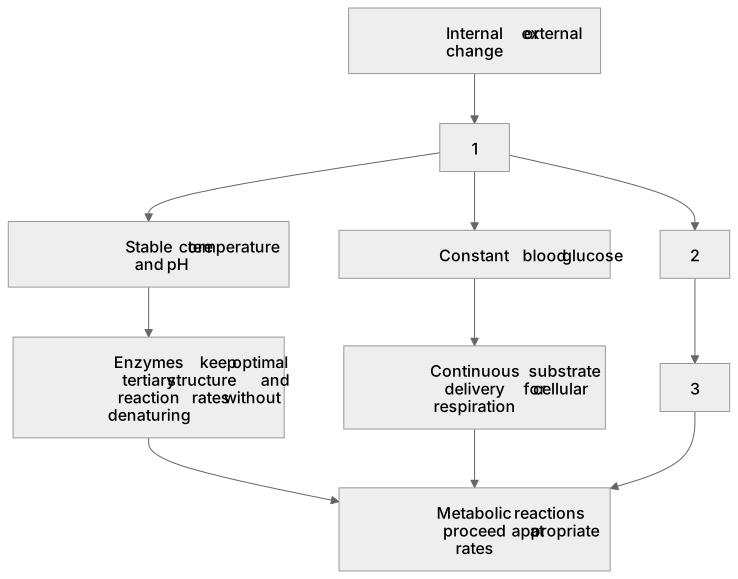
1Box 1
2Box 2
3Box 3
There is more to this lesson
The full lesson goes on to check your understanding and help you earn the marks. Create a free account to carry on, with your progress saved.
A week of Premium from your first lesson · Then the free plan continues · No card, no charge
Test your understanding of Maintaining internal environments: explain the importance of maintaining a constant internal environment in response to internal and external change (to include: allowing metabolic reactions to proceed at appropriate rates)
Active recall beats re-reading. Take an instant quiz now to test what you’ve learned and lock it into long-term memory.
A week of Premium from your first lesson · Then the free plan continues · No card, no charge