OCR · GCSE · Biology
Course version: J247 · Version from Sept 2018
Describe the processes of discovery and development of potential new…
Full specification wording
Monitoring and maintaining health: describe the processes of discovery and development of potential new medicines (to include: preclinical and clinical testing)
Drug development proceeds through structured preclinical and clinical phases to establish safety, efficacy, and dosage.
- Point 22 of 29
- 4 key terms
Study notes
From the teaching notes for this specification point.
The idea
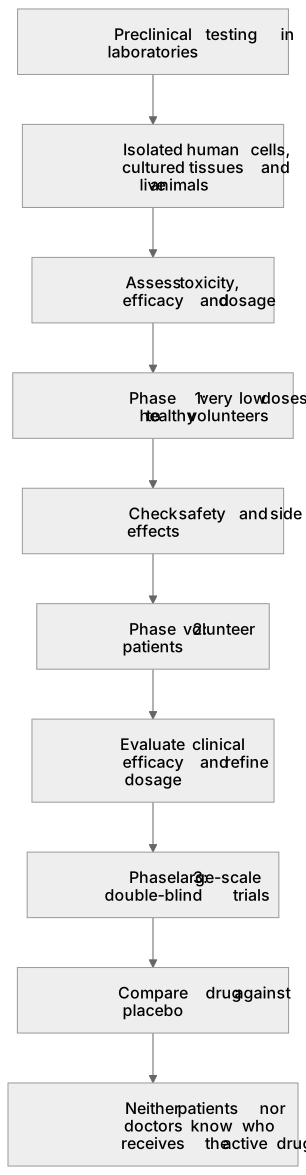
Drug development proceeds through structured preclinical and clinical phases to establish safety, efficacy, and dosage. Preclinical testing takes place in laboratory settings, assessing the chemical on isolated human cells, cultured tissues, and live animals to determine basic efficacy, toxicity, and safe dosage ranges. If cleared, clinical trials commence on humans: Phase 1 administers very low doses to healthy volunteers to check safety and side effects; Phase 2 tests the drug on volunteer patients to evaluate clinical efficacy and refine dosage; Phase 3 conducts large-scale, double-blind trials comparing the drug against a placebo, where neither patients nor doctors know who receives the active drug, eliminating psychological and observer bias.
What earns the marks
- Describe preclinical testing in laboratories using cultured human cells, tissues, and live animals to evaluate toxicity, efficacy, and dosage.
- Describe clinical trials Phase 1 on healthy human volunteers at very low doses to test safety and side effects.
- Describe clinical trials Phase 2 and 3 on patients suffering from the target disease to test efficacy, determine optimum dosage, and monitor rare side effects.
- Explain double-blind placebo-controlled trials, where neither patients nor doctors know who receives the real drug, eliminating bias.
Common mistakes and how to put them right
Thinking Phase 1 clinical trials test whether the drug cures the illness, rather than checking safety on healthy volunteers.
Believing a placebo is a poison, rather than an inert substance (such as a sugar pill) containing no active medicine.
Exam tips
- Clearly distinguish between toxicity (is it harmful?), efficacy (does it work?), and dosage (how much is needed?).
- Explain that double-blind trials eliminate psychological bias from patients (placebo effect) and subjective bias from doctors analysing results.
Try the lesson
The start of the Monitoring and maintaining health: describe the processes of discovery and development of potential new medicines (to include: preclinical and clinical testing) lesson, made from teaching notes for this specification point.
Have a go first
In the development of a potential new medicine, what is tested during the preclinical stage?
Listen
Drug development proceeds through structured preclinical and clinical phases to establish safety, efficacy, and dosage. Preclinical testing takes place in laboratory settings, assessing the chemical on isolated human cells, cultured tissues, and live animals to determine basic efficacy, toxicity, and safe dosage ranges. If cleared, clinical trials commence on humans: Phase 1 administers very low doses to healthy volunteers to check safety and side effects; Phase 2 tests the drug on volunteer patients to evaluate clinical efficacy and refine dosage; Phase 3 conducts large-scale, double-blind trials comparing the drug against a placebo, where neither patients nor doctors know who receives the active drug, eliminating psychological and observer bias. A strong answer earns marks for these points. Describe preclinical testing in laboratories using cultured human cells, tissues, and live animals to evaluate toxicity, efficacy, and dosage. Describe clinical trials Phase 1 on healthy human volunteers at very low doses to test safety and side effects. Describe clinical trials Phase 2 and 3 on patients suffering from the target disease to test efficacy, determine optimum dosage, and monitor rare side effects. Explain double-blind placebo-controlled trials, where neither patients nor doctors know who receives the real drug, eliminating bias. Exam tip: Clearly distinguish between toxicity (is it harmful?), efficacy (does it work?), and dosage (how much is needed?
See it
Key words
Say what each word means before you turn the card.
preclinical testing
Try answering aloud or in your head before turning the card.
clinical human trials
Try answering aloud or in your head before turning the card.
double-blind placebo trials
Try answering aloud or in your head before turning the card.
placebo
Try answering aloud or in your head before turning the card.
See every definition
- preclinical testing
- Takes place in laboratory settings, assessing the chemical on isolated human cells, cultured tissues, and live animals to determine basic efficacy, toxicity, and safe dosage ranges.
- clinical human trials
- Commence on humans if cleared, with Phase 1 administering very low doses to healthy volunteers to check safety and side effects.
- double-blind placebo trials
- Large-scale trials comparing the drug against a placebo, where neither patients nor doctors know who receives the active drug, eliminating psychological and observer bias.
- placebo
- An inert substance containing no active medicine, used in double-blind trials for comparison against the drug.
Label the diagram
Some boxes have lost their names. Pick the right name for each number.
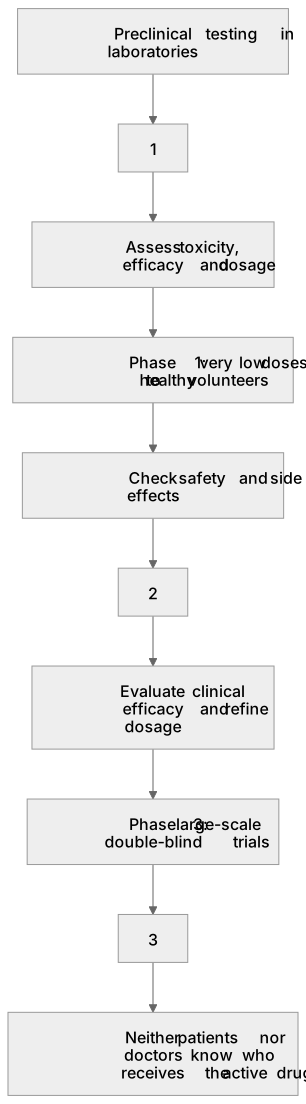
1Box 1
2Box 2
3Box 3
There is more to this lesson
The full lesson goes on to check your understanding and help you earn the marks. Create a free account to carry on, with your progress saved.
A week of Premium from your first lesson · Then the free plan continues · No card, no charge
Test your understanding of Monitoring and maintaining health: describe the processes of discovery and development of potential new medicines (to include: preclinical and clinical testing)
Active recall beats re-reading. Take an instant quiz now to test what you’ve learned and lock it into long-term memory.
A week of Premium from your first lesson · Then the free plan continues · No card, no charge