OCR · GCSE · Biology
Course version: J247 · Version from Sept 2018
Understand the principles of sampling as applied to scientific data
Full specification wording
Monitoring and maintaining health: understand the principles of sampling as applied to scientific data
Sampling principles in clinical trials and epidemiological research ensure that findings are statistically valid, unbiased, and generalisable to human populations.
- Point 3 of 29
- 2 key terms
Study notes
From the teaching notes for this specification point.
The idea
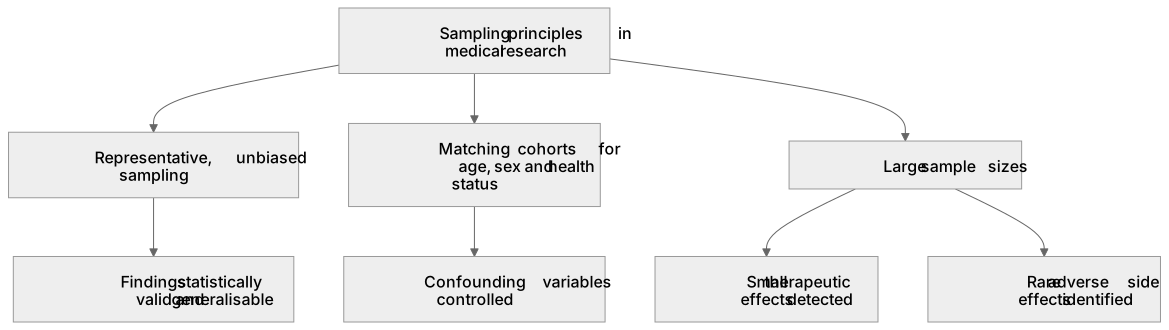
Sampling principles in clinical trials and epidemiological research ensure that findings are statistically valid, unbiased, and generalisable to human populations. Large, randomized sample cohorts eliminate selection bias. In pharmaceutical drug trials, representative patient cohorts matched for age, biological sex, and baseline health conditions are recruited. Sample sizes must be sufficiently large to detect small therapeutic effects, calculate statistical significance, and identify rare adverse side effects that would remain undetected in small test groups.
What earns the marks
- Explain the necessity of representative, unbiased sampling in clinical trials and public health studies.
- Describe how matching patient cohorts for age, sex, and health status eliminates confounding variables.
- Explain why large sample sizes are required to identify rare adverse drug reactions and verify efficacy.
Common mistakes and how to put them right
Assuming a small clinical trial with ten volunteers provides sufficient evidence to license a new drug.
Overlooking confounding variables like diet, smoking, or age when selecting participant sample groups.
Exam tips
- State that large sample sizes reduce the effect of individual anomalies and allow rare side effects to be discovered.
- Always mention matching control groups for age, sex, and lifestyle to ensure a fair comparison.
Try the lesson
The start of the Monitoring and maintaining health: understand the principles of sampling as applied to scientific data lesson, made from teaching notes for this specification point.
Have a go first
Why do scientists take a sample rather than measure every individual in a large population?
Listen
Sampling principles in clinical trials and epidemiological research ensure that findings are statistically valid, unbiased, and generalisable to human populations. Large, randomized sample cohorts eliminate selection bias. In pharmaceutical drug trials, representative patient cohorts matched for age, biological sex, and baseline health conditions are recruited. Sample sizes must be sufficiently large to detect small therapeutic effects, calculate statistical significance, and identify rare adverse side effects that would remain undetected in small test groups. A strong answer earns marks for these points. Explain the necessity of representative, unbiased sampling in clinical trials and public health studies. Describe how matching patient cohorts for age, sex, and health status eliminates confounding variables. Explain why large sample sizes are required to identify rare adverse drug reactions and verify efficacy. Exam tip: State that large sample sizes reduce the effect of individual anomalies and allow rare side effects to be discovered.
See it
Key words
Say what each word means before you turn the card.
representative sampling
Try answering aloud or in your head before turning the card.
confounding variables
Try answering aloud or in your head before turning the card.
See every definition
- representative sampling
- Recruiting patient cohorts matched for age, biological sex, and baseline health conditions so findings are unbiased and generalisable to human populations.
- confounding variables
- Factors such as diet, smoking, or age that must be controlled by matching patient cohorts for age, sex, and health status.
Label the diagram
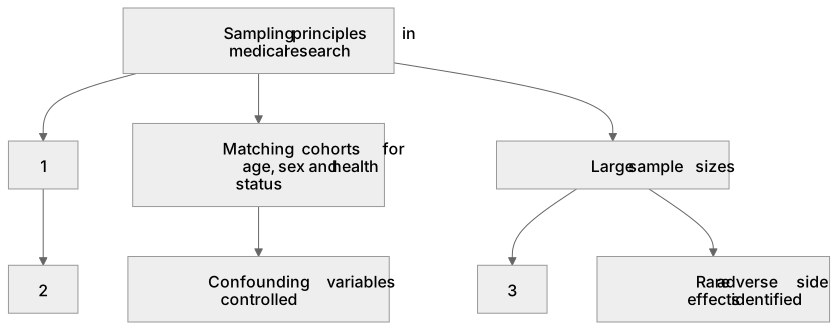
Some boxes have lost their names. Pick the right name for each number.
1Box 1
2Box 2
3Box 3
There is more to this lesson
The full lesson goes on to check your understanding and help you earn the marks. Create a free account to carry on, with your progress saved.
A week of Premium from your first lesson · Then the free plan continues · No card, no charge
Test your understanding of Monitoring and maintaining health: understand the principles of sampling as applied to scientific data
Active recall beats re-reading. Take an instant quiz now to test what you’ve learned and lock it into long-term memory.
A week of Premium from your first lesson · Then the free plan continues · No card, no charge