OCR · GCSE · Biology
Course version: J247 · Version from Sept 2018
Explain some of the benefits and challenges of maintaining local and…
Full specification wording
Monitoring and maintaining the environment: explain some of the benefits and challenges of maintaining local and global biodiversity (to include: the difficulty in gaining agreements for and the monitoring of conservation schemes along with the benefits of ecotourism)
Maintaining biodiversity confers ecological stability, preserves future pharmaceutical resources, and safeguards wild crop relatives.
- Point 8 of 9
- 3 key terms
Study notes
From the teaching notes for this specification point.
The idea
Maintaining biodiversity confers ecological stability, preserves future pharmaceutical resources, and safeguards wild crop relatives. Ecotourism generates valuable revenue for local communities, providing strong financial incentives to protect pristine habitats rather than exploiting them for agriculture or logging. However, major socioeconomic challenges impede conservation. Securing international agreements (such as fishing quotas or greenhouse emission limits) requires complex political consensus between developing and developed nations. Furthermore, monitoring remote habitats is technically demanding and costly, and conservation goals often conflict with local farming needs.
What earns the marks
- Explain the ecological and medical benefits of high biodiversity, including ecosystem resilience and future drug discoveries.
- Describe how ecotourism provides economic income for indigenous communities, incentivising habitat preservation.
- Explain challenges in conservation, including international disagreements, high financial costs, and difficulties monitoring remote areas.
- Explain conflicts of interest between local agricultural livelihoods and legal wildlife conservation schemes.
Common mistakes and how to put them right
Viewing ecotourism solely as leisure travel, ignoring its role in funding local conservation and infrastructure.
Assuming international environmental treaties are simple to enforce, overlooking the lack of policing in international waters or remote forests.
Exam tips
- Balance your response by discussing both economic benefits (ecotourism revenue, medical discoveries) and practical challenges (monitoring costs, political treaties).
- Mention conflicts of interest between farmers needing land to feed families and governments trying to preserve protected habitats.
Try the lesson
The start of the Monitoring and maintaining the environment: explain some of the benefits and challenges of maintaining local and global biodiversity (to include: the difficulty in gaining agreements for and the monitoring of conservation schemes along with the benefits of ecotourism) lesson, made from teaching notes for this specification point.
Have a go first
Which of these is a benefit of ecotourism for maintaining biodiversity?
Listen
Maintaining biodiversity confers ecological stability, preserves future pharmaceutical resources, and safeguards wild crop relatives. Ecotourism generates valuable revenue for local communities, providing strong financial incentives to protect pristine habitats rather than exploiting them for agriculture or logging. However, major socioeconomic challenges impede conservation. Securing international agreements (such as fishing quotas or greenhouse emission limits) requires complex political consensus between developing and developed nations. Furthermore, monitoring remote habitats is technically demanding and costly, and conservation goals often conflict with local farming needs. A strong answer earns marks for these points. Explain the ecological and medical benefits of high biodiversity, including ecosystem resilience and future drug discoveries. Describe how ecotourism provides economic income for indigenous communities, incentivising habitat preservation. Explain challenges in conservation, including international disagreements, high financial costs, and difficulties monitoring remote areas. Explain conflicts of interest between local agricultural livelihoods and legal wildlife conservation schemes. Exam tip: Balance your response by discussing both economic benefits (ecotourism revenue, medical discoveries) and practical challenges (monitoring costs, political treaties).
See it

Key words
Say what each word means before you turn the card.
ecotourism
Try answering aloud or in your head before turning the card.
international conservation agreements
Try answering aloud or in your head before turning the card.
socioeconomic conflicts
Try answering aloud or in your head before turning the card.
See every definition
- ecotourism
- Generates valuable revenue for local communities, providing strong financial incentives to protect pristine habitats rather than exploiting them for agriculture or logging.
- international conservation agreements
- Securing these requires complex political consensus between developing and developed nations, and they are difficult to gain and monitor.
- socioeconomic conflicts
- Conservation goals often conflict with local farming needs, and major socioeconomic challenges impede conservation.
Label the diagram
Some boxes have lost their names. Pick the right name for each number.
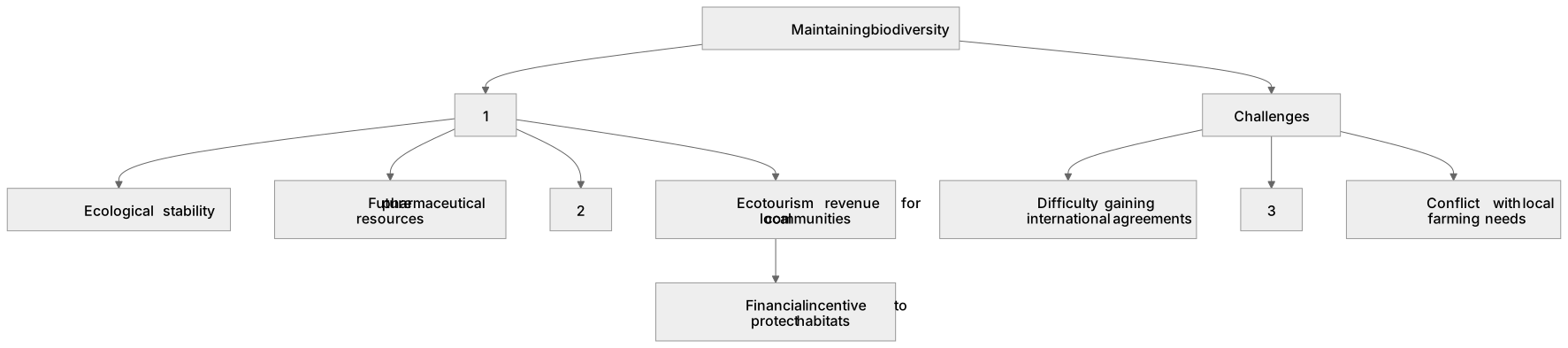
1Box 1
2Box 2
3Box 3
There is more to this lesson
The full lesson goes on to check your understanding and help you earn the marks. Create a free account to carry on, with your progress saved.
A week of Premium from your first lesson · Then the free plan continues · No card, no charge
Test your understanding of Monitoring and maintaining the environment: explain some of the benefits and challenges of maintaining local and global biodiversity (to include: the difficulty in gaining agreements for and the monitoring of conservation schemes along with the benefits of ecotourism)
Active recall beats re-reading. Take an instant quiz now to test what you’ve learned and lock it into long-term memory.
A week of Premium from your first lesson · Then the free plan continues · No card, no charge