OCR · GCSE · Biology
Course version: J247 · Version from Sept 2018
Explain how evolution occurs through the natural selection of variants…
Full specification wording
Natural selection and evolution: explain how evolution occurs through the natural selection of variants that have given rise to phenotypes best suited to their environment (to include: the concept of mutation)
Natural selection is the primary driving mechanism of evolution, functioning through a clear sequence of biological events.
- Point 3 of 6
- 3 key terms
Study notes
From the teaching notes for this specification point.
The idea
Natural selection is the primary driving mechanism of evolution, functioning through a clear sequence of biological events. Within any population, spontaneous random mutations generate genetic variants that produce diverse phenotypes. Organisms produce more offspring than the environment can support, creating competition for limited resources such as food, mates, and territory, alongside predation and disease pressures. Individuals possessing phenotypic characteristics best suited to their environment enjoy higher survival rates and reproductive success. Consequently, these individuals pass their advantageous alleles to their offspring, increasing allele frequency over time.
What earns the marks
- State that spontaneous mutations produce genetic variants leading to phenotypic variation within a population.
- Explain that environmental pressures create competition, so individuals with advantageous phenotypes are more likely to survive and reproduce.
- Explain that surviving individuals pass on their beneficial alleles to their offspring, increasing the allele frequency across generations.
Common mistakes and how to put them right
Using Lamarckian phrasing, claiming organisms adapt or mutate deliberately because they need to survive.
Stating that the organism survives rather than emphasizing that it reproduces and passes on alleles.
Exam tips
- Always follow the standard four-step structure: mutation causes variation, selective pressure creates competition, advantageous phenotypes survive and reproduce, beneficial alleles are passed on.
- Never say an animal changes its genes during its lifetime to suit its environment.
Try the lesson
The start of the Natural selection and evolution: explain how evolution occurs through the natural selection of variants that have given rise to phenotypes best suited to their environment (to include: the concept of mutation) lesson, made from teaching notes for this specification point.
Have a go first
Which process produces new alleles that can give rise to variants in a population?
Listen
Natural selection is the primary driving mechanism of evolution, functioning through a clear sequence of biological events. Within any population, spontaneous random mutations generate genetic variants that produce diverse phenotypes. Organisms produce more offspring than the environment can support, creating competition for limited resources such as food, mates, and territory, alongside predation and disease pressures. Individuals possessing phenotypic characteristics best suited to their environment enjoy higher survival rates and reproductive success. Consequently, these individuals pass their advantageous alleles to their offspring, increasing allele frequency over time. A strong answer earns marks for these points. State that spontaneous mutations produce genetic variants leading to phenotypic variation within a population. Explain that environmental pressures create competition, so individuals with advantageous phenotypes are more likely to survive and reproduce. Explain that surviving individuals pass on their beneficial alleles to their offspring, increasing the allele frequency across generations. Exam tip: Always follow the standard four-step structure: mutation causes variation, selective pressure creates competition, advantageous phenotypes survive and reproduce, beneficial alleles are passed on.
See it
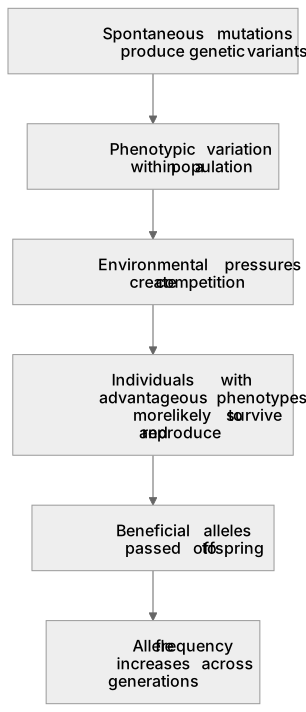
Put it in order
Put these steps in the order they happen.
- 1. Environmental pressures create competition
- 2. Phenotypic variation within a population
- 3. Spontaneous mutations produce genetic variants
- 4. Allele frequency increases across generations
- 5. Beneficial alleles passed to offspring
- 6. Individuals with advantageous phenotypes more likely to survive and reproduce
Key words
Say what each word means before you turn the card.
natural selection
Try answering aloud or in your head before turning the card.
differential survival
Try answering aloud or in your head before turning the card.
allele frequency
Try answering aloud or in your head before turning the card.
See every definition
- natural selection
- The primary driving mechanism of evolution, functioning through a clear sequence of biological events within any population.
- differential survival
- Higher survival rates and reproductive success enjoyed by individuals possessing phenotypic characteristics best suited to their environment.
- allele frequency
- A measure that increases over time as surviving individuals pass their advantageous alleles to their offspring.
Label the diagram
Some boxes have lost their names. Pick the right name for each number.
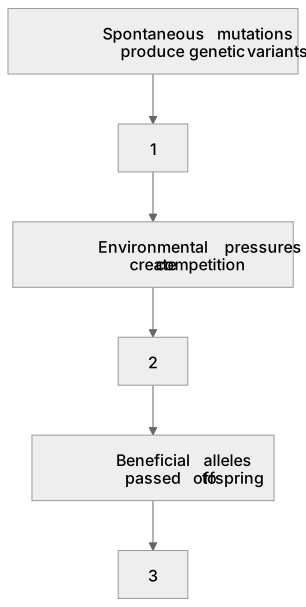
1Box 1
2Box 2
3Box 3
There is more to this lesson
The full lesson goes on to check your understanding and help you earn the marks. Create a free account to carry on, with your progress saved.
A week of Premium from your first lesson · Then the free plan continues · No card, no charge
Test your understanding of Natural selection and evolution: explain how evolution occurs through the natural selection of variants that have given rise to phenotypes best suited to their environment (to include: the concept of mutation)
Active recall beats re-reading. Take an instant quiz now to test what you’ve learned and lock it into long-term memory.
A week of Premium from your first lesson · Then the free plan continues · No card, no charge