OCR · GCSE · Biology
Course version: J247 · Version from Sept 2018
Measurement of rates of reaction by a variety of methods including…
Full specification wording
Photosynthesis: Measurement of rates of reaction by a variety of methods including production of gas, uptake of water and colour change of indicator
Photosynthetic rates can be quantified using bubble counting, volumetric gas collection, water uptake, or indicator colorimetry.
- Point 14 of 15
- 4 key terms
Study notes
From the teaching notes for this specification point.
The idea
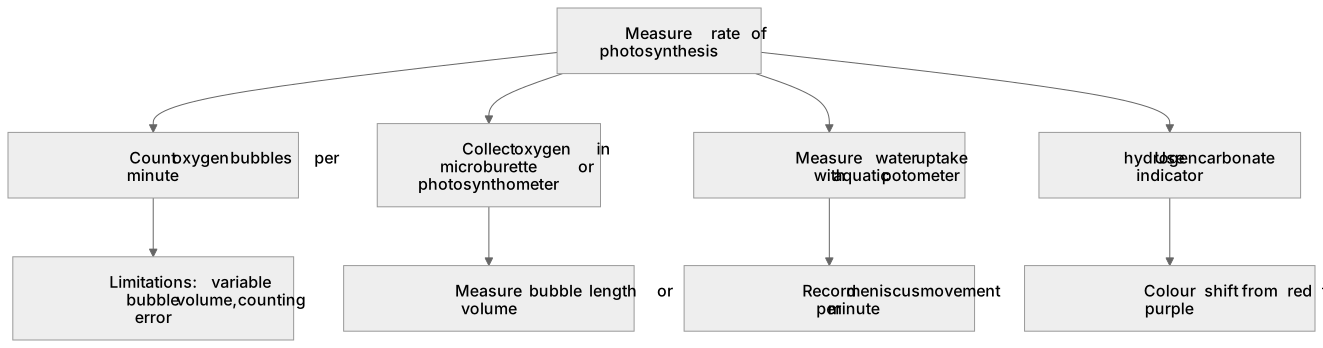
Photosynthetic rates can be quantified using bubble counting, volumetric gas collection, water uptake, or indicator colorimetry. Counting bubbles released per minute from pondweed is simple but error-prone because bubble volume varies and rapid bubbling is hard to count accurately. A photosynthometer or inverted microburette collects oxygen into a capillary tube, where the length of the gas bubble is measured with a millimetre ruler or syringe to calculate exact volume. Uptake of water can be measured with an aquatic potometer: as photosynthesis proceeds, water is drawn along a capillary and the meniscus movement per minute is recorded as a rate. Alternatively, hydrogencarbonate indicator enclosing pondweed or immobilised algae balls changes from red to purple as carbon dioxide is absorbed, providing a colorimetric measure of photosynthetic rate.
What earns the marks
- Count oxygen bubbles produced per minute as a direct, simple measure of photosynthetic rate.
- Collect oxygen gas in a microburette or capillary photosynthometer and measure bubble length or volume to improve measurement accuracy.
- Measure uptake of water using an aquatic potometer, recording meniscus movement per minute as a rate of photosynthesis.
- Use hydrogencarbonate indicator to monitor carbon dioxide consumption, tracking colour shift from red (neutral) to purple (alkaline).
- Compare the limitations of bubble counting (variable bubble volume, human counting error) against volumetric gas measurement and potometry.
Common mistakes and how to put them right
Assuming all bubbles produced by pondweed are equal in volume, leading to inaccurate rate estimations.
Believing bubbles released by pondweed consist purely of oxygen, forgetting they contain dissolved nitrogen and air from intercellular spaces.
Failing to seal capillary apparatus, photosynthometers, or potometers, allowing gas or water leaks that lead to underestimated volumes or meniscus movement.
Confusing the direction of meniscus movement in a potometer with gas production, rather than treating it as a measure of water uptake.
Exam tips
- In evaluation questions, explain that a photosynthometer or gas syringe is superior to bubble counting because it measures actual volume.
- Remember the colour shifts of hydrogencarbonate indicator: yellow in high CO2 (respiration), red at atmospheric CO2, and purple in low CO2 (photosynthesis).
Try the lesson
The start of the Photosynthesis: Measurement of rates of reaction by a variety of methods including production of gas, uptake of water and colour change of indicator lesson, made from teaching notes for this specification point.
Have a go first
In a pondweed photosynthesis experiment, which observation shows that oxygen gas is being produced?
Listen
Photosynthetic rates can be quantified using bubble counting, volumetric gas collection, water uptake, or indicator colorimetry. Counting bubbles released per minute from pondweed is simple but error-prone because bubble volume varies and rapid bubbling is hard to count accurately. A photosynthometer or inverted microburette collects oxygen into a capillary tube, where the length of the gas bubble is measured with a millimetre ruler or syringe to calculate exact volume. Uptake of water can be measured with an aquatic potometer: as photosynthesis proceeds, water is drawn along a capillary and the meniscus movement per minute is recorded as a rate. Alternatively, hydrogencarbonate indicator enclosing pondweed or immobilised algae balls changes from red to purple as carbon dioxide is absorbed, providing a colorimetric measure of photosynthetic rate. A strong answer earns marks for these points. Count oxygen bubbles produced per minute as a direct, simple measure of photosynthetic rate. Collect oxygen gas in a microburette or capillary photosynthometer and measure bubble length or volume to improve measurement accuracy. Measure uptake of water using an aquatic potometer, recording meniscus movement per minute as a rate of photosynthesis. Use hydrogencarbonate indicator to monitor carbon dioxide consumption, tracking colour shift from red (neutral) to purple (alkaline). Exam tip: In evaluation questions, explain that a photosynthometer or gas syringe is superior to bubble counting because it measures actual volume.
See it
Key words
Say what each word means before you turn the card.
bubble counting
Try answering aloud or in your head before turning the card.
volumetric photosynthometer measurement
Try answering aloud or in your head before turning the card.
water uptake potometry
Try answering aloud or in your head before turning the card.
hydrogencarbonate indicator colorimetry
Try answering aloud or in your head before turning the card.
See every definition
- bubble counting
- Counting bubbles released per minute from pondweed as a direct, simple measure of photosynthetic rate, though bubble volume varies and rapid bubbling is hard to count accurately.
- volumetric photosynthometer measurement
- Collecting oxygen gas in a microburette or capillary photosynthometer and measuring bubble length or volume to improve measurement accuracy.
- water uptake potometry
- Measuring uptake of water using an aquatic potometer, recording meniscus movement per minute as a rate of photosynthesis.
- hydrogencarbonate indicator colorimetry
- Using hydrogencarbonate indicator enclosing pondweed or immobilised algae balls, which changes from red to purple as carbon dioxide is absorbed, providing a colorimetric measure of photosynthetic rate.
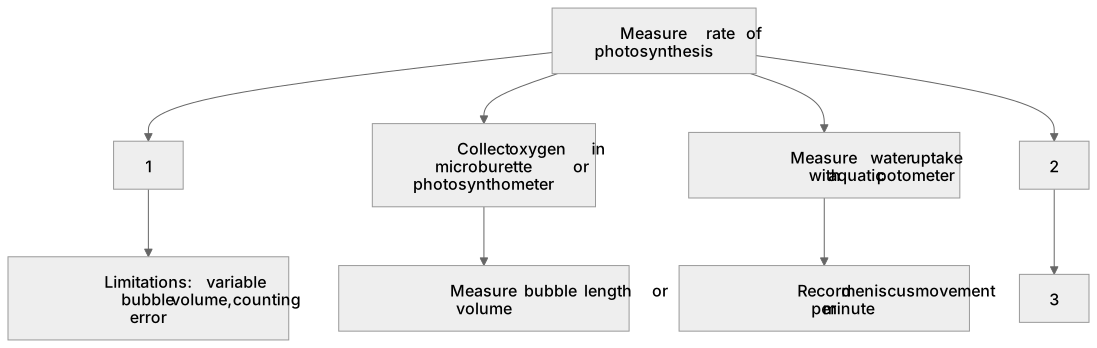
Label the diagram
Some boxes have lost their names. Pick the right name for each number.
1Box 1
2Box 2
3Box 3
There is more to this lesson
The full lesson goes on to check your understanding and help you earn the marks. Create a free account to carry on, with your progress saved.
A week of Premium from your first lesson · Then the free plan continues · No card, no charge
Test your understanding of Photosynthesis: Measurement of rates of reaction by a variety of methods including production of gas, uptake of water and colour change of indicator
Active recall beats re-reading. Take an instant quiz now to test what you’ve learned and lock it into long-term memory.
A week of Premium from your first lesson · Then the free plan continues · No card, no charge