AQA · A-Level · Business
Course version: 7132 · Version from Sept 2023
Overall performance: The importance of core competences
Full specification wording
Analysing the existing internal position of a business to assess strengths and weaknesses: overall performance: The importance of core competences
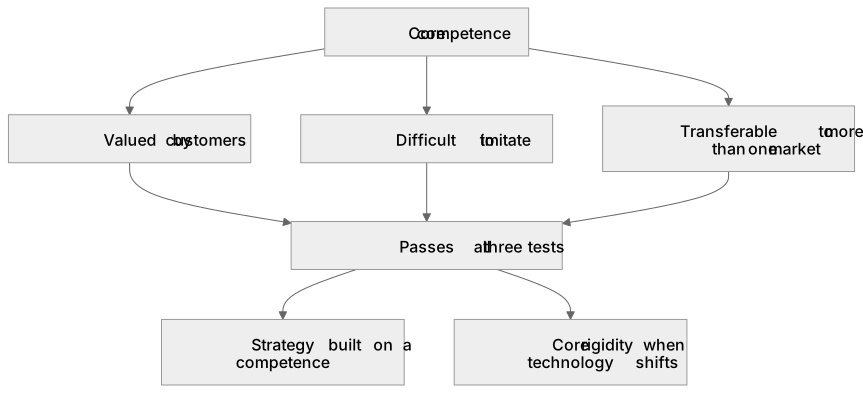
A core competence is something the firm does distinctively well that customers value, that rivals find hard to copy, and that can be carried into more than one market, which is the three part test…
- Point 2 of 4
- 3 key terms
Study notes
From the teaching notes for this specification point.
The idea
A core competence is something the firm does distinctively well that customers value, that rivals find hard to copy, and that can be carried into more than one market, which is the three part test Hamel and Prahalad set. It is used to decide where to compete and what to outsource: strategy built on a competence tends to hold, strategy built on a temporary price advantage does not. Dyson's motor and airflow engineering moved from vacuum cleaners into hand dryers and hair care, which is the third test passing in public. The trade-off is rigidity. The same capability that opened one market becomes a core rigidity when technology shifts, and the firms most invested in it are the slowest to let it go, so evaluation usually turns on whether the strength named in the case really passes all three tests or is simply a strength.
What earns the marks
- Applying the three tests by name, so the competence is shown to be valued by customers, difficult to imitate and transferable to other markets, rather than just asserted.
- Naming the specific capability in the case study, such as a patented process or a distribution network, instead of writing that the business is good at customer service.
- Connecting the competence to the decision in hand, for instance a differentiation strategy that supports a price premium and a wider gross margin.
- Recognising durability as the issue, since a competence that rivals copy within two years cannot carry a ten year strategy.
Common mistakes and how to put them right
Treating any strength as a core competence, so a good location or a pleasant brand is offered with no test of imitability.
Describing the competence at length and never linking it to the strategic choice, which leaves the answer stuck at knowledge and application.
Assuming the competence lasts forever, so an evaluation question gets no counter-argument and no judgement.
Exam tips
- Core competences are almost always examined inside a bigger question on strengths, on diversification or on whether to outsource, so use the idea as a reason rather than as a topic in itself.
- In a long evaluation, a short paragraph on how quickly a rival could imitate the competence earns more than another paragraph describing it.
Try the lesson
The start of the Analysing the existing internal position of a business to assess strengths and weaknesses: overall performance: The importance of core competences lesson, made from teaching notes for this specification point.
Have a go first
What is meant by a core competence of a business?
Listen
A core competence is something the firm does distinctively well that customers value, that rivals find hard to copy, and that can be carried into more than one market, which is the three part test Hamel and Prahalad set. It is used to decide where to compete and what to outsource: strategy built on a competence tends to hold, strategy built on a temporary price advantage does not. Dyson's motor and airflow engineering moved from vacuum cleaners into hand dryers and hair care, which is the third test passing in public. The trade-off is rigidity. The same capability that opened one market becomes a core rigidity when technology shifts, and the firms most invested in it are the slowest to let it go, so evaluation usually turns on whether the strength named in the case really passes all three tests or is simply a strength. A strong answer earns marks for these points. Applying the three tests by name, so the competence is shown to be valued by customers, difficult to imitate and transferable to other markets, rather than just asserted. Naming the specific capability in the case study, such as a patented process or a distribution network, instead of writing that the business is good at customer service. Connecting the competence to the decision in hand, for instance a differentiation strategy that supports a price premium and a wider gross margin. Recognising durability as the issue, since a competence that rivals copy within two years cannot carry a ten year strategy. Exam tip: Core competences are almost always examined inside a bigger question on strengths, on diversification or on whether to outsource, so use the idea as a reason rather than as a topic in itself.
See it
Key words
Say what each word means before you turn the card.
core competence
Try answering aloud or in your head before turning the card.
core rigidity
Try answering aloud or in your head before turning the card.
durability
Try answering aloud or in your head before turning the card.
See every definition
- core competence
- Something the firm does distinctively well that customers value, that rivals find hard to copy, and that can be carried into more than one market.
- core rigidity
- The same capability that opened one market becomes a core rigidity when technology shifts, and the firms most invested in it are the slowest to let it go.
- durability
- The issue that a competence rivals copy within two years cannot carry a ten year strategy.
Label the diagram
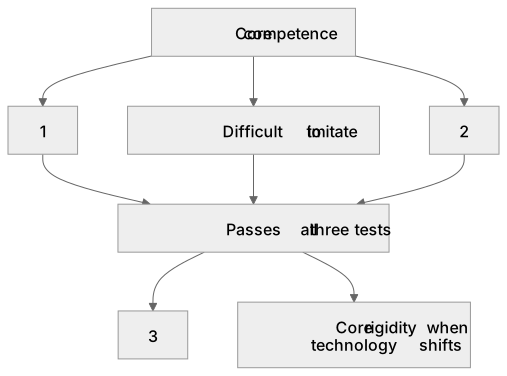
Some boxes have lost their names. Pick the right name for each number.
1Box 1
2Box 2
3Box 3
There is more to this lesson
The full lesson goes on to check your understanding and help you earn the marks. Create a free account to carry on, with your progress saved.
A week of Premium from your first lesson · Then the free plan continues · No card, no charge
Test your understanding of Analysing the existing internal position of a business to assess strengths and weaknesses: overall performance: The importance of core competences
Active recall beats re-reading. Take an instant quiz now to test what you’ve learned and lock it into long-term memory.
A week of Premium from your first lesson · Then the free plan continues · No card, no charge