AQA · A-Level · Business
Course version: 7132 · Version from Sept 2023
Social and technological: The impact of the social and technological…
Full specification wording
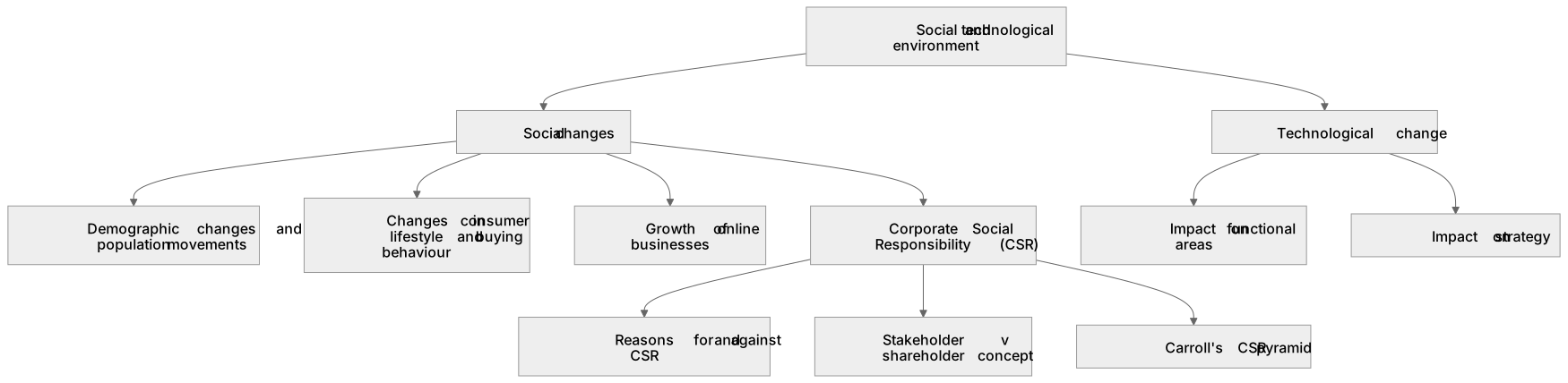
Analysing the external environment to assess opportunities and threats: social and technological: The impact of the social and technological environment on strategic and functional decision making (to include: Social changes to include demographic changes and population movements such as: migration, changes in consumer lifestyle and buying behaviour, the growth of online businesses. The social environment to include Corporate Social Responsibility (CSR) and: the reasons for and against (CSR), the difference between the stakeholder v shareholder concept, Carroll’s Corporate Social Responsibility pyramid. Technological change should include the impact of technological change on functional areas and strategy.)
Social and technological shifts create strategic opportunities and threats.
- Point 1 of 2
- 3 key terms
Study notes
From the teaching notes for this specification point.
The idea
Social and technological shifts create strategic opportunities and threats. Social trends like an ageing population or migration alter both labour supply and consumer demand. Changing lifestyles and the growth of online businesses force firms to adapt their marketing and distribution strategies. Corporate Social Responsibility (CSR) involves balancing commercial objectives with ethical ones. Arguments for CSR include enhanced brand reputation and employee morale. Arguments against focus on the increased costs and potential conflict with the shareholder concept, which prioritises profit. Carroll's pyramid ranks responsibilities: economic, legal, ethical, philanthropic. Technological change impacts all functions and shapes strategy; for example, automation can be central to a cost leadership strategy, while data analytics can drive market development.
What earns the marks
- Linking a specific demographic or lifestyle change from the case to a quantifiable impact on a firm's sales or workforce planning.
- Weighing the arguments for and against a specific CSR action, considering both the potential brand benefits and the financial costs to shareholders.
- Applying Carroll's pyramid correctly to a business scenario, explaining which level of responsibility a particular action meets.
- Explaining how a specific technological change not only improves functional efficiency (e.g., marketing) but also supports a wider corporate strategy (e.g., differentiation).
Common mistakes and how to put them right
Discussing CSR only in terms of its benefits (e.g., good publicity) while ignoring the direct costs and the potential conflict with profit maximisation for shareholders.
Misinterpreting Carroll's pyramid by placing philanthropic or ethical duties before the fundamental economic and legal responsibilities.
Describing a new technology as 'modern' without explaining its specific impact on costs, productivity, or the firm's competitive strategy.
Exam tips
- Use social and technological factors as the context to justify a strategic recommendation, rather than discussing them in isolation.
- If a case provides financial data for a technological investment (e.g., cost and annual savings), calculate the payback period to support your judgement on its viability.
Try the lesson
The start of the Analysing the external environment to assess opportunities and threats: social and technological: The impact of the social and technological environment on strategic and functional decision making (to include: Social changes to include demographic changes and population movements such as: migration, changes in consumer lifestyle and buying behaviour, the growth of online businesses. The social environment to include Corporate Social Responsibility (CSR) and: the reasons for and against (CSR), the difference between the stakeholder v shareholder concept, Carroll’s Corporate Social Responsibility pyramid. Technological change should include the impact of technological change on functional areas and strategy.) lesson, made from teaching notes for this specification point.
Have a go first
Which of the following best describes the shareholder concept of a business?
Listen
Social and technological shifts create strategic opportunities and threats. Social trends like an ageing population or migration alter both labour supply and consumer demand. Changing lifestyles and the growth of online businesses force firms to adapt their marketing and distribution strategies. Corporate Social Responsibility (CSR) involves balancing commercial objectives with ethical ones. Arguments for CSR include enhanced brand reputation and employee morale. Arguments against focus on the increased costs and potential conflict with the shareholder concept, which prioritises profit. Carroll's pyramid ranks responsibilities: economic, legal, ethical, philanthropic. Technological change impacts all functions and shapes strategy; for example, automation can be central to a cost leadership strategy, while data analytics can drive market development. A strong answer earns marks for these points. Linking a specific demographic or lifestyle change from the case to a quantifiable impact on a firm's sales or workforce planning. Weighing the arguments for and against a specific CSR action, considering both the potential brand benefits and the financial costs to shareholders. Applying Carroll's pyramid correctly to a business scenario, explaining which level of responsibility a particular action meets. Explaining how a specific technological change not only improves functional efficiency (e.g., marketing) but also supports a wider corporate strategy (e.g., differentiation). Exam tip: Use social and technological factors as the context to justify a strategic recommendation, rather than discussing them in isolation.
See it
Key words
Say what each word means before you turn the card.
Corporate Social Responsibility (CSR)
Try answering aloud or in your head before turning the card.
Shareholder vs stakeholder concepts
Try answering aloud or in your head before turning the card.
Carroll's Corporate Social Responsibility pyramid
Try answering aloud or in your head before turning the card.
See every definition
- Corporate Social Responsibility (CSR)
- Balancing commercial objectives with ethical ones, with reasons for and against it considered in the social environment.
- Shareholder vs stakeholder concepts
- The difference between the shareholder concept, which prioritises profit, and the stakeholder concept.
- Carroll's Corporate Social Responsibility pyramid
- Ranks responsibilities as economic, legal, ethical and philanthropic.
Label the diagram
Some boxes have lost their names. Pick the right name for each number.
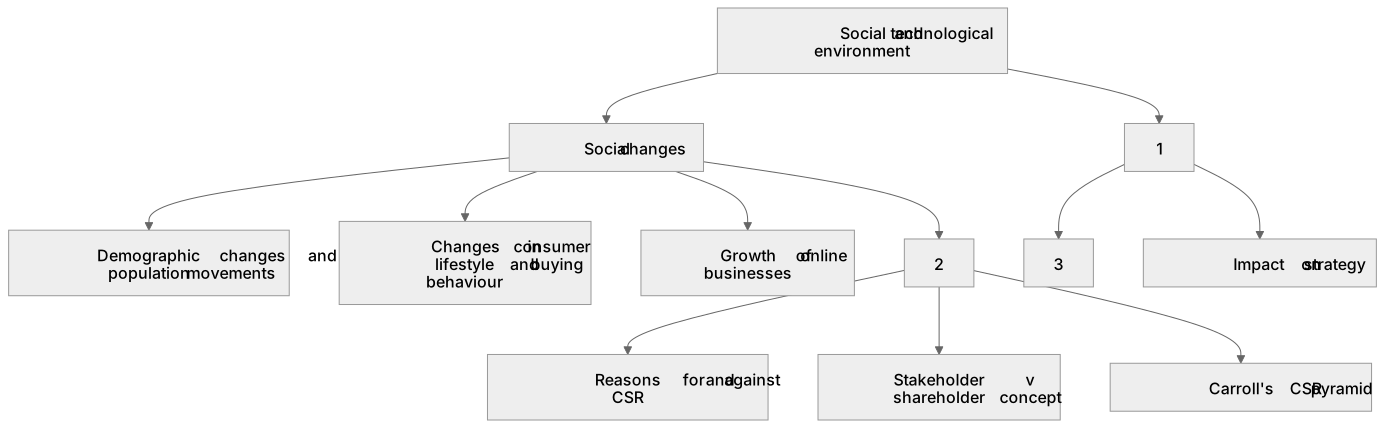
1Box 1
2Box 2
3Box 3
There is more to this lesson
The full lesson goes on to check your understanding and help you earn the marks. Create a free account to carry on, with your progress saved.
A week of Premium from your first lesson · Then the free plan continues · No card, no charge
Test your understanding of Analysing the external environment to assess opportunities and threats: social and technological: The impact of the social and technological environment on strategic and functional decision making (to include: Social changes to include demographic changes and population movements such as: migration, changes in consumer lifestyle and buying behaviour, the growth of online businesses. The social environment to include Corporate Social Responsibility (CSR) and: the reasons for and against (CSR), the difference between the stakeholder v shareholder concept, Carroll’s Corporate Social Responsibility pyramid. Technological change should include the impact of technological change on functional areas and strategy.)
Active recall beats re-reading. Take an instant quiz now to test what you’ve learned and lock it into long-term memory.
A week of Premium from your first lesson · Then the free plan continues · No card, no charge