AQA · A-Level · Business
Course version: 7132 · Version from Sept 2023
Social and technological: The pressures for socially responsible behaviour
Full specification wording
Analysing the external environment to assess opportunities and threats: social and technological: The pressures for socially responsible behaviour
Responsible behaviour is rarely a free choice; it is usually a response to pressure.
- Point 2 of 2
Study notes
From the teaching notes for this specification point.
The idea
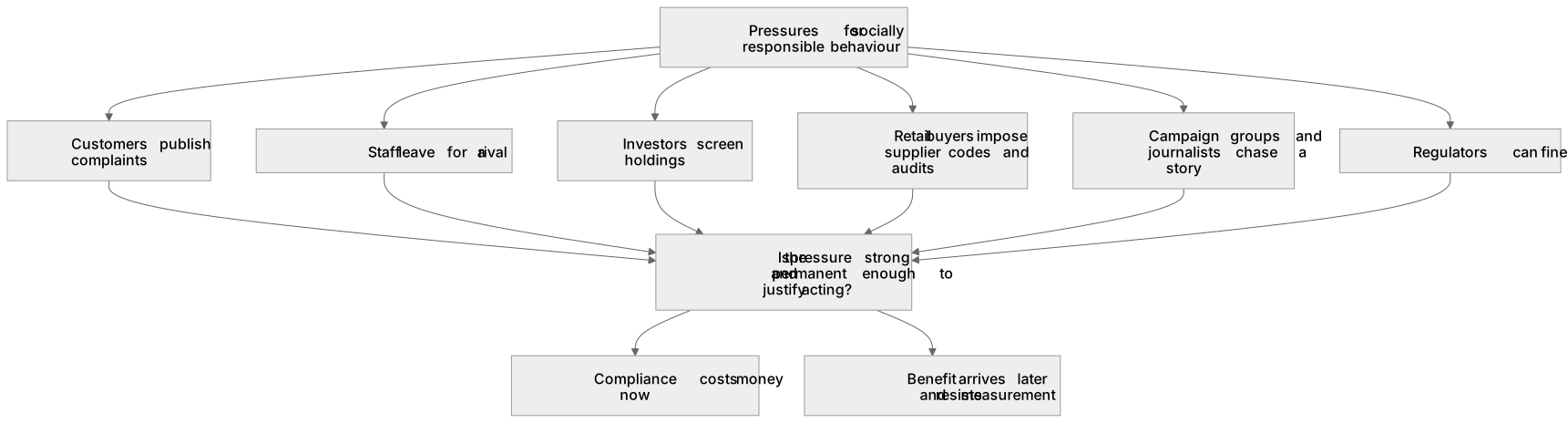
Responsible behaviour is rarely a free choice; it is usually a response to pressure. Customers can publish a complaint to millions, staff can leave for a rival, investors screen holdings on environmental and governance grounds, retail buyers impose supplier codes and audits, campaign groups and journalists chase a story, and regulators can fine. The commercial question is whether that pressure is strong enough and permanent enough to justify acting, because compliance costs money now while the benefit, in brand strength, staff retention and fines avoided, arrives later and resists measurement. Low margin commodity producers feel this trade-off hardest, which is why the judgement turns on how visible the firm is to the final consumer, how much margin it has to spend and whether its customers would actually pay more for better behaviour.
What earns the marks
- Identifying the specific source of pressure in the case by name, whether a retail customer, an investor, a union or a campaign group, rather than writing that society expects more.
- Explaining the mechanism by which the pressure bites, such as a lost supply contract, difficulty recruiting skilled staff or a fall in the share price.
- Setting the cost of responding against the commercial benefit and saying over what period each one lands.
- Judging how exposed this particular firm is, since a household brand and an unseen component supplier face very different levels of pressure.
Common mistakes and how to put them right
Assuming every firm faces identical pressure, when a business selling only to other businesses may face almost none from consumers.
Claiming that acting responsibly always raises profit, which removes the trade-off the question was written to test.
Confusing pressure with legal duty, so meeting a statutory minimum is presented as voluntary responsibility.
Exam tips
- This is usually asked as an assess or evaluate question on whether to adopt a costly policy, so build both sides and decide on the firm's margin, its market and its visibility.
- Quote the source of pressure from the case text; a generic reference to the media or to society scores badly on application.
Try the lesson
The start of the Analysing the external environment to assess opportunities and threats: social and technological: The pressures for socially responsible behaviour lesson, made from teaching notes for this specification point.
Have a go first
Which of the following is a pressure for socially responsible behaviour?
Listen
Responsible behaviour is rarely a free choice; it is usually a response to pressure. Customers can publish a complaint to millions, staff can leave for a rival, investors screen holdings on environmental and governance grounds, retail buyers impose supplier codes and audits, campaign groups and journalists chase a story, and regulators can fine. The commercial question is whether that pressure is strong enough and permanent enough to justify acting, because compliance costs money now while the benefit, in brand strength, staff retention and fines avoided, arrives later and resists measurement. Low margin commodity producers feel this trade-off hardest, which is why the judgement turns on how visible the firm is to the final consumer, how much margin it has to spend and whether its customers would actually pay more for better behaviour. A strong answer earns marks for these points. Identifying the specific source of pressure in the case by name, whether a retail customer, an investor, a union or a campaign group, rather than writing that society expects more. Explaining the mechanism by which the pressure bites, such as a lost supply contract, difficulty recruiting skilled staff or a fall in the share price. Setting the cost of responding against the commercial benefit and saying over what period each one lands. Judging how exposed this particular firm is, since a household brand and an unseen component supplier face very different levels of pressure. Exam tip: This is usually asked as an assess or evaluate question on whether to adopt a costly policy, so build both sides and decide on the firm's margin, its market and its visibility.
See it
Label the diagram
Some boxes have lost their names. Pick the right name for each number.
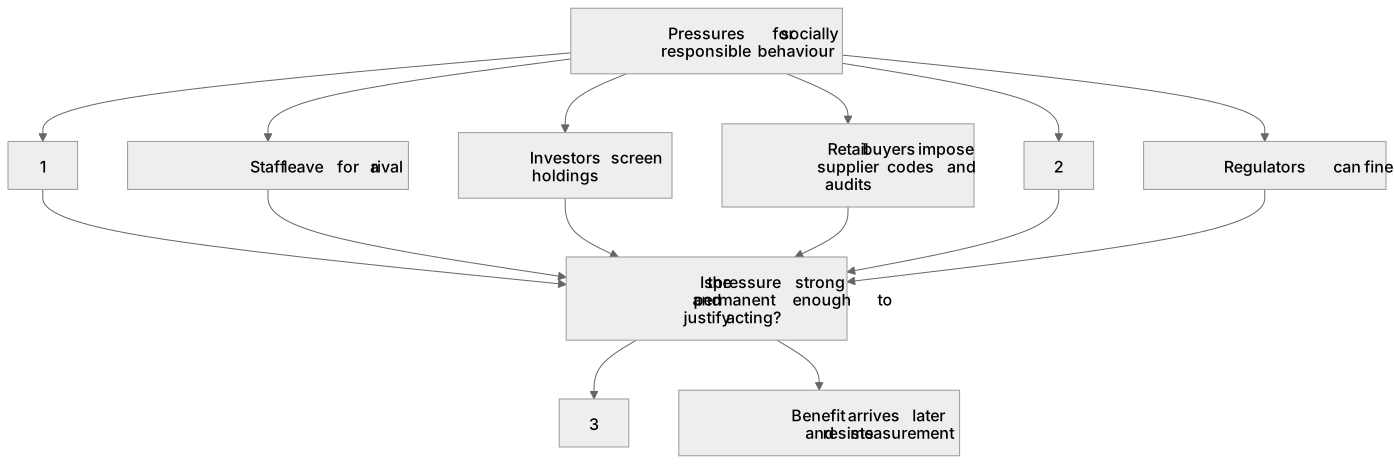
1Box 1
2Box 2
3Box 3
There is more to this lesson
The full lesson goes on to check your understanding and help you earn the marks. Create a free account to carry on, with your progress saved.
A week of Premium from your first lesson · Then the free plan continues · No card, no charge
Test your understanding of Analysing the external environment to assess opportunities and threats: social and technological: The pressures for socially responsible behaviour
Active recall beats re-reading. Take an instant quiz now to test what you’ve learned and lock it into long-term memory.
A week of Premium from your first lesson · Then the free plan continues · No card, no charge