AQA · A-Level · Business
Course version: 7132 · Version from Sept 2023
Quantitative skills in business: calculate, use and understand percentages…
Full specification wording
Annex: quantitative skills in business: calculate, use and understand percentages and percentage changes
A percentage rescales a figure onto a common base of one hundred, so a rise in sales at a corner shop can be set beside one at a supermarket chain.
- Point 2 of 9
- 4 key terms
Study notes
From the teaching notes for this specification point.
The idea
A percentage rescales a figure onto a common base of one hundred, so a rise in sales at a corner shop can be set beside one at a supermarket chain. Percentage change is the new figure minus the original, divided by the original, then multiplied by one hundred, and the denominator is always the earlier or base value, never the later one. Margins are the same arithmetic in different clothes: gross profit margin is gross profit over revenue, operating profit margin uses operating profit, and each is stated as a per cent of sales. The trap in a case study is that the figure hides the size of the base, so a start-up can post spectacular growth on a tiny opening number while a mature rival adds far more actual cash on a modest one.
What earns the marks
- Using the original or base year figure as the denominator and stating the answer as a rise or a fall, not as a bare number floating free of direction.
- Separating a percentage change from a change in percentage points, so a margin moving from ten per cent to twelve per cent is a rise of two percentage points and a rise of twenty per cent.
- Converting the percentage back into money for the business, because three percentage points off the margin on revenue of forty million pounds is a real sum the board must find somewhere.
- Carrying the figure into a decision, such as whether a price rise of 5 per cent covers a supplier increase given what the extract says about demand.
Common mistakes and how to put them right
Dividing by the new figure instead of the original, which understates every rise and overstates every fall.
Adding percentages taken from different bases, so a fall of twenty per cent followed by a rise of twenty per cent is treated as a return to the starting point when the business is still below where it began.
Reading a margin as a percentage of profit rather than of revenue, so a gross profit margin of 25 per cent is misread as 25 per cent of profit instead of 25p of gross profit in every pound of sales.
Exam tips
- Data response papers print tables with mixed units on purpose, so read the column heading for thousands or millions before touching the arithmetic.
- In an assess question the percentage is evidence rather than the answer, so follow it immediately with what it means for cash flow, competitiveness or the workforce.
Try the lesson
The start of the Annex: quantitative skills in business: calculate, use and understand percentages and percentage changes lesson, made from teaching notes for this specification point.
Have a go first
A business sells 250 units in January and 300 units in February. Calculate the percentage increase in units sold from January to February.
Listen
A percentage rescales a figure onto a common base of one hundred, so a rise in sales at a corner shop can be set beside one at a supermarket chain. Percentage change is the new figure minus the original, divided by the original, then multiplied by one hundred, and the denominator is always the earlier or base value, never the later one. Margins are the same arithmetic in different clothes: gross profit margin is gross profit over revenue, operating profit margin uses operating profit, and each is stated as a per cent of sales. The trap in a case study is that the figure hides the size of the base, so a start-up can post spectacular growth on a tiny opening number while a mature rival adds far more actual cash on a modest one. A strong answer earns marks for these points. Using the original or base year figure as the denominator and stating the answer as a rise or a fall, not as a bare number floating free of direction. Separating a percentage change from a change in percentage points, so a margin moving from ten per cent to twelve per cent is a rise of two percentage points and a rise of twenty per cent. Converting the percentage back into money for the business, because three percentage points off the margin on revenue of forty million pounds is a real sum the board must find somewhere. Carrying the figure into a decision, such as whether a price rise of 5 per cent covers a supplier increase given what the extract says about demand. Exam tip: Data response papers print tables with mixed units on purpose, so read the column heading for thousands or millions before touching the arithmetic.
See it
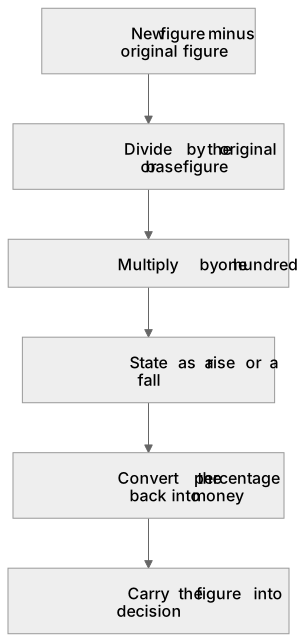
Put it in order
Put these steps in the order they happen.
- 1. Multiply by one hundred
- 2. Divide by the original or base figure
- 3. New figure minus original figure
- 4. Carry the figure into a decision
- 5. Convert the percentage back into money
- 6. State as a rise or a fall
Key words
Say what each word means before you turn the card.
percentage change
Try answering aloud or in your head before turning the card.
percentage points
Try answering aloud or in your head before turning the card.
gross profit margin
Try answering aloud or in your head before turning the card.
operating profit margin
Try answering aloud or in your head before turning the card.
See every definition
- percentage change
- The new figure minus the original, divided by the original, then multiplied by one hundred, with the denominator always the earlier or base value.
- percentage points
- A change in percentage points is distinct from a percentage change, so a margin moving from ten per cent to twelve per cent is a rise of two percentage points.
- gross profit margin
- Gross profit over revenue, stated as a per cent of sales.
- operating profit margin
- Operating profit over revenue, stated as a per cent of sales.
Label the diagram
Some boxes have lost their names. Pick the right name for each number.
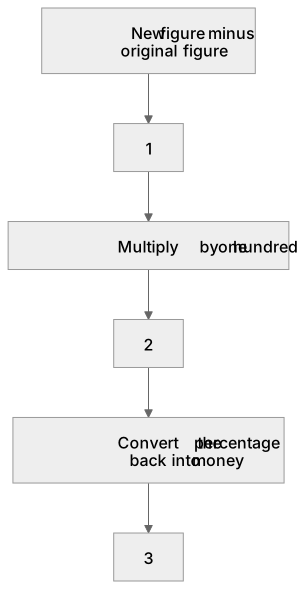
1Box 1
2Box 2
3Box 3
There is more to this lesson
The full lesson goes on to check your understanding and help you earn the marks. Create a free account to carry on, with your progress saved.
A week of Premium from your first lesson · Then the free plan continues · No card, no charge
Test your understanding of Annex: quantitative skills in business: calculate, use and understand percentages and percentage changes
Active recall beats re-reading. Take an instant quiz now to test what you’ve learned and lock it into long-term memory.
A week of Premium from your first lesson · Then the free plan continues · No card, no charge