AQA · A-Level · Business
Course version: 7132 · Version from Sept 2023
Quantitative skills in business: interpret, apply and analyse information…
Full specification wording
Annex: quantitative skills in business: interpret, apply and analyse information in written, graphical and numerical forms.
This skill underpins much of the paper and explains why a memorised definition scores badly.
- Point 9 of 9
- 4 key terms
Study notes
From the teaching notes for this specification point.
The idea
This skill underpins much of the paper and explains why a memorised definition scores badly. Case material may include written extracts, tables, charts or accounts, and marks often come from moving between them: noticing that an upbeat quotation from the chief executive sits beside a cash flow forecast turning negative in the third quarter, or that a rising sales line hides a falling margin. Application means naming the firm and using its figures and market rather than a generic business. Analysis means building a chain in which a cause leads to an effect and the effect to a consequence for something the firm cares about. A practical routine is to read the questions first, then annotate the material, tagging each figure with the question it will feed.
What earns the marks
- Quoting evidence from the extract or the appendix rather than paraphrasing it loosely, so the answer names the product, the figure and the year.
- Connecting two sources, reading a comment about delivery delays against the stock turnover figure in the table, which is where the sharper points come from.
- Developing a chain of reasoning in which every step follows from the last and ends at a named objective such as cash flow, market share or unit cost.
- Using precise vocabulary for what the data actually shows, so a fall in the rate of increase is described as slowing growth rather than as a decline.
- Applying a numerical technique correctly to the supplied data, for example calculating a percentage change or margin, and then interpreting what the result means for the business.
Common mistakes and how to put them right
Copying a sentence out of the extract and doing nothing with it.
Put it right: This is description and may not by itself demonstrate application.
Writing an answer that would fit any firm in any industry, with the case study's name dropped in once at the start as decoration.
Skipping the appendix because the arithmetic looked optional, when the appendix is often where the evidence for the final judgement is hidden.
Treating a chart or table as decoration and describing its shape without extracting a figure to support the argument.
Exam tips
- Identify the objective stated in the case material, because analyse and assess questions often turn on whether something helps or hinders that objective.
- Split your time in proportion to the marks, and plan the longest answer so it draws on the sources most relevant to the question rather than every source mechanically.
Try the lesson
The start of the Annex: quantitative skills in business: interpret, apply and analyse information in written, graphical and numerical forms. lesson, made from teaching notes for this specification point.
Have a go first
A business sells 4 000 units at £15 each. What is its total revenue?
Listen
This skill underpins much of the paper and explains why a memorised definition scores badly. Case material may include written extracts, tables, charts or accounts, and marks often come from moving between them: noticing that an upbeat quotation from the chief executive sits beside a cash flow forecast turning negative in the third quarter, or that a rising sales line hides a falling margin. Application means naming the firm and using its figures and market rather than a generic business. Analysis means building a chain in which a cause leads to an effect and the effect to a consequence for something the firm cares about. A practical routine is to read the questions first, then annotate the material, tagging each figure with the question it will feed. A strong answer earns marks for these points. Quoting evidence from the extract or the appendix rather than paraphrasing it loosely, so the answer names the product, the figure and the year. Connecting two sources, reading a comment about delivery delays against the stock turnover figure in the table, which is where the sharper points come from. Developing a chain of reasoning in which every step follows from the last and ends at a named objective such as cash flow, market share or unit cost. Using precise vocabulary for what the data actually shows, so a fall in the rate of increase is described as slowing growth rather than as a decline. Exam tip: Identify the objective stated in the case material, because analyse and assess questions often turn on whether something helps or hinders that objective.
See it
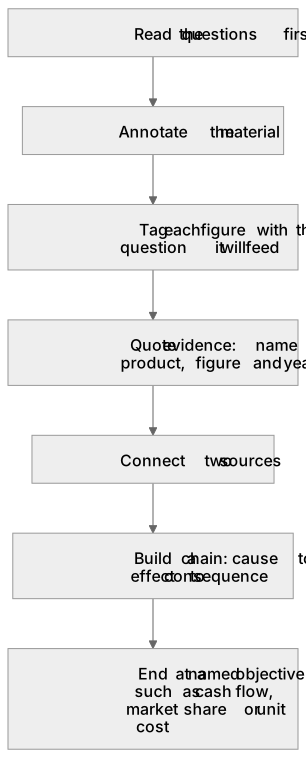
Put it in order
Put these steps in the order they happen.
- 1. End at a named objective such as cash flow, market share or unit cost
- 2. Build a chain: cause to effect to consequence
- 3. Tag each figure with the question it will feed
- 4. Connect two sources
- 5. Read the questions first
- 6. Annotate the material
- 7. Quote evidence: name the product, figure and year
Key words
Say what each word means before you turn the card.
application
Try answering aloud or in your head before turning the card.
analysis
Try answering aloud or in your head before turning the card.
case study evidence
Try answering aloud or in your head before turning the card.
cross-referencing sources
Try answering aloud or in your head before turning the card.
See every definition
- application
- Naming the firm and using its figures and market rather than a generic business.
- analysis
- Building a chain in which a cause leads to an effect and the effect to a consequence for something the firm cares about.
- case study evidence
- Quoting evidence from the extract or the appendix rather than paraphrasing it loosely, so the answer names the product, the figure and the year.
- cross-referencing sources
- Connecting two sources, reading a comment against a figure in the table, which is where the sharper points come from.
Label the diagram
Some boxes have lost their names. Pick the right name for each number.
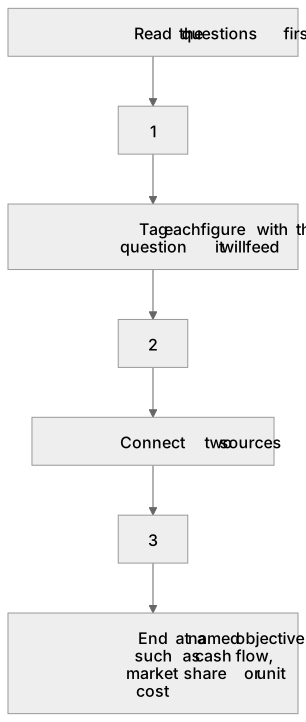
1Box 1
2Box 2
3Box 3
There is more to this lesson
The full lesson goes on to check your understanding and help you earn the marks. Create a free account to carry on, with your progress saved.
A week of Premium from your first lesson · Then the free plan continues · No card, no charge
Test your understanding of Annex: quantitative skills in business: interpret, apply and analyse information in written, graphical and numerical forms.
Active recall beats re-reading. Take an instant quiz now to test what you’ve learned and lock it into long-term memory.
A week of Premium from your first lesson · Then the free plan continues · No card, no charge