AQA · A-Level · Business
Course version: 7132 · Version from Sept 2023
Quantitative skills in business: use and interpret quantitative and…
Full specification wording
Annex: quantitative skills in business: use and interpret quantitative and non-quantitative information in order to make decisions
Every decision question on this paper is a mixture, and the marks sit in the mixing rather than in either half alone.
- Point 8 of 9
- 4 key terms
Study notes
From the teaching notes for this specification point.
The idea
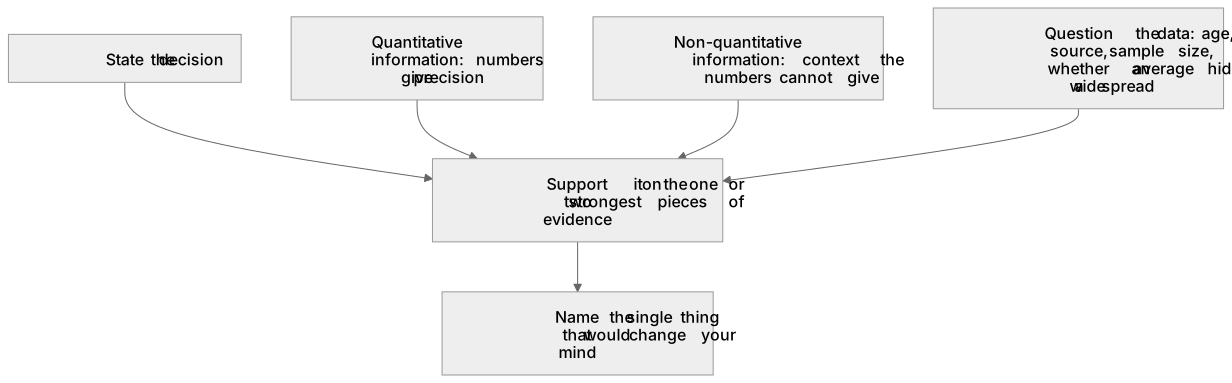
Every decision question on this paper is a mixture, and the marks sit in the mixing rather than in either half alone. Numbers give precision: a break-even output, a net present value, a labour turnover rate. What they cannot give is context, so the answer has to weigh what no spreadsheet holds, the mood of a workforce already through one redundancy round, the damage to a brand built on ethical sourcing, the strength of a forecast resting on a survey of thirty customers, the objectives of the owners. Strong evaluation interrogates the data itself: how old is it, who gathered it, how large was the sample, does a mean conceal a wide spread. The routine that scores is to state the decision, support it on the one or two strongest pieces of evidence, then name the single thing that would change your mind.
What earns the marks
- Reaching a supported decision rather than parading a list of considerations, and saying explicitly which evidence carried the most weight and why.
- Questioning the quality of the information given, its age, its source, the size of the sample, or whether an average is hiding a wide range of outcomes.
- Bringing in what the calculation cannot capture, staff morale, reputation, supplier relationships or the owners' own aims, and setting it against the figures rather than beside them.
- Stating the condition under which the recommendation would flip, for instance if forecast volume came in a fifth below plan.
Common mistakes and how to put them right
Calculating faultlessly and then recommending on that figure alone, which caps the answer because the judgement marks reward weighing one thing against another.
Listing advantages and disadvantages in two neat columns and stopping there, so no decision is reached and the top level is never entered.
Believing a number because it is printed in the case, when it may be the marketing director's own optimistic forecast rather than an audited fact.
Exam tips
- The final question on each case carries the most marks and is marked on judgement, so protect time for it and put the decision in the opening line.
- Use the business's own objectives as the yardstick, because a good outcome for a family firm planning for grandchildren is not a good outcome for a plc chasing shareholder returns.
Try the lesson
The start of the Annex: quantitative skills in business: use and interpret quantitative and non-quantitative information in order to make decisions lesson, made from teaching notes for this specification point.
Have a go first
A business sells 400 units at £15 each. What is its total revenue?
Listen
Every decision question on this paper is a mixture, and the marks sit in the mixing rather than in either half alone. Numbers give precision: a break-even output, a net present value, a labour turnover rate. What they cannot give is context, so the answer has to weigh what no spreadsheet holds, the mood of a workforce already through one redundancy round, the damage to a brand built on ethical sourcing, the strength of a forecast resting on a survey of thirty customers, the objectives of the owners. Strong evaluation interrogates the data itself: how old is it, who gathered it, how large was the sample, does a mean conceal a wide spread. The routine that scores is to state the decision, support it on the one or two strongest pieces of evidence, then name the single thing that would change your mind. A strong answer earns marks for these points. Reaching a supported decision rather than parading a list of considerations, and saying explicitly which evidence carried the most weight and why. Questioning the quality of the information given, its age, its source, the size of the sample, or whether an average is hiding a wide range of outcomes. Bringing in what the calculation cannot capture, staff morale, reputation, supplier relationships or the owners' own aims, and setting it against the figures rather than beside them. Stating the condition under which the recommendation would flip, for instance if forecast volume came in a fifth below plan. Exam tip: The final question on each case carries the most marks and is marked on judgement, so protect time for it and put the decision in the opening line.
See it
Key words
Say what each word means before you turn the card.
supported judgement
Try answering aloud or in your head before turning the card.
data quality
Try answering aloud or in your head before turning the card.
qualitative factors
Try answering aloud or in your head before turning the card.
decision criteria
Try answering aloud or in your head before turning the card.
See every definition
- supported judgement
- Reaching a decision rather than parading a list of considerations, and saying explicitly which evidence carried the most weight and why.
- data quality
- Questioning the information given, its age, its source, the size of the sample, or whether an average is hiding a wide range of outcomes.
- qualitative factors
- Bringing in what the calculation cannot capture, such as staff morale, reputation, supplier relationships or the owners' own aims, and setting it against the figures rather than beside them.
- decision criteria
- Using the business's own objectives as the yardstick, because a good outcome for a family firm planning for grandchildren is not a good outcome for a plc chasing shareholder returns.
Label the diagram
Some boxes have lost their names. Pick the right name for each number.
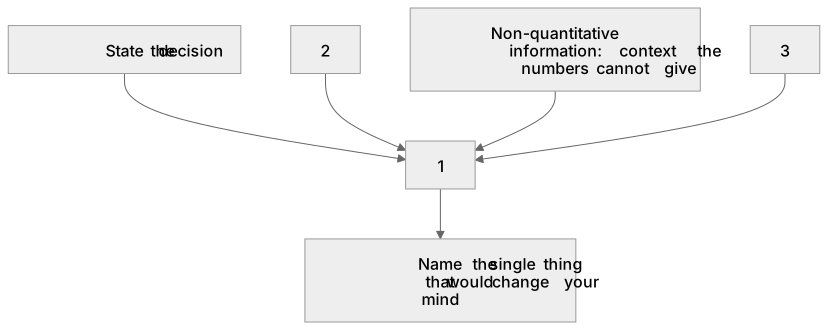
1Box 1
2Box 2
3Box 3
There is more to this lesson
The full lesson goes on to check your understanding and help you earn the marks. Create a free account to carry on, with your progress saved.
A week of Premium from your first lesson · Then the free plan continues · No card, no charge
Test your understanding of Annex: quantitative skills in business: use and interpret quantitative and non-quantitative information in order to make decisions
Active recall beats re-reading. Take an instant quiz now to test what you’ve learned and lock it into long-term memory.
A week of Premium from your first lesson · Then the free plan continues · No card, no charge