AQA · A-Level · Business
Course version: 7132 · Version from Sept 2023
How to manage issues caused by growth and retrenchment (to include: Issues…
Full specification wording
Assessing a change in scale: How to manage issues caused by growth and retrenchment (to include: Issues with growth should include: economies of scale (including technical, purchasing and managerial), economies of scope, diseconomies of scale, synergy, overtrading.)
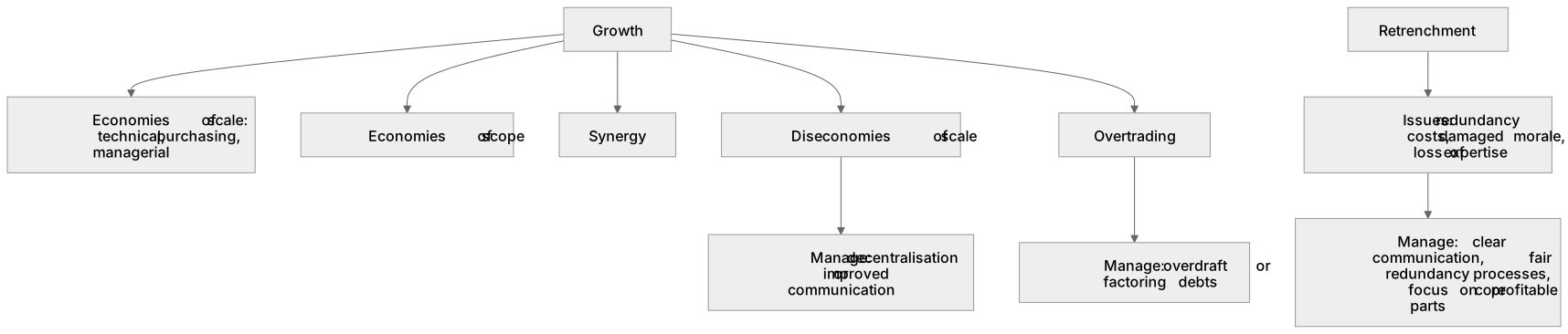
Growth can lower unit costs through economies of scale (technical, purchasing, managerial) and scope (shared resources).
- Point 3 of 5
- 4 key terms
Study notes
From the teaching notes for this specification point.
The idea
Growth can lower unit costs through economies of scale (technical, purchasing, managerial) and scope (shared resources). However, it can lead to diseconomies of scale if communication and coordination falter. Managing this involves decentralisation or improving communication systems. Overtrading, where sales outpace working capital, is a critical risk managed by securing overdrafts or factoring debts. Synergy is the forecast that a combined business is worth more than its parts. Retrenchment is a strategic reduction in scale, often to tackle diseconomies or poor performance. This creates issues like redundancy costs, damaged morale, and loss of expertise. Managing retrenchment requires clear communication, fair redundancy processes, and a focus on the core, profitable parts of the business.
What earns the marks
- Identifying a specific economy of scale and explaining its impact on unit cost.
- Diagnosing overtrading by linking rising sales to a worsening cash position and proposing a suitable financial control like an overdraft.
- Recommending a specific strategy to manage diseconomies of scale, such as delayering or creating autonomous divisions.
- Explaining how to manage the negative effects of retrenchment, such as using a fair redundancy selection process to maintain morale among remaining staff.
Common mistakes and how to put them right
Confusing economies of scale (cost savings from more of the same) with economies of scope (cost savings from variety).
Assuming diseconomies of scale are inevitable at a certain size, rather than a management failure that can be postponed or mitigated.
Ignoring the financial and human costs of retrenchment, such as redundancy payments, loss of skills, and damage to employee motivation.
Exam tips
- Overtrading is a common scenario. Look for evidence of rising sales combined with a falling cash balance or rising trade receivables.
- When assessing retrenchment, balance the intended benefits (cost reduction, improved focus) against the potential drawbacks (loss of market share, poor morale).
Try the lesson
The start of the Assessing a change in scale: How to manage issues caused by growth and retrenchment (to include: Issues with growth should include: economies of scale (including technical, purchasing and managerial), economies of scope, diseconomies of scale, synergy, overtrading.) lesson, made from teaching notes for this specification point.
Have a go first
Which term describes the cost savings a business gains as its output rises?
Listen
Growth can lower unit costs through economies of scale (technical, purchasing, managerial) and scope (shared resources). However, it can lead to diseconomies of scale if communication and coordination falter. Managing this involves decentralisation or improving communication systems. Overtrading, where sales outpace working capital, is a critical risk managed by securing overdrafts or factoring debts. Synergy is the forecast that a combined business is worth more than its parts. Retrenchment is a strategic reduction in scale, often to tackle diseconomies or poor performance. This creates issues like redundancy costs, damaged morale, and loss of expertise. Managing retrenchment requires clear communication, fair redundancy processes, and a focus on the core, profitable parts of the business. A strong answer earns marks for these points. Identifying a specific economy of scale and explaining its impact on unit cost. Diagnosing overtrading by linking rising sales to a worsening cash position and proposing a suitable financial control like an overdraft. Recommending a specific strategy to manage diseconomies of scale, such as delayering or creating autonomous divisions. Explaining how to manage the negative effects of retrenchment, such as using a fair redundancy selection process to maintain morale among remaining staff. Exam tip: Overtrading is a common scenario. Look for evidence of rising sales combined with a falling cash balance or rising trade receivables.
See it
Key words
Say what each word means before you turn the card.
Economies of scale
Try answering aloud or in your head before turning the card.
Economies of scope
Try answering aloud or in your head before turning the card.
Overtrading
Try answering aloud or in your head before turning the card.
Synergy
Try answering aloud or in your head before turning the card.
See every definition
- Economies of scale
- Cost savings that lower unit costs through technical, purchasing and managerial economies as a business grows.
- Economies of scope
- Cost savings that come from shared resources when a business produces a variety of products.
- Overtrading
- A situation where sales outpace working capital, managed by securing overdrafts or factoring debts.
- Synergy
- The forecast that a combined business is worth more than its parts.
Label the diagram
Some boxes have lost their names. Pick the right name for each number.
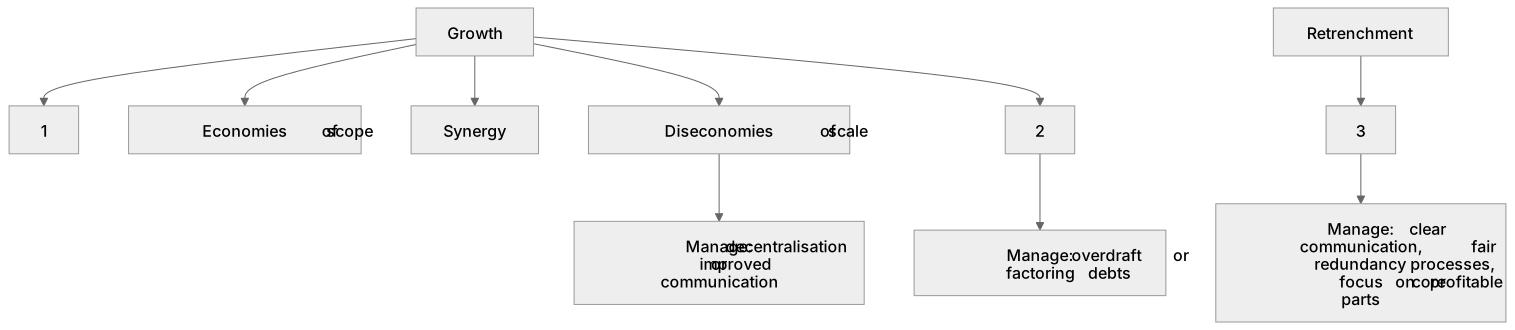
1Box 1
2Box 2
3Box 3
There is more to this lesson
The full lesson goes on to check your understanding and help you earn the marks. Create a free account to carry on, with your progress saved.
A week of Premium from your first lesson · Then the free plan continues · No card, no charge
Test your understanding of Assessing a change in scale: How to manage issues caused by growth and retrenchment (to include: Issues with growth should include: economies of scale (including technical, purchasing and managerial), economies of scope, diseconomies of scale, synergy, overtrading.)
Active recall beats re-reading. Take an instant quiz now to test what you’ve learned and lock it into long-term memory.
A week of Premium from your first lesson · Then the free plan continues · No card, no charge