AQA · A-Level · Business
Course version: 7132 · Version from Sept 2023
The difference between organic and external growth
Full specification wording
Assessing a change in scale: The difference between organic and external growth
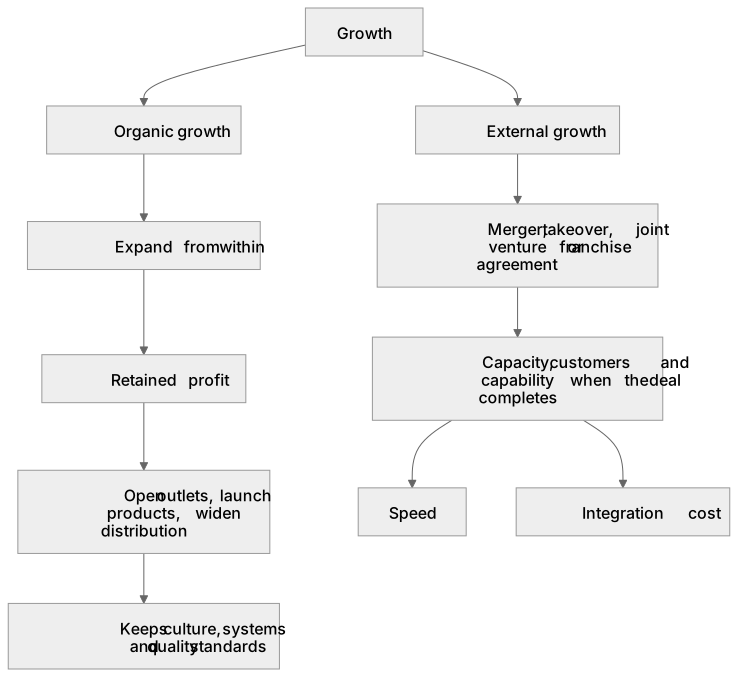
Organic growth means expanding from within, using retained profit to open outlets, launch products or widen distribution, so the firm keeps its culture, systems and quality standards and pays as…
- Point 2 of 5
- 4 key terms
Study notes
From the teaching notes for this specification point.
The idea
Organic growth means expanding from within, using retained profit to open outlets, launch products or widen distribution, so the firm keeps its culture, systems and quality standards and pays as it goes. External growth means a merger, takeover, joint venture or franchise agreement, delivering capacity, customers and capability when the deal completes. Speed is the argument for external growth; integration cost is the risk. Acquirers often pay a premium above book value for goodwill, then find promised savings need two workforces, two software systems and two cultures to cooperate. Evidence on takeover failure rates is contested, so treat claims cautiously. Greggs added shops one at a time; Tesco bought Booker to reach wholesale customers quickly.
What earns the marks
- Set the two routes against a criterion that matters to the case, usually speed, cost, risk or control, rather than describing each route in turn.
- Explain why the organic route protects quality and culture while the external route imports both, linking this to integration cost after the deal.
- Recognise that organic growth is limited by the cash a business generates, so a firm with weak operating cash flow may have no realistic choice.
- Judge which route suits the firm's position, for instance an external deal where a patent or distribution network cannot be built quickly enough to matter.
- Distinguish a merger (agreed between boards) from a takeover (which can be resisted), since this changes the cost and the aftermath.
Common mistakes and how to put them right
Treating a merger and a takeover as the same word, when one is agreed between boards and the other can be resisted, which changes the cost and the aftermath.
Put it right: State explicitly whether the deal is agreed or contested.
Claiming the external route is faster and stopping there, with no cost of acquisition, no premium paid and no integration problem to weigh against it.
Put it right: Balance speed against the premium and integration cost.
Assuming organic expansion carries no risk, when opening outlets ahead of demand ties up cash in stock and property just as surely as a deal does.
Put it right: Identify the specific cash and demand risks of organic growth.
Exam tips
- A question on this normally hands you a firm that has done one and is considering the other, so build the answer around what changed in its circumstances.
- Quantify wherever the appendix lets you, since a comparison of the cash cost of a deal with the firm's retained profit turns a generic contrast into applied analysis.
Try the lesson
The start of the Assessing a change in scale: The difference between organic and external growth lesson, made from teaching notes for this specification point.
Have a go first
Which term describes growth achieved by a business increasing its own output and sales rather than by joining with another business?
Listen
Organic growth means expanding from within, using retained profit to open outlets, launch products or widen distribution, so the firm keeps its culture, systems and quality standards and pays as it goes. External growth means a merger, takeover, joint venture or franchise agreement, delivering capacity, customers and capability when the deal completes. Speed is the argument for external growth; integration cost is the risk. Acquirers often pay a premium above book value for goodwill, then find promised savings need two workforces, two software systems and two cultures to cooperate. Evidence on takeover failure rates is contested, so treat claims cautiously. Greggs added shops one at a time; Tesco bought Booker to reach wholesale customers quickly. A strong answer earns marks for these points. Set the two routes against a criterion that matters to the case, usually speed, cost, risk or control, rather than describing each route in turn. Explain why the organic route protects quality and culture while the external route imports both, linking this to integration cost after the deal. Recognise that organic growth is limited by the cash a business generates, so a firm with weak operating cash flow may have no realistic choice. Judge which route suits the firm's position, for instance an external deal where a patent or distribution network cannot be built quickly enough to matter. A common slip: Treating a merger and a takeover as the same word, when one is agreed between boards and the other can be resisted, which changes the cost and the aftermath. Instead, state explicitly whether the deal is agreed or contested. Exam tip: A question on this normally hands you a firm that has done one and is considering the other, so build the answer around what changed in its circumstances.
See it
Key words
Say what each word means before you turn the card.
organic growth
Try answering aloud or in your head before turning the card.
external growth
Try answering aloud or in your head before turning the card.
integration cost
Try answering aloud or in your head before turning the card.
merger
Try answering aloud or in your head before turning the card.
See every definition
- organic growth
- Expanding from within, using retained profit to open outlets, launch products or widen distribution, so the firm keeps its culture, systems and quality standards and pays as it goes.
- external growth
- A merger, takeover, joint venture or franchise agreement, delivering capacity, customers and capability when the deal completes.
- integration cost
- The risk of external growth, where promised savings need two workforces, two software systems and two cultures to cooperate.
- merger
- A deal agreed between boards, which changes the cost and the aftermath compared with a takeover that can be resisted.
Label the diagram
Some boxes have lost their names. Pick the right name for each number.
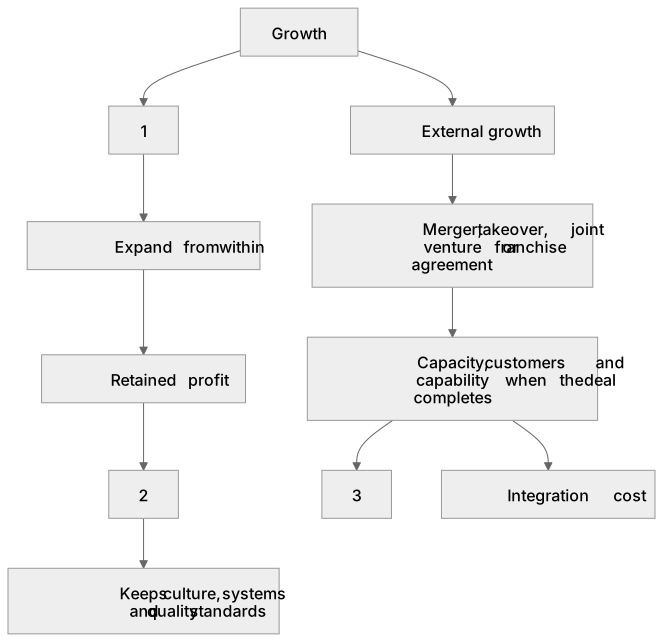
1Box 1
2Box 2
3Box 3
There is more to this lesson
The full lesson goes on to check your understanding and help you earn the marks. Create a free account to carry on, with your progress saved.
A week of Premium from your first lesson · Then the free plan continues · No card, no charge
Test your understanding of Assessing a change in scale: The difference between organic and external growth
Active recall beats re-reading. Take an instant quiz now to test what you’ve learned and lock it into long-term memory.
A week of Premium from your first lesson · Then the free plan continues · No card, no charge