AQA · A-Level · Business
Course version: 7132 · Version from Sept 2023
The reasons why businesses grow or retrench (to include: Types of growth…
Full specification wording
Assessing a change in scale: The reasons why businesses grow or retrench (to include: Types of growth to include organic and external)
Businesses change scale for strategic reasons.
- Point 1 of 5
- 4 key terms
Study notes
From the teaching notes for this specification point.
The idea
Businesses change scale for strategic reasons. Growth can be organic, using a firm's own resources to expand, such as by launching new products or opening new branches. This is often slower but less risky and easier to manage. Alternatively, growth can be external, through mergers or takeovers, which is faster but more expensive and carries risks of culture clashes. Motives for growth include achieving economies of scale to cut unit costs, gaining market power to influence prices, diversifying to spread risk, or satisfying managerial ambitions. Retrenchment is a deliberate strategy to reduce scale, perhaps by selling a division. This is not failure; it can raise cash, improve liquidity, and increase return on capital employed (ROCE) by shedding underperforming assets.
What earns the marks
- Correctly identifying the type of growth from the case study (e.g., a takeover is external, developing a new product line is organic) and justifying the choice.
- Tying the motive for growth or retrenchment to specific data in the case, such as a rising order book or a falling profit margin.
- Calculating the impact of the change in scale, for example how purchasing economies cut cost per unit, or how a disposal raises cash and improves ROCE.
- Weighing the chosen strategy against the firm's stated objectives, such as whether rapid external growth serves shareholders or just managerial status.
Common mistakes and how to put them right
Confusing the types of growth, for instance describing a new factory build (organic) as a merger (external).
Assuming growth is always good and retrenchment is always failure, rather than seeing both as strategic options to improve performance.
Listing generic motives for growth without applying them to the specific context and data provided in the case study.
Exam tips
- Look for keywords that signal the type of growth: 'acquired', 'merged' or 'took over' for external; 'invested in', 'launched' or 'expanded' for organic.
- For evaluation, always weigh the pros and cons of the chosen method. For example, external growth is fast but risky; organic growth is safer but slower to deliver results.
Try the lesson
The start of the Assessing a change in scale: The reasons why businesses grow or retrench (to include: Types of growth to include organic and external) lesson, made from teaching notes for this specification point.
Have a go first
Which term describes a business increasing its size by opening new outlets itself rather than by merging with another business?
Listen
Businesses change scale for strategic reasons. Growth can be organic, using a firm's own resources to expand, such as by launching new products or opening new branches. This is often slower but less risky and easier to manage. Alternatively, growth can be external, through mergers or takeovers, which is faster but more expensive and carries risks of culture clashes. Motives for growth include achieving economies of scale to cut unit costs, gaining market power to influence prices, diversifying to spread risk, or satisfying managerial ambitions. Retrenchment is a deliberate strategy to reduce scale, perhaps by selling a division. This is not failure; it can raise cash, improve liquidity, and increase return on capital employed (ROCE) by shedding underperforming assets. A strong answer earns marks for these points. Correctly identifying the type of growth from the case study (e.g., a takeover is external, developing a new product line is organic) and justifying the choice. Tying the motive for growth or retrenchment to specific data in the case, such as a rising order book or a falling profit margin. Calculating the impact of the change in scale, for example how purchasing economies cut cost per unit, or how a disposal raises cash and improves ROCE. Weighing the chosen strategy against the firm's stated objectives, such as whether rapid external growth serves shareholders or just managerial status. Exam tip: Look for keywords that signal the type of growth: 'acquired', 'merged' or 'took over' for external; 'invested in', 'launched' or 'expanded' for organic.
See it
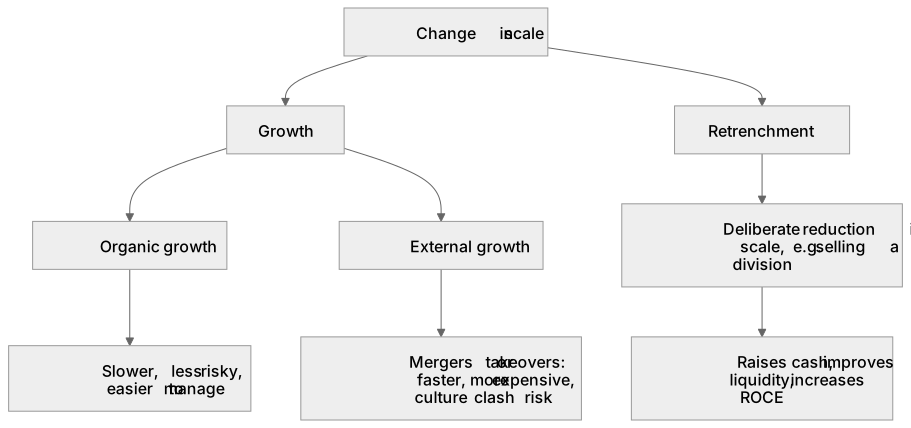
Key words
Say what each word means before you turn the card.
Organic growth
Try answering aloud or in your head before turning the card.
External growth
Try answering aloud or in your head before turning the card.
Economies of scale
Try answering aloud or in your head before turning the card.
Retrenchment
Try answering aloud or in your head before turning the card.
See every definition
- Organic growth
- Growth using a firm's own resources to expand, such as by launching new products or opening new branches, which is often slower but less risky and easier to manage.
- External growth
- Growth through mergers or takeovers, which is faster but more expensive and carries risks of culture clashes.
- Economies of scale
- A motive for growth, involving cutting unit costs.
- Retrenchment
- A deliberate strategy to reduce scale, perhaps by selling a division, which can raise cash, improve liquidity and increase return on capital employed by shedding underperforming assets.
Label the diagram
Some boxes have lost their names. Pick the right name for each number.
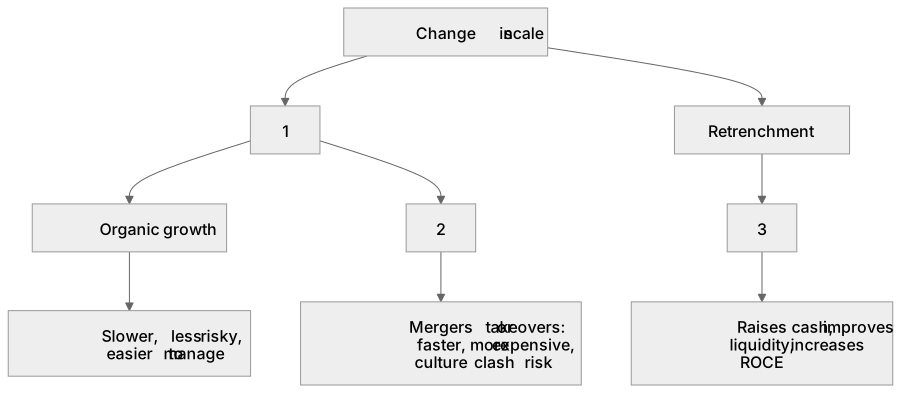
1Box 1
2Box 2
3Box 3
There is more to this lesson
The full lesson goes on to check your understanding and help you earn the marks. Create a free account to carry on, with your progress saved.
A week of Premium from your first lesson · Then the free plan continues · No card, no charge
Test your understanding of Assessing a change in scale: The reasons why businesses grow or retrench (to include: Types of growth to include organic and external)
Active recall beats re-reading. Take an instant quiz now to test what you’ve learned and lock it into long-term memory.
A week of Premium from your first lesson · Then the free plan continues · No card, no charge