AQA · A-Level · Business
Course version: 7132 · Version from Sept 2023
The pressures for innovation (to include: Types of innovation should…
Full specification wording
Assessing innovation: The pressures for innovation (to include: Types of innovation should include product and process innovation.)
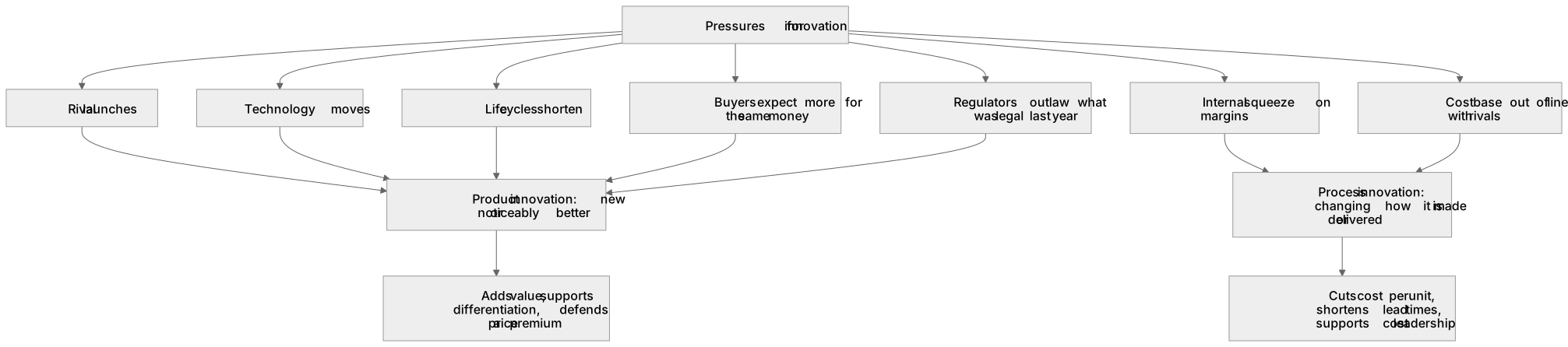
Rivals launch, technology moves, life cycles shorten, buyers expect more for the same money, and regulators outlaw what was legal last year, so standing still is a decision with a price attached.
- Point 1 of 5
- 4 key terms
Study notes
From the teaching notes for this specification point.
The idea
Rivals launch, technology moves, life cycles shorten, buyers expect more for the same money, and regulators outlaw what was legal last year, so standing still is a decision with a price attached. Two answers are available and they are not interchangeable. Creating something new or noticeably better adds value, supports a differentiation strategy and defends a price premium. Changing how the thing is made or delivered cuts cost per unit, shortens lead times and supports a cost leadership strategy. Porter's five forces locates where the pressure is coming from, whether rivalry, buyer power, the threat of substitutes, new entrants or supplier power, though it takes a snapshot of an industry and says nothing about how fast that industry is changing, which is exactly what these questions turn on.
What earns the marks
- Identifying the source of pressure from the case, such as a patent expiring, a rival's launch, new emissions rules or a supermarket squeezing supplier prices.
- Choosing the appropriate response and justifying it, so cost pressure in a price sensitive market points to changing the process rather than restyling the product.
- Linking the response to added value, either a higher price the customer accepts or a lower cost the rival cannot match.
- Using a model to structure the pressures rather than listing them, and saying what the model leaves out when the industry is changing quickly.
Common mistakes and how to put them right
Using the two types of innovation as synonyms, so a question about cutting unit costs is answered with ideas for new product features.
Treating every pressure as external, when an internal squeeze on margins or a cost base that is out of line with rivals is just as strong a trigger.
Describing a model at length and never applying it, which earns knowledge marks only however accurate the description is.
Exam tips
- Look at the appendix for the clue to which pressure dominates, since a falling market share points somewhere different from a falling operating margin.
- On an assess question, argue that the urgency of the pressure matters as much as its existence, because a firm with cash and a strong brand can afford to wait where a highly geared one cannot.
Try the lesson
The start of the Assessing innovation: The pressures for innovation (to include: Types of innovation should include product and process innovation.) lesson, made from teaching notes for this specification point.
Have a go first
Which of the following best describes process innovation?
Listen
Rivals launch, technology moves, life cycles shorten, buyers expect more for the same money, and regulators outlaw what was legal last year, so standing still is a decision with a price attached. Two answers are available and they are not interchangeable. Creating something new or noticeably better adds value, supports a differentiation strategy and defends a price premium. Changing how the thing is made or delivered cuts cost per unit, shortens lead times and supports a cost leadership strategy. Porter's five forces locates where the pressure is coming from, whether rivalry, buyer power, the threat of substitutes, new entrants or supplier power, though it takes a snapshot of an industry and says nothing about how fast that industry is changing, which is exactly what these questions turn on. A strong answer earns marks for these points. Identifying the source of pressure from the case, such as a patent expiring, a rival's launch, new emissions rules or a supermarket squeezing supplier prices. Choosing the appropriate response and justifying it, so cost pressure in a price sensitive market points to changing the process rather than restyling the product. Linking the response to added value, either a higher price the customer accepts or a lower cost the rival cannot match. Using a model to structure the pressures rather than listing them, and saying what the model leaves out when the industry is changing quickly. Exam tip: Look at the appendix for the clue to which pressure dominates, since a falling market share points somewhere different from a falling operating margin.
See it
Key words
Say what each word means before you turn the card.
product innovation
Try answering aloud or in your head before turning the card.
process innovation
Try answering aloud or in your head before turning the card.
competitive pressure
Try answering aloud or in your head before turning the card.
life cycle pressure
Try answering aloud or in your head before turning the card.
See every definition
- product innovation
- Creating something new or noticeably better, which adds value, supports a differentiation strategy and defends a price premium.
- process innovation
- Changing how the thing is made or delivered, which cuts cost per unit, shortens lead times and supports a cost leadership strategy.
- competitive pressure
- Pressure from rivalry, buyer power, the threat of substitutes, new entrants or supplier power, located using Porter's five forces.
- life cycle pressure
- Pressure arising because life cycles shorten, so standing still is a decision with a price attached.
Label the diagram
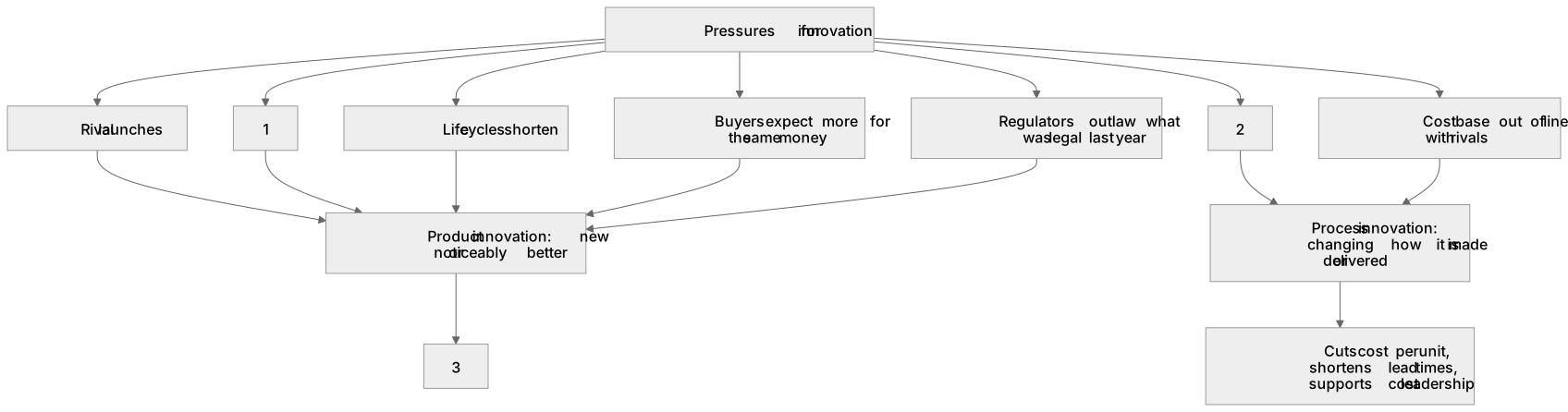
Some boxes have lost their names. Pick the right name for each number.
1Box 1
2Box 2
3Box 3
There is more to this lesson
The full lesson goes on to check your understanding and help you earn the marks. Create a free account to carry on, with your progress saved.
A week of Premium from your first lesson · Then the free plan continues · No card, no charge
Test your understanding of Assessing innovation: The pressures for innovation (to include: Types of innovation should include product and process innovation.)
Active recall beats re-reading. Take an instant quiz now to test what you’ve learned and lock it into long-term memory.
A week of Premium from your first lesson · Then the free plan continues · No card, no charge