AQA · A-Level · Business
Course version: 7132 · Version from Sept 2023
Assessing innovation: The value of innovation
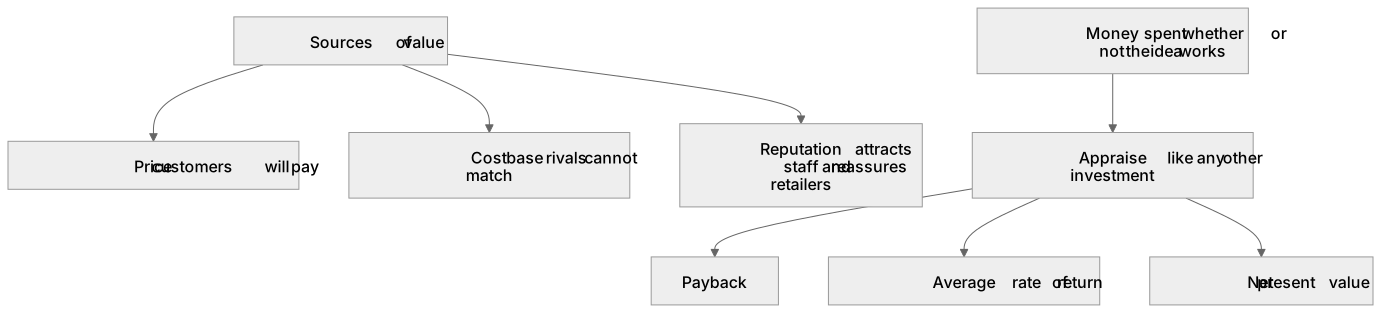
The payoff shows up in three places: a price customers will pay because nobody else offers this, a cost base rivals cannot match, and a reputation that attracts staff and reassures retailers.
- Point 2 of 5
- 4 key terms
Study notes
From the teaching notes for this specification point.
The idea
The payoff shows up in three places: a price customers will pay because nobody else offers this, a cost base rivals cannot match, and a reputation that attracts staff and reassures retailers. Set against that is money spent whether or not the idea works. Appraise it like any other investment. Payback is the time taken for net cash inflows to cover the initial outlay, average rate of return is average annual profit divided by the initial outlay times one hundred, and net present value discounts future cash flows back to today's money. New ideas usually look poor on payback and better on net present value, and a high discount rate can kill a sound project on paper. The Boston matrix explains the cash logic, with cash cows funding question marks, but it ignores how products support one another.
What earns the marks
- Naming the specific source of value for this firm, for example a price premium, a lower cost per unit, a longer product life cycle or a stronger brand.
- Using the right appraisal tool and stating its units, so payback is quoted in years and months and average rate of return as a percentage.
- Acknowledging the risk explicitly, since most projects fail and the spending is committed long before any revenue arrives.
- Judging the value against what else the money could do, such as reducing borrowing or refurbishing existing outlets, which is the opportunity cost argument.
Common mistakes and how to put them right
Asserting that it always raises profit, with no cost of development, no failure rate and no timescale over which the returns would have to arrive.
Mixing up payback and average rate of return, then quoting a percentage as a number of years or a period as a rate.
Forgetting that the first year of a project is usually the outlay, so the running total starts negative and the payback calculation slips by a full year.
Exam tips
- Where an appendix gives forecast cash flows, do the arithmetic before you judge, because the numerical verdict is what an analysis or a recommendation should rest on.
- Strong evaluation points at the reliability of the forecast itself, since estimates of demand for something that does not yet exist are the weakest numbers in the case.
Try the lesson
The start of the Assessing innovation: The value of innovation lesson, made from teaching notes for this specification point.
Have a go first
Which of the following best describes innovation in a business context?
Listen
The payoff shows up in three places: a price customers will pay because nobody else offers this, a cost base rivals cannot match, and a reputation that attracts staff and reassures retailers. Set against that is money spent whether or not the idea works. Appraise it like any other investment. Payback is the time taken for net cash inflows to cover the initial outlay, average rate of return is average annual profit divided by the initial outlay times one hundred, and net present value discounts future cash flows back to today's money. New ideas usually look poor on payback and better on net present value, and a high discount rate can kill a sound project on paper. The Boston matrix explains the cash logic, with cash cows funding question marks, but it ignores how products support one another. A strong answer earns marks for these points. Naming the specific source of value for this firm, for example a price premium, a lower cost per unit, a longer product life cycle or a stronger brand. Using the right appraisal tool and stating its units, so payback is quoted in years and months and average rate of return as a percentage. Acknowledging the risk explicitly, since most projects fail and the spending is committed long before any revenue arrives. Judging the value against what else the money could do, such as reducing borrowing or refurbishing existing outlets, which is the opportunity cost argument. Exam tip: Where an appendix gives forecast cash flows, do the arithmetic before you judge, because the numerical verdict is what an analysis or a recommendation should rest on.
See it
Key words
Say what each word means before you turn the card.
payback
Try answering aloud or in your head before turning the card.
average rate of return
Try answering aloud or in your head before turning the card.
net present value
Try answering aloud or in your head before turning the card.
opportunity cost
Try answering aloud or in your head before turning the card.
See every definition
- payback
- The time taken for net cash inflows to cover the initial outlay, quoted in years and months.
- average rate of return
- Average annual profit divided by the initial outlay times one hundred, quoted as a percentage.
- net present value
- A method that discounts future cash flows back to today's money.
- opportunity cost
- Judging the value against what else the money could do, such as reducing borrowing or refurbishing existing outlets.
Label the diagram
Some boxes have lost their names. Pick the right name for each number.
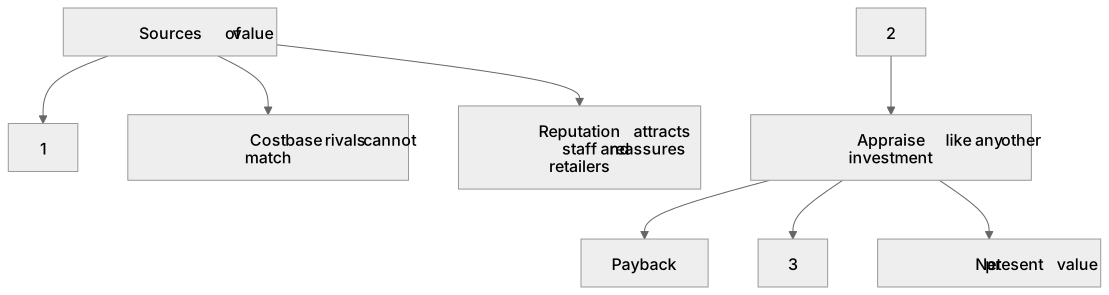
1Box 1
2Box 2
3Box 3
There is more to this lesson
The full lesson goes on to check your understanding and help you earn the marks. Create a free account to carry on, with your progress saved.
A week of Premium from your first lesson · Then the free plan continues · No card, no charge
Test your understanding of Assessing innovation: The value of innovation
Active recall beats re-reading. Take an instant quiz now to test what you’ve learned and lock it into long-term memory.
A week of Premium from your first lesson · Then the free plan continues · No card, no charge