AQA · A-Level · Business
Course version: 7132 · Version from Sept 2023
The ways of becoming an innovative organisation (to include: Ways of…
Full specification wording
Assessing innovation: The ways of becoming an innovative organisation (to include: Ways of becoming innovative include: Kaizen, research and development, intrapreneurship, benchmarking.)
Four routes to innovation, differing in risk, speed and potential impact.
- Point 3 of 5
- 4 key terms
Study notes
From the teaching notes for this specification point.
The idea
Four routes to innovation, differing in risk, speed and potential impact. Kaizen, or continuous improvement, asks every employee for minor gains. It costs little and lifts productivity steadily, as on Toyota's assembly lines, but it rarely produces a breakthrough. Formal research and development (R&D) can produce one, but it is a high-risk investment with long time lags and no guarantee of success. Intrapreneurship gives employees time and resources to develop their own ideas within the firm, applying motivators like responsibility and achievement, but requires a culture that tolerates failure. Benchmarking involves identifying and adapting best practices from other organisations, even in different sectors, to improve processes and spark new ideas.
What earns the marks
- Matching the route to the firm's resources and culture, so a business with limited cash is pointed towards Kaizen rather than a large R&D department.
- Distinguishing incremental gains (Kaizen) from potentially breakthrough but higher-risk gains (R&D), and arguing which the case firm needs.
- Explaining how benchmarking can be innovative by adapting ideas from another industry, not just copying a direct competitor.
- Using a motivation theory, for example Herzberg's motivators, to explain why intrapreneurship can be effective.
Common mistakes and how to put them right
Describing Kaizen as a top-down cost-cutting exercise, when its basis is suggestions coming from employees doing the job.
Mistaking benchmarking for simple copying of competitors, rather than adapting best practice from any sector to create a unique advantage.
Naming a motivation theorist without using the theory to explain any behaviour in the case.
Exam tips
- Expect a question that offers two routes and asks which the firm should take; compare them on cost, speed, risk and fit with the existing culture.
- Culture is often key to evaluation, because every route on this list can fail in a business where mistakes are punished and ideas are ignored.
Try the lesson
The start of the Assessing innovation: The ways of becoming an innovative organisation (to include: Ways of becoming innovative include: Kaizen, research and development, intrapreneurship, benchmarking.) lesson, made from teaching notes for this specification point.
Have a go first
Which way of becoming an innovative organisation involves employees continuously suggesting small improvements to working methods?
Listen
Four routes to innovation, differing in risk, speed and potential impact. Kaizen, or continuous improvement, asks every employee for minor gains. It costs little and lifts productivity steadily, as on Toyota's assembly lines, but it rarely produces a breakthrough. Formal research and development (R&D) can produce one, but it is a high-risk investment with long time lags and no guarantee of success. Intrapreneurship gives employees time and resources to develop their own ideas within the firm, applying motivators like responsibility and achievement, but requires a culture that tolerates failure. Benchmarking involves identifying and adapting best practices from other organisations, even in different sectors, to improve processes and spark new ideas. A strong answer earns marks for these points. Matching the route to the firm's resources and culture, so a business with limited cash is pointed towards Kaizen rather than a large R&D department. Distinguishing incremental gains (Kaizen) from potentially breakthrough but higher-risk gains (R&D), and arguing which the case firm needs. Explaining how benchmarking can be innovative by adapting ideas from another industry, not just copying a direct competitor. Using a motivation theory, for example Herzberg's motivators, to explain why intrapreneurship can be effective. Exam tip: Expect a question that offers two routes and asks which the firm should take; compare them on cost, speed, risk and fit with the existing culture.
See it

Key words
Say what each word means before you turn the card.
Kaizen
Try answering aloud or in your head before turning the card.
research and development
Try answering aloud or in your head before turning the card.
intrapreneurship
Try answering aloud or in your head before turning the card.
benchmarking
Try answering aloud or in your head before turning the card.
See every definition
- Kaizen
- Also called continuous improvement, it asks every employee for minor gains, costs little and lifts productivity steadily but rarely produces a breakthrough.
- research and development
- A formal route to innovation that can produce a breakthrough, but is a high-risk investment with long time lags and no guarantee of success.
- intrapreneurship
- Gives employees time and resources to develop their own ideas within the firm, applying motivators like responsibility and achievement, but requires a culture that tolerates failure.
- benchmarking
- Involves identifying and adapting best practices from other organisations, even in different sectors, to improve processes and spark new ideas.
Label the diagram
Some boxes have lost their names. Pick the right name for each number.
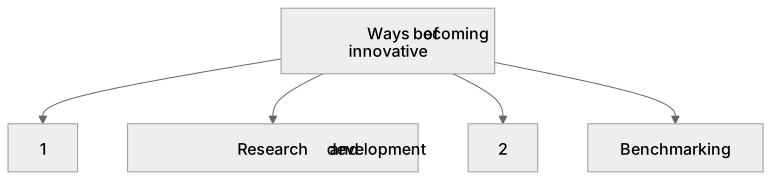
1Box 1
2Box 2
There is more to this lesson
The full lesson goes on to check your understanding and help you earn the marks. Create a free account to carry on, with your progress saved.
A week of Premium from your first lesson · Then the free plan continues · No card, no charge
Test your understanding of Assessing innovation: The ways of becoming an innovative organisation (to include: Ways of becoming innovative include: Kaizen, research and development, intrapreneurship, benchmarking.)
Active recall beats re-reading. Take an instant quiz now to test what you’ve learned and lock it into long-term memory.
A week of Premium from your first lesson · Then the free plan continues · No card, no charge