AQA · A-Level · Business
Course version: 7132 · Version from Sept 2023
Financial management: market conditions and competition
Where a firm sits in its market shapes what a sensible financial target looks like.
- Point 3 of 6
- 3 key terms
Study notes
From the teaching notes for this specification point.
The idea
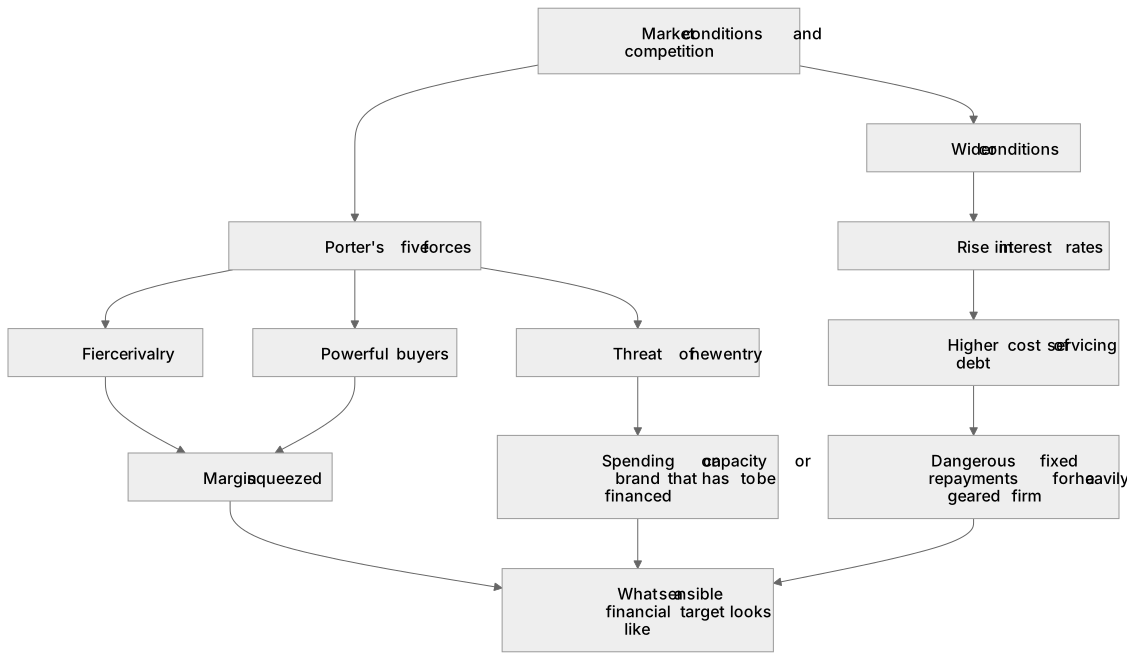
Where a firm sits in its market shapes what a sensible financial target looks like. In a price war a gross margin target of a fifth of revenue may be out of reach, so the board switches to cost and cash objectives until the fight ends. Porter's five forces is the usual frame: fierce rivalry and powerful buyers squeeze margin, while a credible threat of new entry forces spending on capacity or brand that has to be financed somehow. Wider conditions bite too, because a rise in interest rates lifts the cost of servicing debt and makes a heavily geared firm's fixed repayments dangerous. The frame is blind to time and to the firm's own resources, which is exactly where judgement is earned.
What earns the marks
- Reading the market from the stem, saying whether rivalry runs on price or on differentiation, and then stating which financial objective that makes achievable.
- Linking an external change to a specific line in the accounts, for example a rise in interest rates raising finance costs and cutting profit for the year while operating profit is unchanged.
- Using Porter's five forces to organise the analysis and then naming what it cannot see, including how fast a digital rival can enter and what the firm's own cost advantages are worth.
- Judging how long the condition will last, because a temporary downturn argues for protecting cash while a permanent shift argues for restructuring the cost base.
- Distinguishing a market-wide condition from a firm-specific one, since a recession that hits all rivals equally leaves relative position unchanged while a rival's new plant does not.
Common mistakes and how to put them right
Listing external factors as a memorised checklist without saying which one actually bites here, when only one or two of them are doing real work in the stem.
Put it right: Name the one or two forces that genuinely shape this firm's margin or cash, and show the link to a financial objective.
Assuming a recession damages every business, when discount retailers and repair services often gain as consumers trade down.
Put it right: State which way demand moves for this particular product before claiming the effect on revenue.
Treating five forces as the answer rather than as a route to a judgement about this firm's margin and its ability to fund investment.
Put it right: Use the model to structure the analysis, then close with a judgement about what the firm should do and why.
Exam tips
- Market conditions usually appear as the reason a plan might fail, so build them into the evaluation of whatever decision the question is really about.
- If the stem gives a market share or a competitor's price, use the figure rather than writing about competition in general terms.
- Finish by stating the limitation of the model you used, because a supported judgement about what the framework cannot capture strengthens the evaluation.
Try the lesson
The start of the Financial management: market conditions and competition lesson, made from teaching notes for this specification point.
Have a go first
Which market condition is most likely to reduce a firm's ability to raise its selling prices?
Listen
Where a firm sits in its market shapes what a sensible financial target looks like. In a price war a gross margin target of a fifth of revenue may be out of reach, so the board switches to cost and cash objectives until the fight ends. Porter's five forces is the usual frame: fierce rivalry and powerful buyers squeeze margin, while a credible threat of new entry forces spending on capacity or brand that has to be financed somehow. Wider conditions bite too, because a rise in interest rates lifts the cost of servicing debt and makes a heavily geared firm's fixed repayments dangerous. The frame is blind to time and to the firm's own resources, which is exactly where judgement is earned. A strong answer earns marks for these points. Reading the market from the stem, saying whether rivalry runs on price or on differentiation, and then stating which financial objective that makes achievable. Linking an external change to a specific line in the accounts, for example a rise in interest rates raising finance costs and cutting profit for the year while operating profit is unchanged. Using Porter's five forces to organise the analysis and then naming what it cannot see, including how fast a digital rival can enter and what the firm's own cost advantages are worth. Judging how long the condition will last, because a temporary downturn argues for protecting cash while a permanent shift argues for restructuring the cost base. A common slip: Listing external factors as a memorised checklist without saying which one actually bites here, when only one or two of them are doing real work in the stem. Instead, name the one or two forces that genuinely shape this firm's margin or cash, and show the link to a financial objective. Exam tip: Market conditions usually appear as the reason a plan might fail, so build them into the evaluation of whatever decision the question is really about.
See it
Key words
Say what each word means before you turn the card.
external influences on finance
Try answering aloud or in your head before turning the card.
Porter's five forces
Try answering aloud or in your head before turning the card.
setting objectives under uncertainty
Try answering aloud or in your head before turning the card.
See every definition
- external influences on finance
- A rise in interest rates lifts the cost of servicing debt and makes a heavily geared firm's fixed repayments dangerous.
- Porter's five forces
- The usual frame in which fierce rivalry and powerful buyers squeeze margin, while a credible threat of new entry forces spending on capacity or brand.
- setting objectives under uncertainty
- In a price war a gross margin target of a fifth of revenue may be out of reach, so the board switches to cost and cash objectives until the fight ends.
Label the diagram
Some boxes have lost their names. Pick the right name for each number.
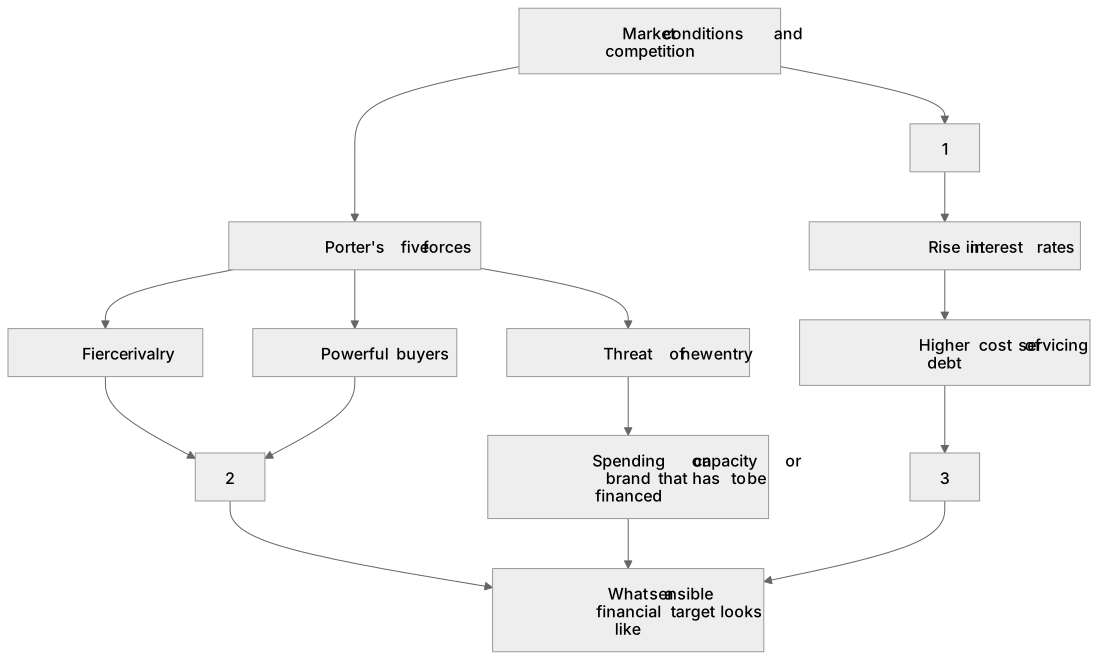
1Box 1
2Box 2
3Box 3
There is more to this lesson
The full lesson goes on to check your understanding and help you earn the marks. Create a free account to carry on, with your progress saved.
A week of Premium from your first lesson · Then the free plan continues · No card, no charge
Test your understanding of Financial management: market conditions and competition
Active recall beats re-reading. Take an instant quiz now to test what you’ve learned and lock it into long-term memory.
A week of Premium from your first lesson · Then the free plan continues · No card, no charge