AQA · A-Level · Business
Course version: 7132 · Version from Sept 2023
Students should consider the following throughout this section of the…
Full specification wording
Human resource management: Students should consider the following throughout this section of the specification:
This is the specification's standing instruction for the whole of human resource management, and it changes what a good answer looks like rather than adding new content.
- Point 1 of 6
- 4 key terms
Study notes
From the teaching notes for this specification point.
The idea
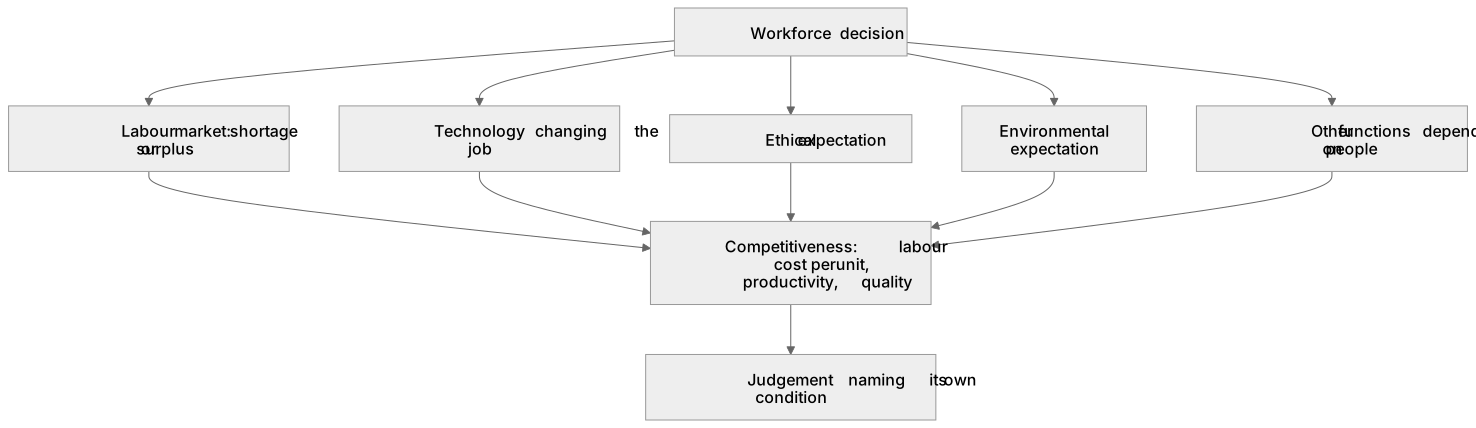
This is the specification's standing instruction for the whole of human resource management, and it changes what a good answer looks like rather than adding new content. Every workforce decision on this paper sits inside a labour market with a shortage or a surplus, a technology that is changing what the job actually is, an ethical expectation about how people are treated, an environmental expectation about the footprint the employer leaves, and three other functions that depend on those people turning up. So a question about delayering is really a question about what operations loses in supervision and what marketing loses in service quality. The bullets that follow are the checklist for the judgement paragraph, and the judgement paragraph is where the difference between a middling answer and a strong one is made.
What earns the marks
- Tying the workforce decision to a named condition in the stem, such as a local shortage of qualified technicians, so the answer is about this employer and not about employers in general.
- Carrying the consequence into another function, for example that a recruitment freeze leaves operations unable to reach the output the sales forecast has already assumed.
- Saying how the decision reaches competitiveness, through labour cost per unit, through productivity or through the quality the customer experiences.
- Bringing in the environmental bullet where it bites, for instance that a decision to move staff to remote working cuts commuting emissions as well as office costs.
- Closing on a judgement that names its own condition, such as whether the skills shortage is temporary or structural.
Common mistakes and how to put them right
Setting out a motivation theory in full and never returning to the business in the case, which leaves the application and evaluation marks out of reach.
Treating ethics as a paragraph added at the end rather than a factor inside the decision, for instance ignoring what casual contracts do to the employer reputation.
Forgetting that the labour market limits what the firm can do, and recommending recruitment in a market where nobody is available at the wage on offer.
Leaving the environmental bullet out altogether, when a workforce decision such as relocation or remote working has an obvious environmental dimension.
Exam tips
- Read the stem sentences about the labour market, technology and the environment before you plan, because they are the hooks the mark scheme is built around.
- The longer human resource questions carry more marks for judgement than for describing a theory, so budget your writing time to match.
- Assess and evaluate questions here usually expect the people option to be compared with something else, most often automation.
Try the lesson
The start of the Human resource management: Students should consider the following throughout this section of the specification: lesson, made from teaching notes for this specification point.
Have a go first
Which term describes the proportion of employees who leave a business over a given period?
Listen
This is the specification's standing instruction for the whole of human resource management, and it changes what a good answer looks like rather than adding new content. Every workforce decision on this paper sits inside a labour market with a shortage or a surplus, a technology that is changing what the job actually is, an ethical expectation about how people are treated, an environmental expectation about the footprint the employer leaves, and three other functions that depend on those people turning up. So a question about delayering is really a question about what operations loses in supervision and what marketing loses in service quality. The bullets that follow are the checklist for the judgement paragraph, and the judgement paragraph is where the difference between a middling answer and a strong one is made. A strong answer earns marks for these points. Tying the workforce decision to a named condition in the stem, such as a local shortage of qualified technicians, so the answer is about this employer and not about employers in general. Carrying the consequence into another function, for example that a recruitment freeze leaves operations unable to reach the output the sales forecast has already assumed. Saying how the decision reaches competitiveness, through labour cost per unit, through productivity or through the quality the customer experiences. Bringing in the environmental bullet where it bites, for instance that a decision to move staff to remote working cuts commuting emissions as well as office costs. Exam tip: Read the stem sentences about the labour market, technology and the environment before you plan, because they are the hooks the mark scheme is built around.
See it
Key words
Say what each word means before you turn the card.
labour market conditions
Try answering aloud or in your head before turning the card.
functional interdependence
Try answering aloud or in your head before turning the card.
competitiveness through people
Try answering aloud or in your head before turning the card.
environmental influences on workforce decisions
Try answering aloud or in your head before turning the card.
See every definition
- labour market conditions
- Every workforce decision sits inside a labour market with a shortage or a surplus, which limits what the firm can do.
- functional interdependence
- Three other functions depend on those people turning up, so a workforce decision carries consequences into another function.
- competitiveness through people
- A decision reaches competitiveness through labour cost per unit, through productivity or through the quality the customer experiences.
- environmental influences on workforce decisions
- An environmental expectation about the footprint the employer leaves, where a decision such as relocation or remote working has an obvious environmental dimension.
Label the diagram
Some boxes have lost their names. Pick the right name for each number.
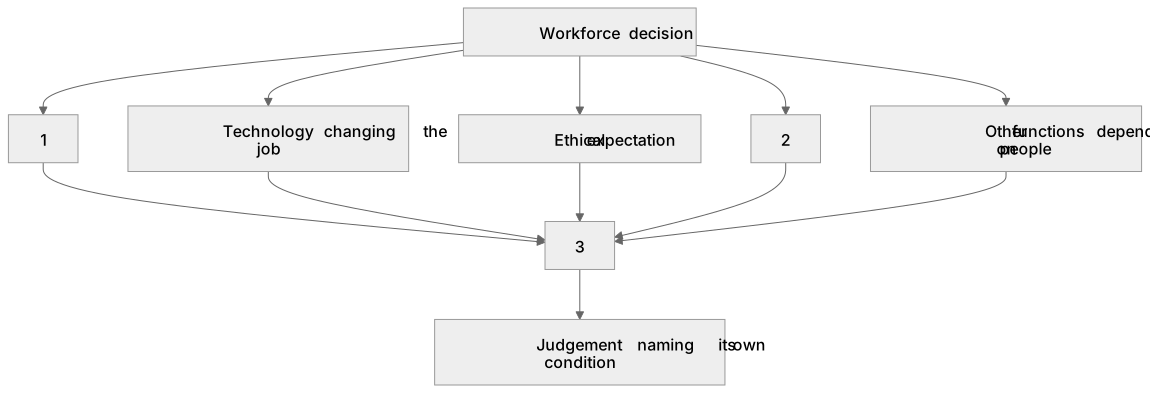
1Box 1
2Box 2
3Box 3
There is more to this lesson
The full lesson goes on to check your understanding and help you earn the marks. Create a free account to carry on, with your progress saved.
A week of Premium from your first lesson · Then the free plan continues · No card, no charge
Test your understanding of Human resource management: Students should consider the following throughout this section of the specification:
Active recall beats re-reading. Take an instant quiz now to test what you’ve learned and lock it into long-term memory.
A week of Premium from your first lesson · Then the free plan continues · No card, no charge