AQA · A-Level · Business
Course version: 7132 · Version from Sept 2023
Improving employer-employee relations: Influences on the extent and…
Full specification wording
Making human resource decisions: improving employer-employee relations: Influences on the extent and methods of employee involvement in decision making (to include: Employee representation methods to include trade unions and works councils.)
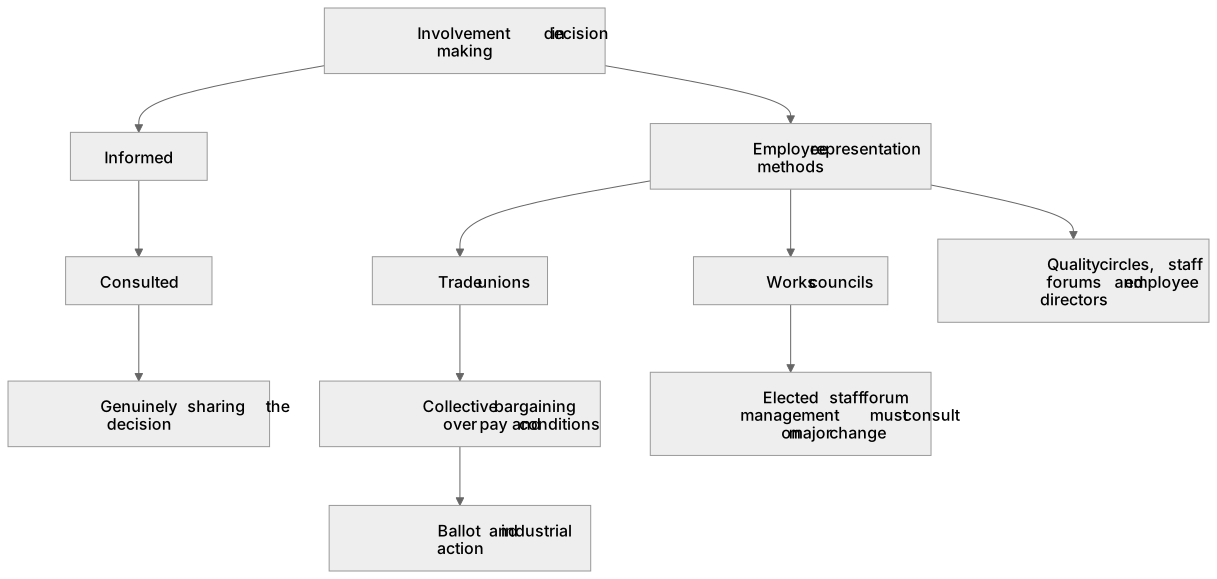
Involvement runs along a ladder from being informed, through being consulted, to genuinely sharing the decision, and the marks come from knowing which rung a business is actually on.
- Point 1 of 3
- 4 key terms
Study notes
From the teaching notes for this specification point.
The idea
Involvement runs along a ladder from being informed, through being consulted, to genuinely sharing the decision, and the marks come from knowing which rung a business is actually on. A recognised trade union bargains collectively over pay and conditions and can escalate to a ballot and industrial action. A works council is a standing forum of elected staff that management must consult on major change, standard across much of the European Union and long used by firms such as Volkswagen. Quality circles, staff forums and employee directors sit between the two. What decides the extent is management style and whether leaders trust staff with information, the size and spread of the workforce, union density in the sector, the law, the urgency of the decision and the cost of consulting.
What earns the marks
- Distinguishing consultation, where management asks and then decides, from negotiation, where agreement is needed, because the difference decides how much power staff really hold.
- Explaining what a named method actually does, so a works council covers union and non-union staff and must be consulted on restructuring, while a union negotiates terms for its members.
- Tying an influence to the firm, such as low union density in a young technology company making a staff forum more likely than recognition of a union.
- Weighing the trade-off directly, that involvement improves the quality of a decision and buy-in for it, while slowing it and raising expectations the firm may not be able to meet.
Common mistakes and how to put them right
Treating trade unions as automatically hostile and equating involvement with strikes, when most union work is routine consultation that never reaches a ballot.
Recommending that a business should involve staff more without saying in which decisions, through which forum, and at what cost in management time.
Confusing a works council with a union, and so claiming the council can call a strike or sign a pay deal.
Arguing that involvement always improves motivation, when consultation that visibly changes nothing is more corrosive than not asking at all.
Exam tips
- Involvement is often set inside a change scenario, so link it to Kotter and Schlesinger, where participation converts resistance into ownership but is the slowest route to a decision.
- Check the case for whether a union is recognised and what proportion of staff belong to it, because that single fact drives most of the analysis.
- Finish by sorting decisions into types; a routine shift rota is worth consulting on, an urgent plant closure rarely survives a long consultation.
Try the lesson
The start of the Making human resource decisions: improving employer-employee relations: Influences on the extent and methods of employee involvement in decision making (to include: Employee representation methods to include trade unions and works councils.) lesson, made from teaching notes for this specification point.
Have a go first
Which of the following is a formal method of employee representation in decision making?
Listen
Involvement runs along a ladder from being informed, through being consulted, to genuinely sharing the decision, and the marks come from knowing which rung a business is actually on. A recognised trade union bargains collectively over pay and conditions and can escalate to a ballot and industrial action. A works council is a standing forum of elected staff that management must consult on major change, standard across much of the European Union and long used by firms such as Volkswagen. Quality circles, staff forums and employee directors sit between the two. What decides the extent is management style and whether leaders trust staff with information, the size and spread of the workforce, union density in the sector, the law, the urgency of the decision and the cost of consulting. A strong answer earns marks for these points. Distinguishing consultation, where management asks and then decides, from negotiation, where agreement is needed, because the difference decides how much power staff really hold. Explaining what a named method actually does, so a works council covers union and non-union staff and must be consulted on restructuring, while a union negotiates terms for its members. Tying an influence to the firm, such as low union density in a young technology company making a staff forum more likely than recognition of a union. Weighing the trade-off directly, that involvement improves the quality of a decision and buy-in for it, while slowing it and raising expectations the firm may not be able to meet. Exam tip: Involvement is often set inside a change scenario, so link it to Kotter and Schlesinger, where participation converts resistance into ownership but is the slowest route to a decision.
See it
Key words
Say what each word means before you turn the card.
consultation versus negotiation
Try answering aloud or in your head before turning the card.
trade union recognition
Try answering aloud or in your head before turning the card.
works councils
Try answering aloud or in your head before turning the card.
management style and trust
Try answering aloud or in your head before turning the card.
See every definition
- consultation versus negotiation
- Management asks staff and then decides, whereas agreement is needed in negotiation, and the difference decides how much power staff really hold.
- trade union recognition
- A recognised trade union bargains collectively over pay and conditions and can escalate to a ballot and industrial action.
- works councils
- A standing forum of elected staff that management must consult on major change, covering union and non-union staff.
- management style and trust
- What decides the extent of involvement is management style and whether leaders trust staff with information.
Label the diagram
Some boxes have lost their names. Pick the right name for each number.
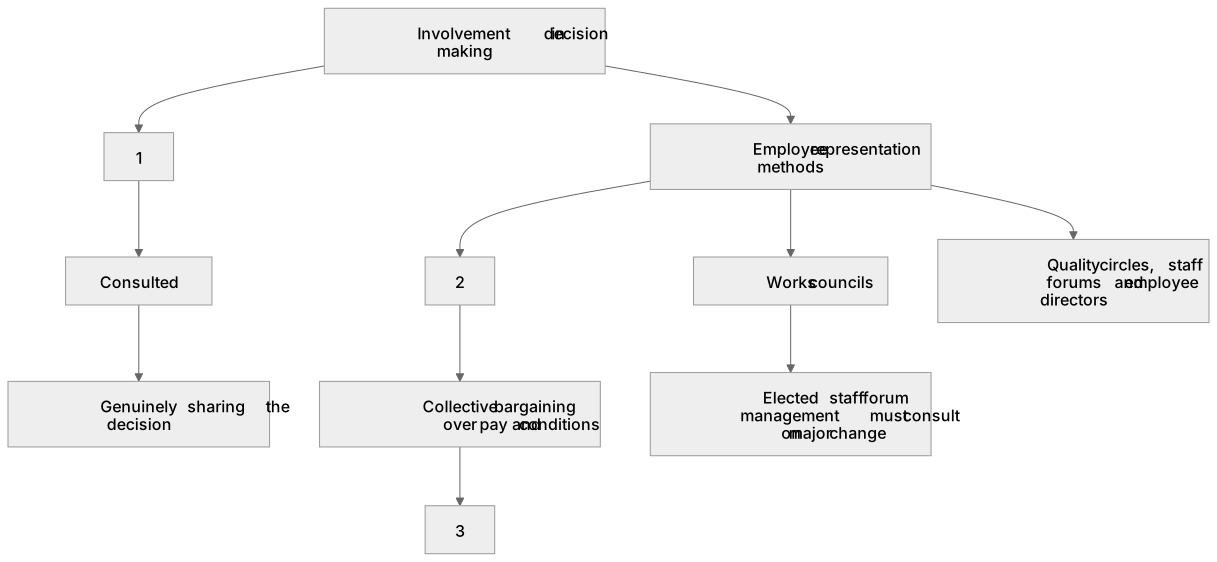
1Box 1
2Box 2
3Box 3
There is more to this lesson
The full lesson goes on to check your understanding and help you earn the marks. Create a free account to carry on, with your progress saved.
A week of Premium from your first lesson · Then the free plan continues · No card, no charge
Test your understanding of Making human resource decisions: improving employer-employee relations: Influences on the extent and methods of employee involvement in decision making (to include: Employee representation methods to include trade unions and works councils.)
Active recall beats re-reading. Take an instant quiz now to test what you’ve learned and lock it into long-term memory.
A week of Premium from your first lesson · Then the free plan continues · No card, no charge