AQA · A-Level · Business
Course version: 7132 · Version from Sept 2023
Improving employer-employee relations: How to manage and improve…
Full specification wording
Making human resource decisions: improving employer-employee relations: How to manage and improve employer-employee communications and relations
Communication only improves when the channel suits the message and the feedback loop actually closes, which in practice means team briefings and appraisals for anything sensitive, an intranet or…
- Point 2 of 3
- 4 key terms
Study notes
From the teaching notes for this specification point.
The idea
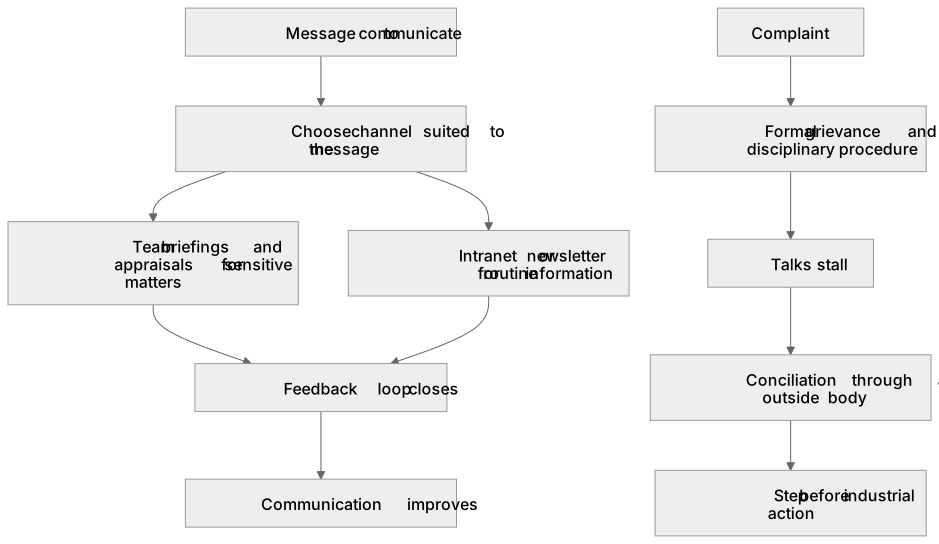
Communication only improves when the channel suits the message and the feedback loop actually closes, which in practice means team briefings and appraisals for anything sensitive, an intranet or newsletter for routine information, and a formal grievance and disciplinary procedure so a complaint has somewhere to go before it becomes a dispute. Firms also use single union agreements, no strike deals with binding arbitration, joint consultative committees, and the Advisory, Conciliation and Arbitration Service once talks stall. The obstacles are worth naming: too many layers in the hierarchy distort a message on the way down, a wide span of control leaves managers no time to listen, shift and remote work fragments the audience, and overload means the important notice is the one nobody opens.
What earns the marks
- Naming a specific channel and the problem it solves, for instance a monthly team briefing with a question session to stop rumour spreading ahead of a restructure.
- Showing the communication is two way, with evidence that feedback changed a decision, because a newsletter that only broadcasts is information rather than consultation.
- Identifying a structural cause, so delayering or widening a narrow chain of command is offered as the fix where messages are being distorted between shop floor and board.
- Recognising escalation, that a grievance procedure handles the individual case and conciliation through an outside body is the step before industrial action, not a substitute for talking.
Common mistakes and how to put them right
Offering improve communication as a catch-all remedy with no channel, frequency or audience named, which examiners see constantly and reward with almost nothing.
Assuming more communication is always better, when overload and constant consultation slow decisions and leave staff ignoring the message that mattered.
Believing a grievance procedure prevents disputes, when what it does is channel them, so relations can still be poor while the paperwork is immaculate.
Confusing communication with relations, so a slick internal app is presented as proof of trust that the turnover and absence figures flatly contradict.
Exam tips
- This topic is regularly paired with change management, so use Kotter and Schlesinger, where communication and education is the method for resistance built on poor information.
- Mine the appendix for a symptom such as a rise in grievances, days lost or an engagement score, and make your chosen method treat that symptom.
- On the medium length analyse questions, build one chain fully, from the method to the effect on staff to the effect on cost or output, rather than three half chains.
Try the lesson
The start of the Making human resource decisions: improving employer-employee relations: How to manage and improve employer-employee communications and relations lesson, made from teaching notes for this specification point.
Have a go first
Which method of communication involves managers and employees meeting face to face to discuss work issues?
Listen
Communication only improves when the channel suits the message and the feedback loop actually closes, which in practice means team briefings and appraisals for anything sensitive, an intranet or newsletter for routine information, and a formal grievance and disciplinary procedure so a complaint has somewhere to go before it becomes a dispute. Firms also use single union agreements, no strike deals with binding arbitration, joint consultative committees, and the Advisory, Conciliation and Arbitration Service once talks stall. The obstacles are worth naming: too many layers in the hierarchy distort a message on the way down, a wide span of control leaves managers no time to listen, shift and remote work fragments the audience, and overload means the important notice is the one nobody opens. A strong answer earns marks for these points. Naming a specific channel and the problem it solves, for instance a monthly team briefing with a question session to stop rumour spreading ahead of a restructure. Showing the communication is two way, with evidence that feedback changed a decision, because a newsletter that only broadcasts is information rather than consultation. Identifying a structural cause, so delayering or widening a narrow chain of command is offered as the fix where messages are being distorted between shop floor and board. Recognising escalation, that a grievance procedure handles the individual case and conciliation through an outside body is the step before industrial action, not a substitute for talking. Exam tip: This topic is regularly paired with change management, so use Kotter and Schlesinger, where communication and education is the method for resistance built on poor information.
See it
Key words
Say what each word means before you turn the card.
two-way communication
Try answering aloud or in your head before turning the card.
grievance and disciplinary procedures
Try answering aloud or in your head before turning the card.
hierarchy and span of control
Try answering aloud or in your head before turning the card.
conciliation and arbitration
Try answering aloud or in your head before turning the card.
See every definition
- two-way communication
- Communication where the feedback loop actually closes, with evidence that feedback changed a decision, rather than a newsletter that only broadcasts information.
- grievance and disciplinary procedures
- A formal procedure so a complaint has somewhere to go before it becomes a dispute, handling the individual case.
- hierarchy and span of control
- Structural causes of poor communication: too many layers distort a message on the way down, and a wide span leaves managers no time to listen.
- conciliation and arbitration
- Steps used once talks stall, including conciliation through an outside body as the step before industrial action, and binding arbitration under no strike deals.
Label the diagram
Some boxes have lost their names. Pick the right name for each number.
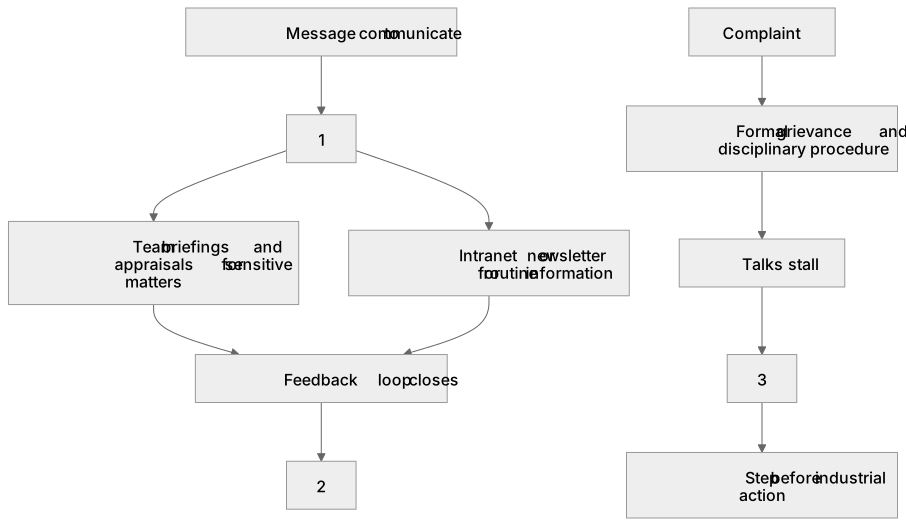
1Box 1
2Box 2
3Box 3
There is more to this lesson
The full lesson goes on to check your understanding and help you earn the marks. Create a free account to carry on, with your progress saved.
A week of Premium from your first lesson · Then the free plan continues · No card, no charge
Test your understanding of Making human resource decisions: improving employer-employee relations: How to manage and improve employer-employee communications and relations
Active recall beats re-reading. Take an instant quiz now to test what you’ve learned and lock it into long-term memory.
A week of Premium from your first lesson · Then the free plan continues · No card, no charge