AQA · A-Level · Business
Course version: 7132 · Version from Sept 2023
Improving employer-employee relations: Value of good employer-employee…
Full specification wording
Making human resource decisions: improving employer-employee relations: Value of good employer-employee relations
The commercial case is measurable.
- Point 3 of 3
- 3 key terms
Study notes
From the teaching notes for this specification point.
The idea
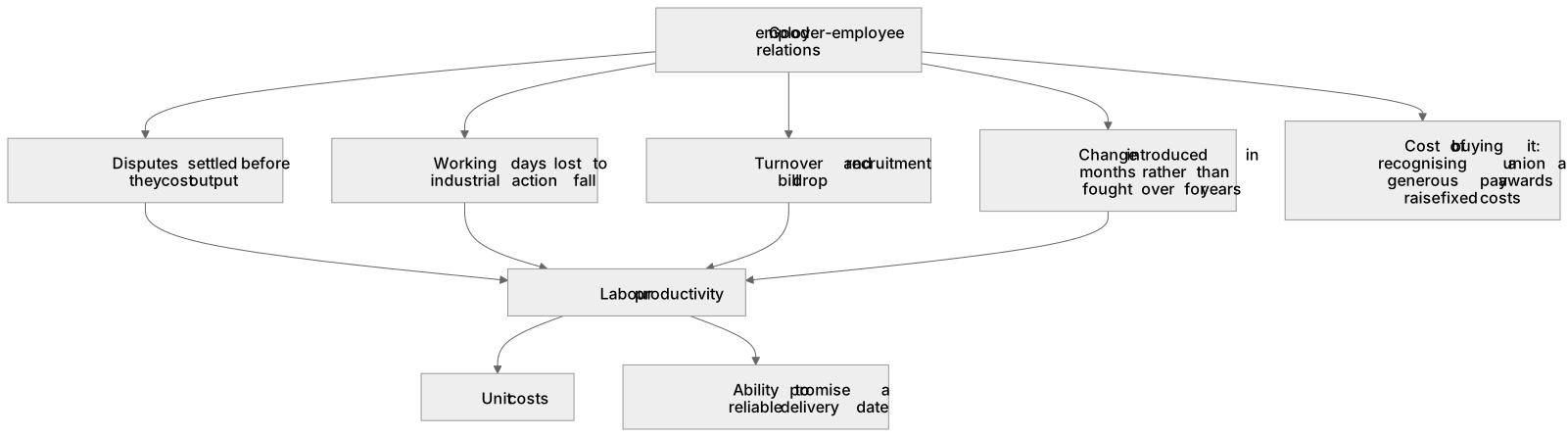
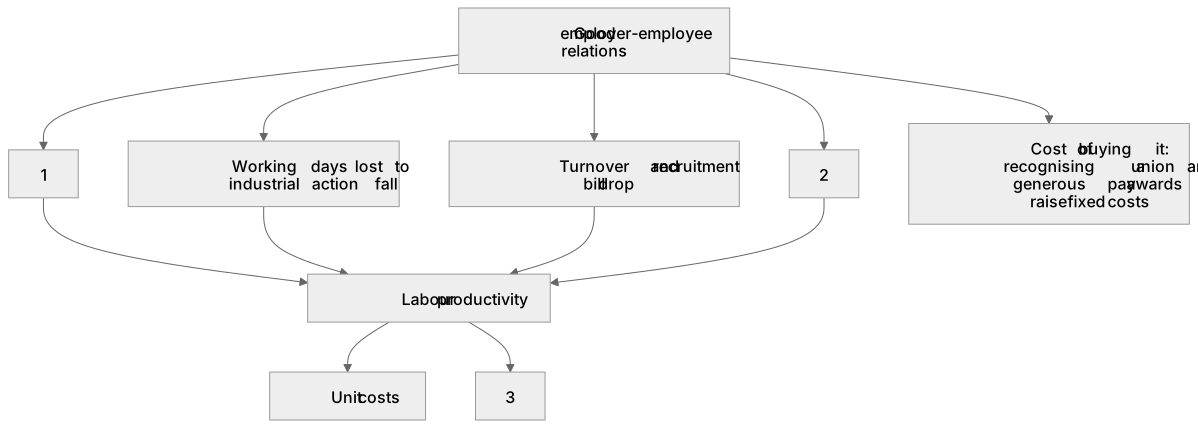
The commercial case is measurable. Where the workforce and management trust each other, disputes are settled before they cost output, working days lost to industrial action fall towards nothing, turnover and the recruitment bill drop, and a change such as new technology or a new shift pattern can be introduced in months rather than fought over for years. That runs straight into labour productivity, unit costs and the ability to promise a reliable delivery date. The reverse is publicly expensive, as strike days at Royal Mail and on the railways showed, since the revenue lost while customers switch does not come back. The evaluation lies in the price of buying it, because recognising a union and conceding generous pay awards raises fixed costs that are hard to reverse in a downturn.
What earns the marks
- Quantifying the gain where the case allows, using working days lost, turnover rates, recruitment cost per hire or output lost during a stoppage rather than asserting that relations are important.
- Linking sound relations to the ease of implementing change, using Lewin's unfreezing or Kotter's coalition to argue that trust shortens the time a firm takes to adapt.
- Stating the cost side, that settlements, consultation time and conceded working practices raise fixed costs, so the benefit has to exceed a real and continuing price.
- Judging by sector and strategy, since a firm competing on cost leadership with low skilled and easily replaced labour gains less from investing in relations than a hospital or an airline does.
Common mistakes and how to put them right
Asserting that happy workers work harder with no mechanism and no measure attached, which is the single most common weak paragraph in this part of the paper.
Ignoring that good relations cost money, so the answer reads as a list of benefits with no judgement, which cannot reach the top evaluation level.
Treating industrial action as the only sign of poor relations, when absence, turnover, grievance numbers and quality usually move first and are visible earlier.
Claiming that recognising a union always prevents disputes, when recognition also gives staff a vehicle for organising one.
Exam tips
- This is typically the long evaluate question closing the human resources section, so decide in advance which measure of relations matters most for this firm and justify that criterion.
- Use the case's own numbers, since a judgement built on a quoted turnover rate or an appendix of days lost is what separates the top level from a fluent but general answer.
- Connect back to corporate objectives, because relations are a means to something, whether that is reliable delivery, low unit cost or a reputation that helps recruitment.
Try the lesson
The start of the Making human resource decisions: improving employer-employee relations: Value of good employer-employee relations lesson, made from teaching notes for this specification point.
Have a go first
Which of the following is a primary benefit to a business of maintaining good employer-employee relations?
Listen
The commercial case is measurable. Where the workforce and management trust each other, disputes are settled before they cost output, working days lost to industrial action fall towards nothing, turnover and the recruitment bill drop, and a change such as new technology or a new shift pattern can be introduced in months rather than fought over for years. That runs straight into labour productivity, unit costs and the ability to promise a reliable delivery date. The reverse is publicly expensive, as strike days at Royal Mail and on the railways showed, since the revenue lost while customers switch does not come back. The evaluation lies in the price of buying it, because recognising a union and conceding generous pay awards raises fixed costs that are hard to reverse in a downturn. A strong answer earns marks for these points. Quantifying the gain where the case allows, using working days lost, turnover rates, recruitment cost per hire or output lost during a stoppage rather than asserting that relations are important. Linking sound relations to the ease of implementing change, using Lewin's unfreezing or Kotter's coalition to argue that trust shortens the time a firm takes to adapt. Stating the cost side, that settlements, consultation time and conceded working practices raise fixed costs, so the benefit has to exceed a real and continuing price. Judging by sector and strategy, since a firm competing on cost leadership with low skilled and easily replaced labour gains less from investing in relations than a hospital or an airline does. Exam tip: This is typically the long evaluate question closing the human resources section, so decide in advance which measure of relations matters most for this firm and justify that criterion.
See it
Key words
Say what each word means before you turn the card.
days lost to industrial action
Try answering aloud or in your head before turning the card.
implementing change
Try answering aloud or in your head before turning the card.
cost of settlements
Try answering aloud or in your head before turning the card.
See every definition
- days lost to industrial action
- A measure of disputes that falls towards nothing where the workforce and management trust each other.
- implementing change
- Introducing something such as new technology or a new shift pattern, which can be done in months rather than fought over for years where trust exists.
- cost of settlements
- A price on the cost side, since conceding generous pay awards raises fixed costs that are hard to reverse in a downturn.
Label the diagram
Some boxes have lost their names. Pick the right name for each number.
1Box 1
2Box 2
3Box 3
There is more to this lesson
The full lesson goes on to check your understanding and help you earn the marks. Create a free account to carry on, with your progress saved.
A week of Premium from your first lesson · Then the free plan continues · No card, no charge
Test your understanding of Making human resource decisions: improving employer-employee relations: Value of good employer-employee relations
Active recall beats re-reading. Take an instant quiz now to test what you’ve learned and lock it into long-term memory.
A week of Premium from your first lesson · Then the free plan continues · No card, no charge