AQA · A-Level · Business
Course version: 7132 · Version from Sept 2023
Improving organisational design and managing the human resource flow:…
Full specification wording
Making human resource decisions: improving organisational design and managing the human resource flow: Influences on organisational design (to include: Decisions relating to organisational design include: authority, span, hierarchy, delegation, centralisation and decentralisation.)
Design is the set of choices that turn a chart into a working chain of command.
- Point 2 of 4
- 4 key terms
Study notes
From the teaching notes for this specification point.
The idea
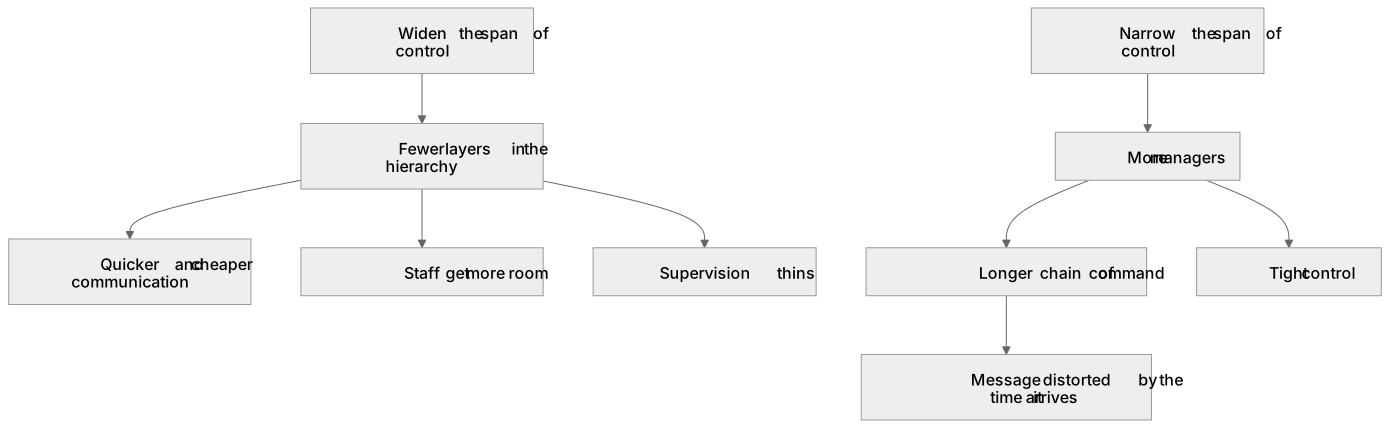
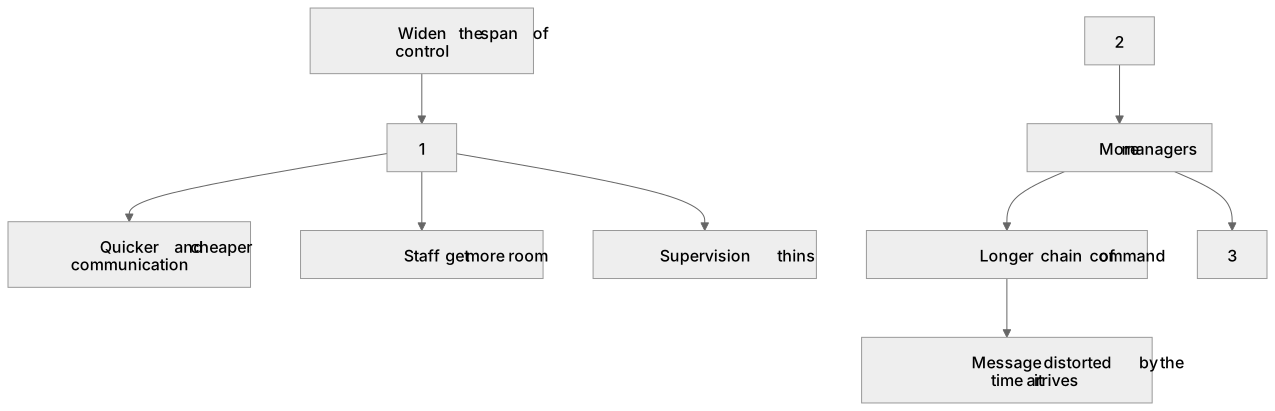
Design is the set of choices that turn a chart into a working chain of command. Authority is the right to decide; delegation passes the task and the authority down while accountability stays with the manager who gave it away. The span of control is the number of people reporting directly to one manager, and it fixes the height of the structure for a given workforce: widen it and layers disappear, communication is quicker and cheaper and staff get more room, but supervision thins. Narrow it and control is tight, at the price of more managers, a longer chain and a message distorted by the time it arrives. Keeping decisions at the top is fast in a crisis and consistent across sites; pushing them down puts them next to the local market and, in Herzberg's terms, hands over the responsibility that motivates. Size, staff skill, technology and the leader's own style decide which fits.
What earns the marks
- Defining the span of control as the number of subordinates reporting directly to one manager and linking it to the number of layers in the structure.
- Separating the delegated task from accountability, which does not move.
- Explaining why this firm can widen its spans, for example because staff are experienced or because a system now reports performance automatically.
- Using a motivation theorist to explain why pushing decisions downward can raise effort, rather than asserting that staff like having a say.
- Weighing the saving from removing a layer against the loss of supervision and of promotion opportunities.
Common mistakes and how to put them right
Confusing the span of control with the chain of command, so the answer claims a wide span produces a tall structure.
Writing that delegation reduces a manager's workload without noting the time taken to train and monitor whoever takes the task on.
Assuming decentralised decisions always motivate, when handing responsibility to an untrained supervisor produces stress rather than satisfaction.
Treating central control as old fashioned, when a brand that must look identical in every store depends on it.
Exam tips
- The command word is usually analyse or assess, so take one design decision and follow it through to an objective rather than defining every term in the list.
- Bring in the pace of change in the market, since a fast moving market is the strongest argument for pushing decisions downward.
- If the case gives staff numbers and layers, use them; working out the average span makes the argument concrete.
Try the lesson
The start of the Making human resource decisions: improving organisational design and managing the human resource flow: Influences on organisational design (to include: Decisions relating to organisational design include: authority, span, hierarchy, delegation, centralisation and decentralisation.) lesson, made from teaching notes for this specification point.
Have a go first
What is meant by the span of control in an organisational structure?
Listen
Design is the set of choices that turn a chart into a working chain of command. Authority is the right to decide; delegation passes the task and the authority down while accountability stays with the manager who gave it away. The span of control is the number of people reporting directly to one manager, and it fixes the height of the structure for a given workforce: widen it and layers disappear, communication is quicker and cheaper and staff get more room, but supervision thins. Narrow it and control is tight, at the price of more managers, a longer chain and a message distorted by the time it arrives. Keeping decisions at the top is fast in a crisis and consistent across sites; pushing them down puts them next to the local market and, in Herzberg's terms, hands over the responsibility that motivates. Size, staff skill, technology and the leader's own style decide which fits. A strong answer earns marks for these points. Defining the span of control as the number of subordinates reporting directly to one manager and linking it to the number of layers in the structure. Separating the delegated task from accountability, which does not move. Explaining why this firm can widen its spans, for example because staff are experienced or because a system now reports performance automatically. Using a motivation theorist to explain why pushing decisions downward can raise effort, rather than asserting that staff like having a say. Exam tip: The command word is usually analyse or assess, so take one design decision and follow it through to an objective rather than defining every term in the list.
See it
Key words
Say what each word means before you turn the card.
span of control
Try answering aloud or in your head before turning the card.
delegation
Try answering aloud or in your head before turning the card.
centralised decisions
Try answering aloud or in your head before turning the card.
decentralised decisions
Try answering aloud or in your head before turning the card.
See every definition
- span of control
- The number of people reporting directly to one manager, which fixes the height of the structure for a given workforce.
- delegation
- Passing the task and the authority down, while accountability stays with the manager who gave it away.
- centralised decisions
- Keeping decisions at the top, which is fast in a crisis and consistent across sites.
- decentralised decisions
- Pushing decisions down, which puts them next to the local market and hands over the responsibility that motivates.
Label the diagram
Some boxes have lost their names. Pick the right name for each number.
1Box 1
2Box 2
3Box 3
There is more to this lesson
The full lesson goes on to check your understanding and help you earn the marks. Create a free account to carry on, with your progress saved.
A week of Premium from your first lesson · Then the free plan continues · No card, no charge
Test your understanding of Making human resource decisions: improving organisational design and managing the human resource flow: Influences on organisational design (to include: Decisions relating to organisational design include: authority, span, hierarchy, delegation, centralisation and decentralisation.)
Active recall beats re-reading. Take an instant quiz now to test what you’ve learned and lock it into long-term memory.
A week of Premium from your first lesson · Then the free plan continues · No card, no charge