AQA · A-Level · Business
Course version: 7132 · Version from Sept 2023
Improving organisational design and managing the human resource flow:…
Full specification wording
Making human resource decisions: improving organisational design and managing the human resource flow: Models of organisational structure (to include: Organisational structures to include: functional, product-based, regional, matrix structure.)
A structure is a decision about how work is grouped and who answers to whom, and every grouping buys one thing at the price of another.
- Point 1 of 4
- 4 key terms
Study notes
From the teaching notes for this specification point.
The idea
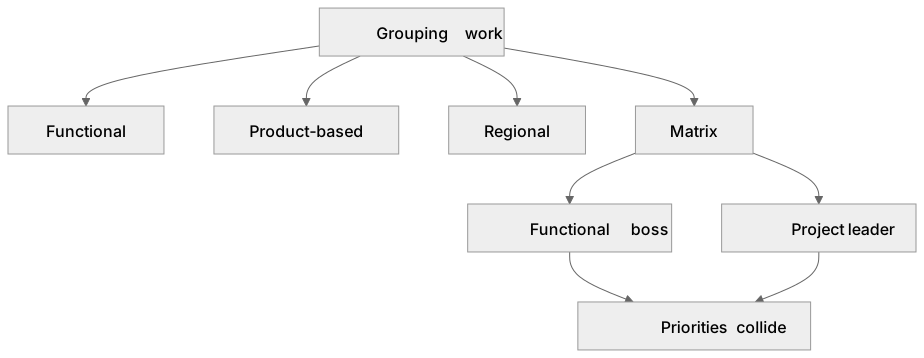
A structure is a decision about how work is grouped and who answers to whom, and every grouping buys one thing at the price of another. Grouping by specialism concentrates expertise and spreads the cost of a single finance or marketing team, but breeds silos and pushes every cross cutting decision upward. Grouping by product gives each division its own profit figure and quick decisions in its own market, at the cost of duplicated support functions. Grouping by region suits a firm whose customers, laws and tastes differ country by country, and duplicates more still. A matrix crosses the two, giving staff a functional boss and a project leader, which suits Handy's task culture and breaks unity of command, so priorities collide and meetings multiply. What every chart is blind to is influence: it shows reporting lines, not who is actually listened to.
What earns the marks
- Describing the structure through the case, for example that the firm has a separate managing director and sales team for each product range.
- Naming one specific benefit and one specific cost of the structure the firm uses rather than listing features of all four.
- Recognising that a matrix gives an employee two managers, and explaining the conflict over priorities and deadlines that follows.
- Linking structure to strategy, so a business growing by entering new countries has a reason to move to regional divisions.
- Judging fit against size and pace of change, since a structure that suited fifty staff rarely suits five hundred.
Common mistakes and how to put them right
Describing the chart and stopping, so the answer never says what the structure does to the speed or quality of decisions.
Treating a flat structure and a matrix as the same thing, when one is about the number of layers and the other about who reports to whom.
Claiming a matrix improves communication with no mention that the same employee now carries two sets of deadlines.
Assuming the formal chart is what happens, ignoring the informal networks and the culture that decide how quickly anything moves.
Exam tips
- Questions pair a structure with a problem in the case, such as slow product launches, so answer the problem rather than the textbook.
- Analyse marks come from a chain that ends at an objective: structure, decision speed, time to market, then revenue.
- For evaluate, weigh the cost of reorganising against the gain, because the chart can be redrawn in an afternoon and the behaviour cannot.
Try the lesson
The start of the Making human resource decisions: improving organisational design and managing the human resource flow: Models of organisational structure (to include: Organisational structures to include: functional, product-based, regional, matrix structure.) lesson, made from teaching notes for this specification point.
Have a go first
Which organisational structure groups employees by the type of work they do, such as marketing, finance and operations?
Listen
A structure is a decision about how work is grouped and who answers to whom, and every grouping buys one thing at the price of another. Grouping by specialism concentrates expertise and spreads the cost of a single finance or marketing team, but breeds silos and pushes every cross cutting decision upward. Grouping by product gives each division its own profit figure and quick decisions in its own market, at the cost of duplicated support functions. Grouping by region suits a firm whose customers, laws and tastes differ country by country, and duplicates more still. A matrix crosses the two, giving staff a functional boss and a project leader, which suits Handy's task culture and breaks unity of command, so priorities collide and meetings multiply. What every chart is blind to is influence: it shows reporting lines, not who is actually listened to. A strong answer earns marks for these points. Describing the structure through the case, for example that the firm has a separate managing director and sales team for each product range. Naming one specific benefit and one specific cost of the structure the firm uses rather than listing features of all four. Recognising that a matrix gives an employee two managers, and explaining the conflict over priorities and deadlines that follows. Linking structure to strategy, so a business growing by entering new countries has a reason to move to regional divisions. Exam tip: Questions pair a structure with a problem in the case, such as slow product launches, so answer the problem rather than the textbook.
See it
Key words
Say what each word means before you turn the card.
functional grouping
Try answering aloud or in your head before turning the card.
product divisions
Try answering aloud or in your head before turning the card.
regional divisions
Try answering aloud or in your head before turning the card.
matrix working
Try answering aloud or in your head before turning the card.
See every definition
- functional grouping
- Grouping by specialism concentrates expertise and spreads the cost of a single finance or marketing team, but breeds silos and pushes every cross cutting decision upward.
- product divisions
- Grouping by product gives each division its own profit figure and quick decisions in its own market, at the cost of duplicated support functions.
- regional divisions
- Grouping by region suits a firm whose customers, laws and tastes differ country by country, and duplicates more still.
- matrix working
- A matrix crosses the two, giving staff a functional boss and a project leader, which suits Handy's task culture and breaks unity of command, so priorities collide and meetings multiply.
Label the diagram
Some boxes have lost their names. Pick the right name for each number.
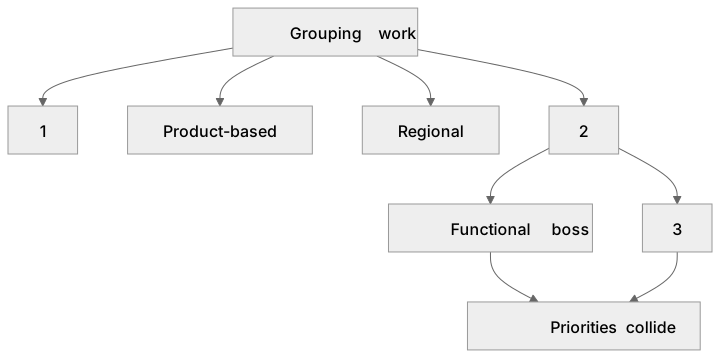
1Box 1
2Box 2
3Box 3
There is more to this lesson
The full lesson goes on to check your understanding and help you earn the marks. Create a free account to carry on, with your progress saved.
A week of Premium from your first lesson · Then the free plan continues · No card, no charge
Test your understanding of Making human resource decisions: improving organisational design and managing the human resource flow: Models of organisational structure (to include: Organisational structures to include: functional, product-based, regional, matrix structure.)
Active recall beats re-reading. Take an instant quiz now to test what you’ve learned and lock it into long-term memory.
A week of Premium from your first lesson · Then the free plan continues · No card, no charge