AQA · A-Level · Business
Course version: 7132 · Version from Sept 2023
Using the marketing mix: Decisions relating to other elements of the…
Full specification wording
Making marketing decisions: using the marketing mix: Decisions relating to other elements of the marketing mix: people, process and physical environment
Where the customer is present while the service is produced, the staff, the system and the surroundings are the product.
- Point 7 of 9
- 4 key terms
Study notes
From the teaching notes for this specification point.
The idea
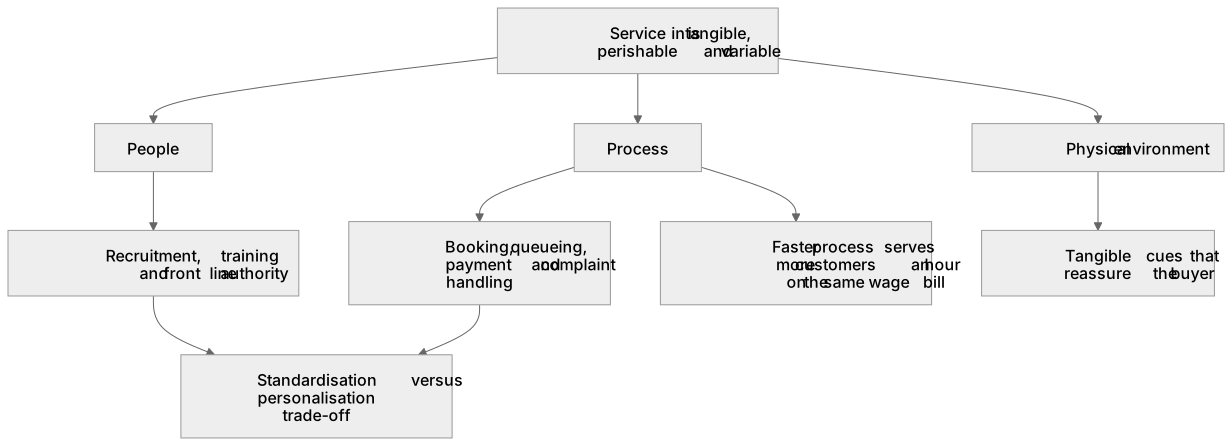
Where the customer is present while the service is produced, the staff, the system and the surroundings are the product. People covers recruitment, training and how much authority a front line employee has to fix a problem without asking a manager. Process covers booking, queueing, payment and complaint handling, and is usually where cost and satisfaction are won together, since a faster process serves more customers an hour on the same wage bill. Physical environment covers the tangible cues that reassure a buyer who cannot test the service first, from the state of a waiting room to the clarity of an app. All three exist because a service is intangible, perishable and variable. The trade-off costs real money: scripting a process makes quality consistent but removes the discretion that makes service feel personal.
What earns the marks
- Explaining the three extra elements as a response to a service being intangible, perishable and variable, not as three more headings to memorise.
- Giving a concrete process improvement for the business in the stem, such as online booking cutting queue time, and linking it to capacity utilisation.
- Connecting people to human resource decisions, so training, pay and empowerment become the mechanism by which service quality improves.
- Recognising the tension between standardisation, which protects consistency and cost, and personalisation, which lifts satisfaction and cost together.
Common mistakes and how to put them right
Listing the three elements without attaching any of them to the service described, which reads as learned content rather than analysis.
Assuming better service must mean more staff, when redesigning the process often raises capacity utilisation with no extra wage cost at all.
Ignoring these elements for an online business, where the process is the checkout and the physical environment is the interface.
Exam tips
- If the case study is a restaurant, clinic, airline or retailer, expect at least one question that is really about people or process whatever else it calls itself.
- Bring in a number where one is offered: waiting time, labour turnover or customers served an hour turn a soft point into a supported one.
- Evaluation here usually turns on cost, so state what the improvement costs and whether the extra custom covers it.
Try the lesson
The start of the Making marketing decisions: using the marketing mix: Decisions relating to other elements of the marketing mix: people, process and physical environment lesson, made from teaching notes for this specification point.
Have a go first
Which element of the extended marketing mix refers to the staff who deal with customers?
Listen
Where the customer is present while the service is produced, the staff, the system and the surroundings are the product. People covers recruitment, training and how much authority a front line employee has to fix a problem without asking a manager. Process covers booking, queueing, payment and complaint handling, and is usually where cost and satisfaction are won together, since a faster process serves more customers an hour on the same wage bill. Physical environment covers the tangible cues that reassure a buyer who cannot test the service first, from the state of a waiting room to the clarity of an app. All three exist because a service is intangible, perishable and variable. The trade-off costs real money: scripting a process makes quality consistent but removes the discretion that makes service feel personal. A strong answer earns marks for these points. Explaining the three extra elements as a response to a service being intangible, perishable and variable, not as three more headings to memorise. Giving a concrete process improvement for the business in the stem, such as online booking cutting queue time, and linking it to capacity utilisation. Connecting people to human resource decisions, so training, pay and empowerment become the mechanism by which service quality improves. Recognising the tension between standardisation, which protects consistency and cost, and personalisation, which lifts satisfaction and cost together. Exam tip: If the case study is a restaurant, clinic, airline or retailer, expect at least one question that is really about people or process whatever else it calls itself.
See it
Key words
Say what each word means before you turn the card.
people
Try answering aloud or in your head before turning the card.
process
Try answering aloud or in your head before turning the card.
physical environment
Try answering aloud or in your head before turning the card.
service characteristics
Try answering aloud or in your head before turning the card.
See every definition
- people
- Covers recruitment, training and how much authority a front line employee has to fix a problem without asking a manager.
- process
- Covers booking, queueing, payment and complaint handling, and is usually where cost and satisfaction are won together.
- physical environment
- Covers the tangible cues that reassure a buyer who cannot test the service first, from the state of a waiting room to the clarity of an app.
- service characteristics
- Intangible, perishable and variable, and all three extra elements exist because of them.
Label the diagram
Some boxes have lost their names. Pick the right name for each number.
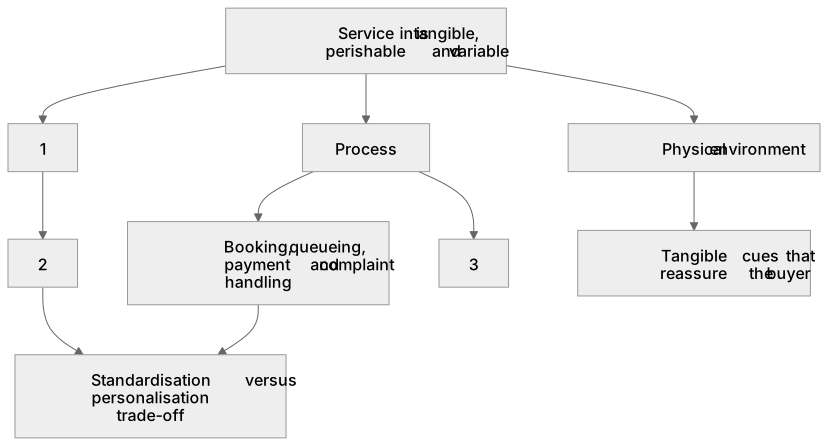
1Box 1
2Box 2
3Box 3
There is more to this lesson
The full lesson goes on to check your understanding and help you earn the marks. Create a free account to carry on, with your progress saved.
A week of Premium from your first lesson · Then the free plan continues · No card, no charge
Test your understanding of Making marketing decisions: using the marketing mix: Decisions relating to other elements of the marketing mix: people, process and physical environment
Active recall beats re-reading. Take an instant quiz now to test what you’ve learned and lock it into long-term memory.
A week of Premium from your first lesson · Then the free plan continues · No card, no charge