AQA · A-Level · Business
Course version: 7132 · Version from Sept 2023
Using the marketing mix: Product decisions (to include: Product decisions…
Full specification wording
Making marketing decisions: using the marketing mix: Product decisions (to include: Product decisions should include: the value of product portfolio analysis and the Boston Matrix, the value of the product life cycle model including extension strategies, influences on and the value of new product development.)
A range is judged as a whole rather than product by product, because the cash a mature seller throws off is what pays for the next launch.
- Point 3 of 9
- 3 key terms
Study notes
From the teaching notes for this specification point.
The idea
A range is judged as a whole rather than product by product, because the cash a mature seller throws off is what pays for the next launch. The Boston Matrix plots relative market share against market growth on a two by two grid, so cash cows fund question marks, stars swallow investment now in the hope of becoming cows later, and dogs are candidates for withdrawal. It is blind to profitability, to how narrowly the market was defined, and to products that sell each other, which is exactly where the evaluation marks live. The life cycle adds timing, from introduction through growth and maturity to decline, with extension strategies such as a new format, a new user group or repositioning buying maturity a few more years. Developing something new spreads risk but burns cash long before any revenue arrives.
What earns the marks
- Placing a named product using both axes, relative market share and the growth of its market, rather than share alone.
- Explaining the cash consequence of that placing, so a cow is described as a net generator of cash funding a question mark, not simply as a strong seller.
- Reading the life cycle stage off evidence in the stem, such as slowing growth and heavy price competition, and matching the mix to that stage.
- Proposing one specific extension strategy for this product, with what it costs and how long it buys, instead of listing extension strategies in general.
- Evaluating what the model cannot see, for example that a dog may be kept because it completes the range or keeps the factory loaded.
Common mistakes and how to put them right
Confusing the axes of the Boston Matrix with the stages of the life cycle, so a star is described as a product whose own sales are growing rather than a high share of a growing market.
Treating every dog as something to delete, when withdrawal can cost shelf space, overhead recovery and customers who buy the whole range.
Using the life cycle as a law that predicts the future, when many products never leave introduction and others stay mature for decades.
Recommending new product development with no reference to the cash available, the failure rate or the capacity to make it.
Exam tips
- If the stem gives sales for several products over several years, the examiner wants portfolio analysis, so calculate growth and comment on the balance of the range.
- Express relative market share as a comparison with the largest rival, because that is what the horizontal axis actually measures.
- In evaluation, judge the portfolio against the objective and the cash position, then say which single product decision matters most and why.
Try the lesson
The start of the Making marketing decisions: using the marketing mix: Product decisions (to include: Product decisions should include: the value of product portfolio analysis and the Boston Matrix, the value of the product life cycle model including extension strategies, influences on and the value of new product development.) lesson, made from teaching notes for this specification point.
Have a go first
In the Boston Matrix, what is a product with a high market share in a fast-growing market called?
Listen
A range is judged as a whole rather than product by product, because the cash a mature seller throws off is what pays for the next launch. The Boston Matrix plots relative market share against market growth on a two by two grid, so cash cows fund question marks, stars swallow investment now in the hope of becoming cows later, and dogs are candidates for withdrawal. It is blind to profitability, to how narrowly the market was defined, and to products that sell each other, which is exactly where the evaluation marks live. The life cycle adds timing, from introduction through growth and maturity to decline, with extension strategies such as a new format, a new user group or repositioning buying maturity a few more years. Developing something new spreads risk but burns cash long before any revenue arrives. A strong answer earns marks for these points. Placing a named product using both axes, relative market share and the growth of its market, rather than share alone. Explaining the cash consequence of that placing, so a cow is described as a net generator of cash funding a question mark, not simply as a strong seller. Reading the life cycle stage off evidence in the stem, such as slowing growth and heavy price competition, and matching the mix to that stage. Proposing one specific extension strategy for this product, with what it costs and how long it buys, instead of listing extension strategies in general. Exam tip: If the stem gives sales for several products over several years, the examiner wants portfolio analysis, so calculate growth and comment on the balance of the range.
See it
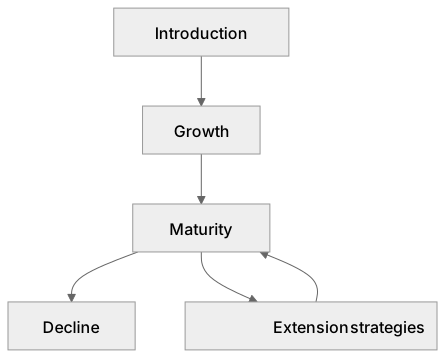
Key words
Say what each word means before you turn the card.
product life cycle
Try answering aloud or in your head before turning the card.
extension strategies
Try answering aloud or in your head before turning the card.
new product development
Try answering aloud or in your head before turning the card.
See every definition
- product life cycle
- Adds timing, from introduction through growth and maturity to decline, with extension strategies buying maturity a few more years.
- extension strategies
- Such as a new format, a new user group or repositioning, buying maturity a few more years.
- new product development
- Developing something new spreads risk but burns cash long before any revenue arrives.
Label the diagram
Some boxes have lost their names. Pick the right name for each number.
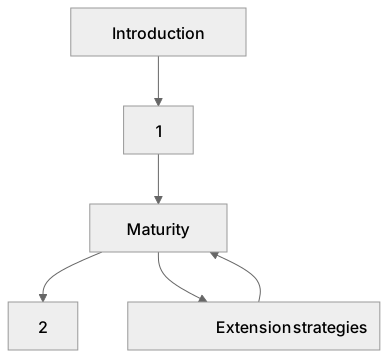
1Box 1
2Box 2
There is more to this lesson
The full lesson goes on to check your understanding and help you earn the marks. Create a free account to carry on, with your progress saved.
A week of Premium from your first lesson · Then the free plan continues · No card, no charge
Test your understanding of Making marketing decisions: using the marketing mix: Product decisions (to include: Product decisions should include: the value of product portfolio analysis and the Boston Matrix, the value of the product life cycle model including extension strategies, influences on and the value of new product development.)
Active recall beats re-reading. Take an instant quiz now to test what you’ve learned and lock it into long-term memory.
A week of Premium from your first lesson · Then the free plan continues · No card, no charge