AQA · A-Level · Business
Course version: 7132 · Version from Sept 2023
Using the marketing mix: The elements of the marketing mix (7Ps)
Full specification wording
Making marketing decisions: using the marketing mix: The elements of the marketing mix (7Ps)
Product, price, promotion and place are the four levers a firm can actually pull, and a service adds people, process and physical environment because a haircut cannot be inspected before it is bought.
- Point 1 of 9
- 2 key terms
Study notes
From the teaching notes for this specification point.
The idea
Product, price, promotion and place are the four levers a firm can actually pull, and a service adds people, process and physical environment because a haircut cannot be inspected before it is bought. The point of the list is not recall, it is coherence: every lever has to say the same thing about the position the business has chosen, so a premium price sold through a discount voucher campaign and a market stall destroys the very positioning it was meant to build. In a case study the marks come from asking which lever this firm can move quickly and cheaply, and which is locked by contracts, capacity or brand history. A bakery chain can change its promotion in a week, but cannot change where it sells without a property deal that takes a year.
What earns the marks
- Naming the specific lever and the specific setting, for example a launch price of eighty pounds sold through named stockists, rather than listing the seven headings with a definition each.
- Explaining why a service needs people, process and physical environment, because the customer is present while the service is produced, so staff behaviour and waiting time are part of the product itself.
- Showing that the elements reinforce one another, so a change in one forces a change in another, and stating which one this business can change fastest.
- Judging the chosen mix against a stated marketing objective such as market share or repeat purchase, so the mix is measured by what the firm wanted from it.
Common mistakes and how to put them right
Writing the seven headings out as a glossary, which is knowledge only and earns nothing for application to the named business.
Treating people, process and physical environment as extras for shops alone, when a bank, an airline and a dentist compete mainly on those three.
Changing one element in isolation, for instance recommending a price cut without noticing that it contradicts the premium promotion the firm already pays for.
Exam tips
- Questions rarely say the words marketing mix; they say a business is losing customers, so use the mix as a plan for the answer rather than as content to write out.
- In an extended evaluation, take two elements and argue them in depth rather than touching all seven, because breadth without development is capped low.
- Watch for a service in the stem: if the firm sells an experience, the three extra elements are where the easiest application marks sit.
Try the lesson
The start of the Making marketing decisions: using the marketing mix: The elements of the marketing mix (7Ps) lesson, made from teaching notes for this specification point.
Have a go first
Which element of the 7Ps refers to where and how customers buy a product?
Listen
Product, price, promotion and place are the four levers a firm can actually pull, and a service adds people, process and physical environment because a haircut cannot be inspected before it is bought. The point of the list is not recall, it is coherence: every lever has to say the same thing about the position the business has chosen, so a premium price sold through a discount voucher campaign and a market stall destroys the very positioning it was meant to build. In a case study the marks come from asking which lever this firm can move quickly and cheaply, and which is locked by contracts, capacity or brand history. A bakery chain can change its promotion in a week, but cannot change where it sells without a property deal that takes a year. A strong answer earns marks for these points. Naming the specific lever and the specific setting, for example a launch price of eighty pounds sold through named stockists, rather than listing the seven headings with a definition each. Explaining why a service needs people, process and physical environment, because the customer is present while the service is produced, so staff behaviour and waiting time are part of the product itself. Showing that the elements reinforce one another, so a change in one forces a change in another, and stating which one this business can change fastest. Judging the chosen mix against a stated marketing objective such as market share or repeat purchase, so the mix is measured by what the firm wanted from it. Exam tip: Questions rarely say the words marketing mix; they say a business is losing customers, so use the mix as a plan for the answer rather than as content to write out.
See it

Key words
Say what each word means before you turn the card.
controllable marketing variables
Try answering aloud or in your head before turning the card.
mix consistency
Try answering aloud or in your head before turning the card.
See every definition
- controllable marketing variables
- The four levers of product, price, promotion and place that a firm can actually pull.
- mix consistency
- Every lever has to say the same thing about the position the business has chosen, so the elements reinforce one another.
Label the diagram
Some boxes have lost their names. Pick the right name for each number.
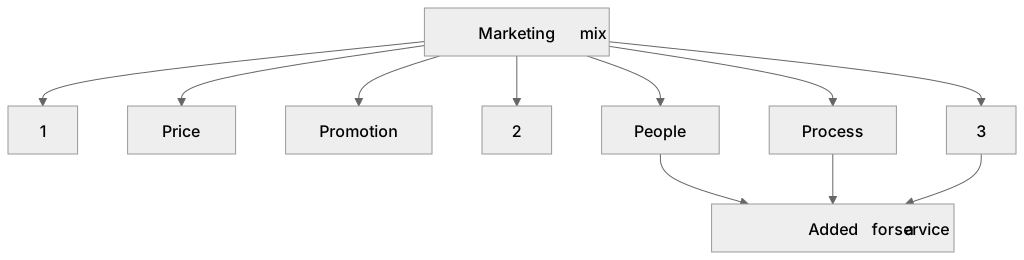
1Box 1
2Box 2
3Box 3
There is more to this lesson
The full lesson goes on to check your understanding and help you earn the marks. Create a free account to carry on, with your progress saved.
A week of Premium from your first lesson · Then the free plan continues · No card, no charge
Test your understanding of Making marketing decisions: using the marketing mix: The elements of the marketing mix (7Ps)
Active recall beats re-reading. Take an instant quiz now to test what you’ve learned and lock it into long-term memory.
A week of Premium from your first lesson · Then the free plan continues · No card, no charge