AQA · A-Level · Business
Course version: 7132 · Version from Sept 2023
Improving quality: Methods of improving quality (to include: Methods of…
Full specification wording
Making operational decisions to improve performance: improving quality: Methods of improving quality (to include: Methods of improving quality should include quality assurance vs quality control.)
Quality means fitness for purpose in the customer's eyes rather than the highest specification, so a budget hotel and a luxury one can both be excellent.
- Point 1 of 3
- 4 key terms
Study notes
From the teaching notes for this specification point.
The idea
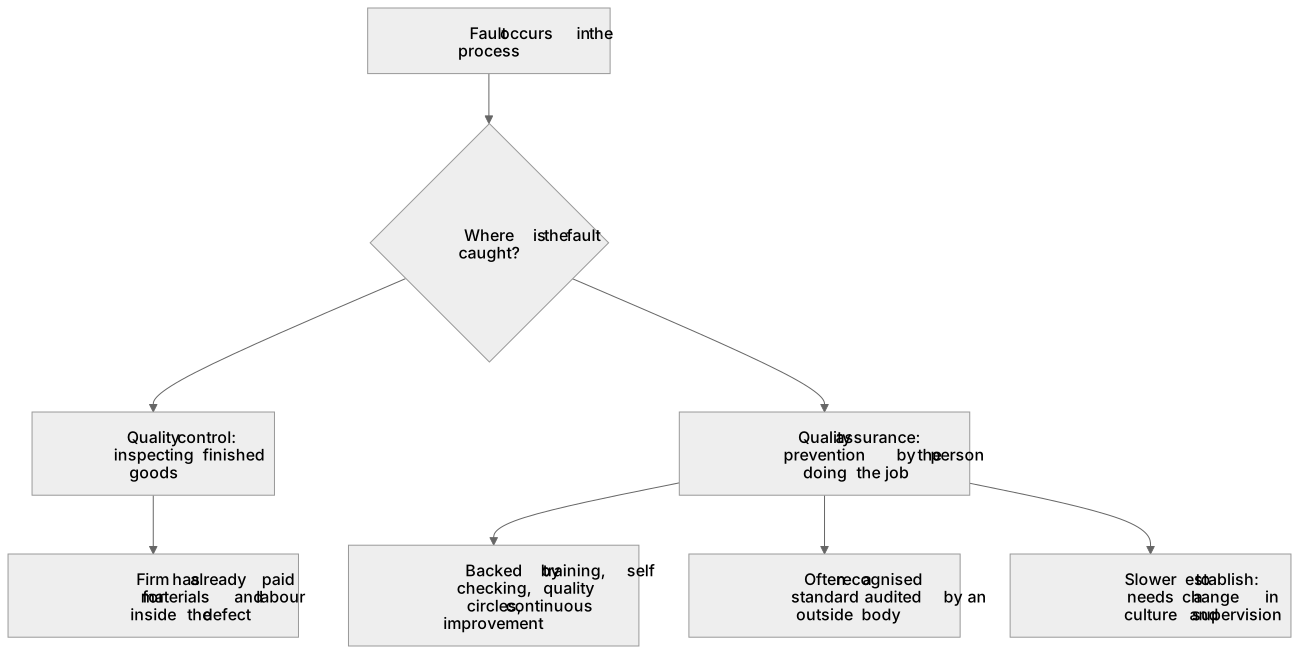
Quality means fitness for purpose in the customer's eyes rather than the highest specification, so a budget hotel and a luxury one can both be excellent. The real choice is where in the process a fault gets caught. Inspecting finished goods catches defects after the firm has already paid for the materials and the labour inside them, so prevention approaches push responsibility onto the person doing the job, backed by training, self checking, quality circles, continuous improvement and often a recognised standard audited by an outside body. Prevention is cheaper per fault avoided but slower to establish, because it asks for a change in culture and supervision rather than simply the hiring of more inspectors.
What earns the marks
- Distinguishing the two approaches by where responsibility sits and when the fault is found, then applying that distinction to this firm's own process.
- Explaining the cost logic, that a defect found by a customer costs far more than one found on the line, which costs more than one designed out at the drawing stage.
- Naming a concrete method with what it changes, such as quality circles giving operators a forum to alter a machine setting, or benchmarking against a named competitor's reject rate.
Common mistakes and how to put them right
Defining quality as the best possible product, which leads to arguments that a budget brand should buy materials its price point cannot support.
Presenting prevention as obviously superior without costing the training, the output lost during the changeover and the supervision culture it replaces.
Muddling the two approaches inside the answer, most often by describing a team of inspectors and then labelling it assurance.
Exam tips
- Questions set up a firm with one specific quality failure, so start from that failure and work back to the method that would have caught it.
- If the stem gives a reject rate, a returns figure or a complaints total, use it, because moving a percentage from one figure to another is application.
- Evaluate answers should close on whether this workforce and this budget can sustain the method, not on which method is better in principle.
Try the lesson
The start of the Making operational decisions to improve performance: improving quality: Methods of improving quality (to include: Methods of improving quality should include quality assurance vs quality control.) lesson, made from teaching notes for this specification point.
Have a go first
Which method checks quality after production is complete?
Listen
Quality means fitness for purpose in the customer's eyes rather than the highest specification, so a budget hotel and a luxury one can both be excellent. The real choice is where in the process a fault gets caught. Inspecting finished goods catches defects after the firm has already paid for the materials and the labour inside them, so prevention approaches push responsibility onto the person doing the job, backed by training, self checking, quality circles, continuous improvement and often a recognised standard audited by an outside body. Prevention is cheaper per fault avoided but slower to establish, because it asks for a change in culture and supervision rather than simply the hiring of more inspectors. A strong answer earns marks for these points. Distinguishing the two approaches by where responsibility sits and when the fault is found, then applying that distinction to this firm's own process. Explaining the cost logic, that a defect found by a customer costs far more than one found on the line, which costs more than one designed out at the drawing stage. Naming a concrete method with what it changes, such as quality circles giving operators a forum to alter a machine setting, or benchmarking against a named competitor's reject rate. Recognising the motivational effect of self checking, which gives responsibility and recognition in the way Herzberg describes, while noting that Herzberg says little about whether this workforce has the skill to judge quality. Exam tip: Questions set up a firm with one specific quality failure, so start from that failure and work back to the method that would have caught it.
See it
Key words
Say what each word means before you turn the card.
fitness for purpose
Try answering aloud or in your head before turning the card.
prevention versus detection
Try answering aloud or in your head before turning the card.
continuous improvement
Try answering aloud or in your head before turning the card.
cost of quality
Try answering aloud or in your head before turning the card.
See every definition
- fitness for purpose
- Quality means meeting the customer's needs rather than the highest specification, so a budget hotel and a luxury one can both be excellent.
- prevention versus detection
- The real choice is where in the process a fault gets caught, with prevention pushing responsibility onto the person doing the job and detection inspecting finished goods.
- continuous improvement
- One of the prevention approaches, alongside training, self checking and quality circles, that asks for a change in culture and supervision.
- cost of quality
- A defect found by a customer costs far more than one found on the line, which costs more than one designed out at the drawing stage.
There is more to this lesson
The full lesson goes on to check your understanding and help you earn the marks. Create a free account to carry on, with your progress saved.
A week of Premium from your first lesson · Then the free plan continues · No card, no charge
Test your understanding of Making operational decisions to improve performance: improving quality: Methods of improving quality (to include: Methods of improving quality should include quality assurance vs quality control.)
Active recall beats re-reading. Take an instant quiz now to test what you’ve learned and lock it into long-term memory.
A week of Premium from your first lesson · Then the free plan continues · No card, no charge